
SOURCE :- THE AGE NEWS
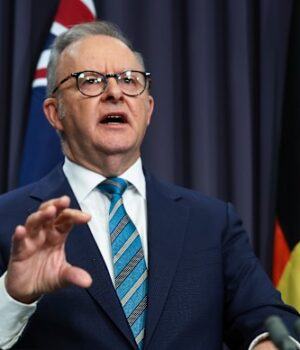
Washington: Prime Minister Anthony Albanese has pushed back against Donald Trump’s repeated complaint that Australia is not helping sufficiently in the war against Iran, noting Canberra was not consulted before the conflict began and stressing his desire for de-escalation.
Trump, having been asked about the United Kingdom’s role in the conflict, added unprompted that “Australia was not great” either. “I was a little surprised by Australia,” he said in a cabinet meeting at the White House.
It was the second time the US president had criticised Australia for what he says is its refusal to assist – a claim the Australian government denies.
“There is no request being made to Australia that has not been agreed to,” Albanese said on Friday. “It’s up to him [Trump] to explain his comments … Australia wasn’t consulted before this action was undertaken. I respect that that’s a matter for the United States.”
Australia has provided an E-7 Wedgetail surveillance aircraft and Advanced Medium-Range Air-to-Air Missiles at the United Arab Emirates’ request.
Deputy Prime Minister and Defence Minister Richard Marles said assisting the Gulf states was the only request the United States had made of Australia, “which is, in fact, what we are doing”.
Opposition industry and sovereign capability spokesman Andrew Hastie has been much more critical of Trump, calling his social media posts “petulant” and saying Australia ought to be more forthright in calling him out.
“President Trump runs his own show, and he’s made it pretty clear that he speaks disparagingly of allies, and I don’t think it’s wrong to push back every once in a while,” Hastie told ABC radio.
Australia was not the only ally Trump criticised in front of his full cabinet – he called Britain’s aircraft carriers “not the best” and “toys compared to what we have”.
As Trump sends Marines and paratroopers to the Middle East, and the Pentagon prepares options for ground-based operations against Iranian islands, Albanese also stressed that Australia wanted to see the conflict de-escalate and end. “This war is having a massive global economic impact,” he said.
Brent crude, the international oil standard, rose nearly 6 per cent on Thursday (US time) to settle at $US108, while the average price of petrol in the US was poised to tip over $US4 ($5.80) a gallon – upping the pressure on the Trump administration over the domestic impact of what the president calls his “excursion” in Iran.
New York sharemarkets had their worst day since the conflict began, with the Nasdaq falling 2.38 per cent, and other indices also closing lower.
After the markets closed, Trump announced he would give Iran another 10 days to make an acceptable deal to end the war, delaying his threat to bomb the country’s energy infrastructure and allowing time for talks he says are “going very well”.
The US has largely avoided striking Iranian oil, gas and electricity facilities so far, despite Trump’s repeated threats. He said he was now “pausing the period of Energy Plant destruction” until April 6.
But the president’s messages were mixed. Earlier, he had described Iranian negotiators as both “great” and “strange”, and suggested a deal with the regime might not be possible.
“They are begging to make a deal, not me,” he said. “I don’t know if we’ll be able to do that. I don’t know if we’re willing to do that. They should have done that four weeks ago … The reason they want to make a deal is they have been just beat to shit.”
Trump’s special envoy, Steve Witkoff, confirmed the US had shared a 15-point “action list” with Iran via Pakistani mediators that could serve as the basis of a peace plan. Witkoff said there were “strong signs” that Iran could be convinced that it was at an “inflection point” with no desirable alternatives.
Pakistan’s Deputy Prime Minister Ishaq Dar appeared to play down the likelihood of imminent in-person talks. In a post on X, he said there had been “unnecessary speculation in the media” about peace talks and, in reality, messages were being relayed indirectly between the two parties through Pakistan.
Meanwhile, Israel claimed it had killed Iranian commodore Alireza Tangsiri, head of the Islamic Revolutionary Guard Corps’ navy, and other senior naval commanders in an airstrike, as it continues eliminating key Iranian military personnel and political leadership.
The Speaker of the Iranian parliament, Mohammad Bagher Ghalibaf, with whom the US is reportedly dealing, congratulated pro-government protesters in Iran following more demonstrations on the streets of Tehran.
He said the protesters’ persistence had “created the conditions for a historic victory for dear Iran”, and “no one can issue an ultimatum to Iran and the Iranian people”, according to an automated translation on X.
US news site Axios reported the Pentagon was preparing multiple options for a “final blow” against Iran that could involve invading or blockading Iran’s crucial Kharg Island oil terminal, invading the island of Larak in the Strait of Hormuz, or seizing Abu Musa and other islands near the entrance to the strait.
Members of the elite US military’s 82nd Airborne Division are being deployed to the Middle East, along with thousands of Marines. Trump had not decided on their duties, the White House said, with press secretary Karoline Leavitt saying the president simply wanted options.
Speaking at a cabinet meeting on Thursday, Trump did not rule out missions to take control of Iran’s vast oil supplies. “We might,” he said when asked. “I wouldn’t talk about it, but it’s an option.”
He also acknowledged that some Gulf partners wanted the US mission in Iran to continue and further weaken the Iranian regime, which has posed a security threat in the region for decades. “They’d probably like us to stay,” Trump said. “If we don’t stay, we’re going to be protecting them.”
Following classified briefings about the operation in Iran, Republicans in Congress are increasingly voicing disquiet about potential mission creep, and accusing the Pentagon of withholding information.
Nancy Mace, a Trump ally from South Carolina, said she would not support putting American troops on the ground, and called for Congress to be given a “greater say” on the war, despite opposing such moves earlier.
“The justifications presented to the American public for the war in Iran were not the same military objectives we were briefed on today,” she said on Wednesday (Washington time).
“This gap is deeply troubling. The longer this war continues, the faster it will lose the support of Congress and the American people.”
Speaking at a Republican fundraising dinner in Washington on Wednesday night, Trump told lawmakers he was no longer going to call the Iran campaign a war.
“They don’t like the word ‘war’ because you’re supposed to get approval,” he said. “So I’ll use the word ‘military operation’, which is really what it is.”
Trump went on to say: “The war essentially ended a few days after we went in.”
Get a note directly from our foreign correspondents on what’s making headlines around the world. Sign up for our weekly What in the World newsletter.
 Michael Koziol is the North America correspondent for The Age and Sydney Morning Herald. He is a former Sydney editor, Sun-Herald deputy editor and a federal political reporter in Canberra.Connect via X or email.