
Source : THE AGE NEWS
The Australian sharemarket slid at its open on Friday after Wall Street fell sharply overnight, but the fall was more muted than expected after US President Donald Trump said he would extend by 10 days a deadline for Tehran to open the Strait of Hormuz.
Oil prices sank about 1.3 per cent from a high of $US108.01 after Trump’s announcement on Truth Social of the new deadline. The president’s change in tone came after torrid day of trade on US markets where the S&P 500 plunged 1.7 per cent, its worst day since the conflict began.
Futures were pointing to a similarly steep 1.2 per cent decline for Australia’s sharemarket but the S&P/ASX 200 was down 51.7 points, or 0.6 per cent, in early trade.
“We’re now thinking forward, and not about a resolution,” said Carl Larry, oil and gas analyst at Enverus. “We’re heading into another weekend with risk still to the upside, and waiting for something worse rather than something better.”
Mining stocks retreated in early trade, with BHP dropping 0.6 per cent while fellow iron ore heavyweights Rio Tinto and Fortescue edged 0.1 per cent lower. Gold miners dropped sharply with the price of the safe haven hovering around $US4400 per ounce, with Northern Star losing 4 per cent and Evolution Mining diving 2.9 per cent.
Financial stocks are mixed with Westpac up 0.3 per cent and Commonwealth Bank adding 0.1 per cent but National Australia Bank lost 0.4 per cent and ANZ Bank dipped 0.1 per cent.
Energy stocks continued their rollercoaster ride, with the overnight rise in oil prices boosting them in early trade. Woodside Energy rose 1 per cent, Santos added 1.1 per cent, Ampol gained 1.6 per cent and Yancoal climbed 0.4 per cent.
Tech stocks are mixed, with WiseTech up 0.2 per cent and Xero adding 1.1 per cent, but NEXTDC lost 2.5 per cent.
The Australian dollar was weaker at US68.95¢ at 10.39am AEDT.
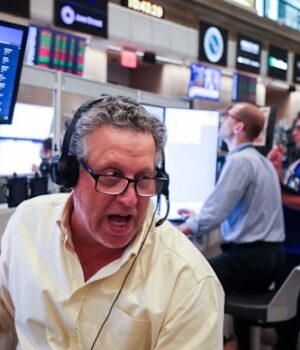
On Wall Street, the S&P 500 slumped 1.7 per cent for its worst day since January and is back on track for a fifth straight losing week. That stretches back to before the Iran war began, and it would be the longest such losing streak in nearly four years.
The Dow Jones dropped 469 points, or 1 per cent, and the Nasdaq composite sank 2.4 per cent to fall more than 10 per cent below its all-time high set early this year. That’s a steep enough drop that professional investors have a name for it: a “correction.”
On Thursday (US time), the fighting continued, and thousands more US troops neared the region. Iran, meanwhile, tightened its grip on the crucial Strait of Hormuz. It may be creating something like a “toll booth” for tankers to get past the narrow waterway, which typically sees a fifth of the world’s oil exit the Persian Gulf through it to customers worldwide.
“They better get serious soon, before it is too late,” Trump said on his social media network Thursday morning about Iran’s negotiators, “because once that happens, there is NO TURNING BACK, and it won’t be pretty!”
High Treasury yields and disruption in the bond market were big factors that Trump named a year ago when he backed off his initial threats for global tariffs made on “Liberation Day.” The moves caused critics to allege Trump always chickens out, or “TACO,” if financial markets show enough pain.
The yield on the 10-year Treasury jumped as high as 4.43 per cent on Thursday from 4.33 per cent late Wednesday and from just 3.97 per cent before the war started. That’s a significant leap for the bond market, and it’s already sent rates higher for mortgages and other kinds of loans for US households and businesses, which slows the economy.
A report on Thursday morning said slightly more US workers filed for unemployment benefits last week, though the number is still low compared with historical figures.
A slowing job market would typically encourage the Federal Reserve to cut interest rates to juice the economy. But hopes have cratered on Wall Street for a possible cut to interest rates this year, even though traders came into 2026 forecasting several. That’s because lower interest rates carry the risk of worsening inflation, and the spike in oil prices has heightened those worries.
On Wall Street, tech stocks were the heaviest weights on the market.
Meta Platforms fell 8 per cent, and Alphabet sank 3.4 per cent after each had held relatively steady the day before, when a jury found Instagram and YouTube liable in a landmark social-media addiction trial.
The financial penalties were small compared with the companies’ vast profits, but it could herald a watershed moment that invites more lawsuits.
Other Big Tech stocks also fell, including drops of 4.2 per cent for Nvidia and 2 per cent for Amazon. Apple was an outlier and inched up 0.1 per cent.
With AP, Bloomberg
The Market Recap newsletter is a wrap of the day’s trading. Get it each weekday afternoon.


