Source : the age
New York: The United States is preparing to send thousands more troops to the Middle East even as it alluded to progress in peace talks with Iran and President Donald Trump heralded a “very big present” purportedly received as a goodwill gesture from Iranian negotiators.
On another day of mixed signals as the war approached its four-week mark, Trump said Iran wanted to make a deal “so badly” and confirmed that he was now interested in a ceasefire – a turnaround from just days earlier.
It also emerged that the US had delivered to Iran – through intermediaries – a 15-point peace plan that largely mirrored previous Trump administration demands of Tehran, before potential in-person talks as soon as this week.
However, Iranian state television’s English-language broadcaster Press TV quoted an anonymous official on Wednesday as saying Iran rejected America’s ceasefire proposal.
“Iran will end the war when it decides to do so and when its own conditions are met,” it quoted the official as saying.
Press TV offered its own five-point plan from the official who rejected the US proposal. It included a halt to killings of its officials, means to make sure no other war is waged against it, reparations for the war, the end of hostilities and Iran’s “exercise of sovereignty over the Strait of Hormuz.”
Iran was still making maximalist and unrealistic demands, including the closure of all American bases in the Gulf and the right to continue its missile program without limitations, The Wall Street Journal reported. There were also unconfirmed reports that Iran had asked to negotiate with Vice President J.D. Vance, whose scepticism about the military operation against Iran has been widely ventilated.
The Iranian regime has also continued to taunt the US with propaganda, and on Wednesday released another Lego-style animated video, showing Iran retaliating to a US missile strike on a girls’ school – an apparent reference to the US hitting an elementary school in southern Iran on the first day of the war, killing at least 165.
The 84-second video ends with bombs raining down on supposedly American cities, and Benjamin Netanyahu and Donald Trump crying in a situation room next to a US serviceman and a horned demon named Baal.
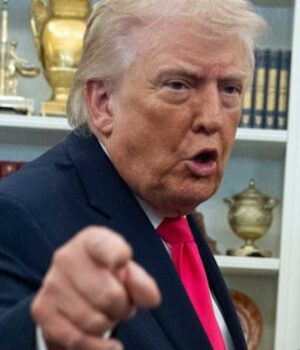
Trump on Tuesday (US time) spoke cryptically about a supposed present the Iranians had given during talks. “They did something yesterday that was amazing,” he said. “They gave us a present, and the present arrived today.
“It was a very big present worth a tremendous amount of money. I’m not going to tell you what the present was, but it was a very significant prize.”
He later said the concession related to the transport of oil and gas through the Strait of Hormuz, a key shipping passage that has been effectively closed as Iran closely controls which vessels are let through.
Trump said the gift “was a very nice thing” and showed him that the US was “dealing with the right people”. His team, including special envoy Steve Witkoff and son-in-law Jared Kushner, are believed to be talking to the Speaker of the Iranian parliament, Mohammad Bagher Ghalibaf, and associates.
Analysts, who noted Trump’s increasing desire to declare victory and make a deal, queried whether a productive settlement with the Iranian regime was possible.
“Washington still doesn’t understand Iran or where it is heading,” Danny Citrinowicz, an Iran expert at the Israel-based Institute for National Security Studies, said on X.
“Trump now faces three choices: accept Iran’s terms, walk away from negotiations, or settle for an empty framework that allows him to declare the war over without resolving anything.”
It was also not clear that a ceasefire now would be supported by the United States’ allies and partners in the region. Israel, which has said it is not party to the talks, has an explicit goal of destroying the Iranian regime, while Gulf states such as Saudi Arabia and the United Arab Emirates are reportedly pressing for Iran’s fighting capability to be further degraded.
Trump argued the regime had already been changed, in effect. “The leaders are all very different than the ones that we started off with that created all those problems,” he said. “I think we can say this is regime change.”
Iran’s new supreme leader is purportedly Mojtaba Khamenei, the son of the assassinated supreme leader Ali Khamenei, but he has not been publicly seen since taking the job and has not provided proof of life.
It was widely reported on Tuesday night (US time) that thousands of troops from the US military’s elite 82nd Airborne Division were being sent to the Middle East. The number of soldiers varied from 1000 to 4000 in the reports, and it was not certain they would be deployed to Iran.
But analysts noted the decision to send troops – on top of US marines already heading for the region – was at odds with claims of progress towards a deal.
“Trump’s decision to delay strikes on Iranian power plants should not be read as de-escalation,” said Arash Reisinezhad, visiting assistant professor at Tufts University’s Fletcher School of Law and Diplomacy. “It may serve to stabilise markets and contain oil shocks but also to buy time for military positioning.”
Pakistan is shaping as a key intermediary in potential talks between the US and Iran. The country’s army chief, Asim Munir, who visited Trump at the White House last year, has emerged as an interlocutor.
The price of Brent crude dropped again on Tuesday amid the signals that a deal to end the war – or at least the US participation in it – was closer.
But other than Trump’s remarks, which he made during a news conference in the Oval Office, the White House was reluctant to confirm any details of the talks with Iran.
“These are sensitive diplomatic discussions and the US will not negotiate through the press,” Trump’s press secretary, Karoline Leavitt, said. “This is a fluid situation, and speculation about meetings should not be deemed as final until they are formally announced by the White House.”
The ongoing build-up of US troops in the region was not the only sign the war could escalate rather than fade. Israel bombed several targets in southern Lebanon, killing nine and adding to a death toll in that country that has already topped 1000, according to the Lebanese health ministry.
Israel also outlined plans to occupy a “security zone” in southern Lebanon – a Hezbollah stronghold – after bombing bridges along a key river that will serve as a new demarcation line.
Meanwhile, French President Emmanuel Macron said he had spoken to Iranian President Masoud Pezeshkian and emphasised the need for Iran to stop its “unacceptable attacks” against countries in the region, and restore free navigation in the Strait of Hormuz.
“I urged Iran to engage in negotiations with good faith to open a path towards de-escalation and establish a framework that can meet the international community’s expectations regarding Iran’s nuclear and missile programs, as well as its destabilising regional activities,” Macron said.
With David Crowe, staff reporter and agencies
Get a note directly from our foreign correspondents on what’s making headlines around the world. Sign up for our weekly What in the World newsletter.
 Michael Koziol is the North America correspondent for The Age and Sydney Morning Herald. He is a former Sydney editor, Sun-Herald deputy editor and a federal political reporter in Canberra.Connect via X or email.