Source : ABC NEWS
The day after the Matildas’ loss to Japan in the final of the Women’s Asian Cup, they fronted a ‘thank you’ event in Sydney, attended by a couple of thousand fans.
The mood from the fans was happy and excited, despite the disappointment of the tense 1-0 defeat at Stadium Australia.
But the players were in no real mood to mingle.
As they were presented on stage, the smattering of sunglasses did not hide the signs of overzealous celebrations, but rather, they shielded the pain of defeat.

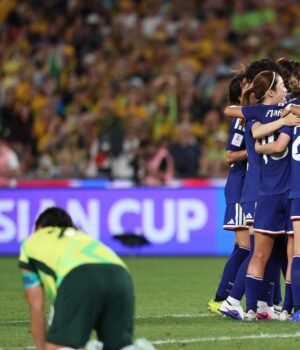
Hayley Raso was a dejected figure for most of the fan event, but still mixed with fans. (Getty Images: Ayush Kumar)
While some, like Mary Fowler and Kyra Cooney-Cross could crack a few smiles and giggles when looking at the fans’ homemade signs asking for their jerseys, the majority were expressionless and empty.
In their corresponding thank-you event in Brisbane after their fourth-place finish at the 2023 World Cup, it was a vastly different scene, with a sense of joy and over-achievement, capped off by Nikki Webster’s performance of the team’s cult anthem Strawberry Kisses.
A small but enthusiastic crowd gathered in Sydney to see the Matildas. (Getty Images: Ayush Kumar)
But this time was different.
Different because it was a win within their grasp, because it was likely the last major tournament on home soil for most of these players, and because the clock is ticking on the careers of these generational talents.
So how do they come back from this?
The grand plan
Most businesses will have a five-year plan, maybe a 10-year plan if you are lucky.
It helps set a direction for the future, while allowing room for movement as needed.
Japanese football is 21 years into a 100-year plan, and it’s that vision and commitment to an approach that Australia is lacking.
Without its own grand plan and a willingness to stick to it, the Matildas may never add to their 2010 Asian Cup triumph.
Joe Montemurro is as well placed as any Matildas manager in recent history to help construct that vision in women’s football, but he cannot do it alone.
Montemurro wants a unified approach to drive Australian women’s football forward. (Getty Images: Cameron Spencer)
“I think we have a tendency in this country to try something, doesn’t work, we start something else, then we do something else,” he said after the loss to Japan.
“We’ve got to decide who we are, what we want to be, and where we want to be in 10, 15 years time, and stick to it.
“We’ve got to believe in an identity of who we want to be and where we want to go, and it has to start at youth levels.”
Montemurro said Australian football may have a smaller population and player pool compared to the likes of Japan, but their system yields results through consistency.
“They make tough decisions at young ages, and they stick to the program. They stick to their development processes,” he said.
The Matildas want to move on from the pain of this defeat. (Getty Images: Cameron Spencer)
Players are currently developed through private academies or A-League Women clubs, and the latter are facing their own issues.
The players have been repeatedly calling for greater investment in the domestic women’s competition to secure full-time professionalism.
And grassroots facilities are not keeping up with the increasing demand of girls and women playing the sport.
Those are money problems the national coach cannot solve, but he can control the blueprint for a national style of play. And he has had that prepared from day one.
Alanna Kennedy was named the Asian Cup’s most valuable player. (Getty Images: Matt King)
The Matildas strayed from it throughout the tournament, but showed their best representation of it in the final.
“We embarked on a process to say, ‘OK, what are the best teams in the world doing, and where do we need to be?'” Montemurro said.
“[It’s about] keeping the ball, we have to control our situation and our destiny.
“And when you’re playing against a team that is super fluid, in terms of my technical perspective, we need to mould that with our physicality and our mentality. So we need to find that balance.”
Where to from here?
For the Matildas, a FIFA friendly series against Malawi and either Kenya or India is coming up in a few weeks.
They are not quite the top-quality opponents Montemurro has been pushing for as he builds his brand, but they could provide a good opportunity for some of the fringe players.
Caitlin Foord had a mixed Asian Cup experience. (Getty Images: Cameron Spencer)
There may start to be some outside noise questioning some of the older players in the team over the next couple of years.
The knives won’t be out for the likes of Kerr, Foord, or Raso, but the midfield could prove more treacherous with Emily van Egmond and Katrina Gorry side-eyeing Amy Sayer and Clare Wheeler in the wings.
“It’s very hard to say bye [to the older players] because they’re all playing Champions League, they’re all playing top-level football,” Montemurro said.
“Maybe in my time, when you’re over 28 or 29 or 30, you were too old.
“But nowadays with our sports science, and now with our recovery and with our processes and our load management, players can still play on, and I’m excited.
“I’m excited about that batch, but the next batch is really, really exciting too.”
But will he have the backing to help that batch deliver the goods?