
SOURCE :- THE AGE NEWS
Thank you for joining our continuing live coverage of the conflict in the Middle East, now in its fourth week.
Here’s a recap of the latest developments:
- US President Donald Trump has threatened to “obliterate” Iranian power plants unless the Strait of Hormuz is reopened, giving the regime a 48-hour deadline, ending at 10.44am on Tuesday (AEDT).
- If the US targets Iranian energy infrastructure, the Islamic Revolutionary Guard Corps – in a statement broadcast by state media – said it would “completely close” the strait. Mohammad Bagher Ghalibaf, the speaker of Iran’s parliament, said that “energy and oil facilities across the region will be considered legitimate targets and will be irreversibly destroyed”.
- Israeli Prime Minister Benjamin Netanyahu warned that Iran’s missiles have the capability to reach “almost everywhere in Europe” after the Iranian regime’s failed attack on a joint UK-US air base on the island of Diego Garcia, 4000 kilometres from Iran. UK Housing Secretary Steve Reed said there was “no specific assessment” by UK agencies that the Iranian regime was targeting the nation or could hit targets there even if it wanted to.
- At least 175 people were injured in Iranian missile attacks on the southern Israeli cities of Arad and Dimona, near an Israeli nuclear facility, after air defences failed.
- Israeli Defence Minister Israel Katz expanded the military’s list of targets to include all bridges over the Litani River in southern Lebanon. Israel later struck the Qasmiyeh Bridge near Tyre.
- Energy Minister Chris Bowen has warned of bumpy supply from next month as crude oil from the Middle East is expected to become scarcer. At least six ships destined for Australia had been cancelled due to the conflict, with about 80 ships expected to arrive, he said.
- Prime Minister Anthony Albanese will step up his diplomatic efforts this week to push Asian countries to keep supplying oil to Australia.
- International Energy Agency executive director Fatih Birol told the National Press Club in Canberra he fears global leaders aren’t recognising the depths of the fuel crisis. The watchdog is consulting with leaders to assess whether more of the world’s oil stores should be released.
- Two flights from Dubai have landed in Sydney and Melbourne. A flight from Abu Dhabi is due to land in Sydney on Monday night, and another flight from Dubai is on its way to Perth. More than 7500 Australians and permanent residents have returned since March 4.
Japan’s government has urged citizens not to panic buy toilet paper as social media posts suggest people are starting to stockpile daily necessities out of concern over the war in the Middle East.
Hoarding toilet paper became a phenomenon in Japan at the time of the 1973 oil shock, which triggered the country’s first postwar economic contraction. More recently, the devastating earthquake and tsunami of 2011, and the COVID-19 pandemic triggered similar patterns of behaviour.
Australians also hoarded toilet paper during the pandemic.
Japan’s Ministry of Economy, Trade and Industry said in a statement that shoppers should make rational decisions about toilet paper purchases based on accurate information.
Australia is negotiating with Japan, China and other regional powers to ensure critical fuel supplies remain open, with gas shipments from the Middle East to Asia set to run out within days, raising the prospect of the Albanese government imposing price caps or export restrictions on liquefied natural gas.
Shipments of LNG from Qatari gas fields have stopped, with no sign of when they might resume. Those ships will unload their cargoes in 10 days’ time.
The Persian Gulf nation produces about a fifth of the world’s LNG, but was forced to shut down exports after Iran blockaded the Strait of Hormuz and its largest plant was badly damaged in a missile attack last week.
International Energy Agency chief Fatih Birol has warned that the world faces the worst oil market crisis in history, issuing a call for workers to stay home, motorists to drive more slowly and travellers to cut back on flights, to preserve fuel.
Australia imports about 80 per cent of its liquid fuels, and Prime Minister Anthony Albanese said he would use Australia’s gas exports as leverage to ensure Asian nations maintained their exports to the country.
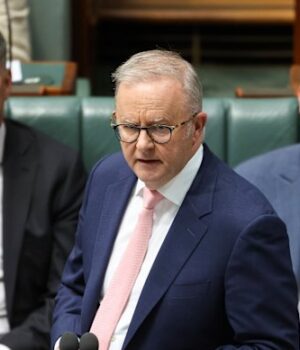
In federal parliament, Opposition Leader Angus Taylor has just asked about shipments of fuel to Australia, to begin question time.
Energy Minister Chris Bowen yesterday said six of 80 impending shipments of oil had been cancelled.
Taylor asked: “When was the government advised six shipments of vital fuel supply down for Australia were cancelled, and as of today, how many ships have been cancelled?”
Prime Minister Anthony Albanese responded saying he was in constant contact with importers. The question was then asked again to Energy Minister Chris Bowen who said the government was in contact with oil refiners Ampol and Viva every day.
You can follow question time in our dedicated live blog here.
The world’s energy watchdog fears the depth of the fuel crisis isn’t being recognised by global leaders, and oil is not the only commodity that will be hit during the war in the Middle East.
International Energy Agency executive director Fatih Birol said his fears had grown by the end of last week.
“Some of the vital arteries of the global economy, such as petrochemicals, such as fertilisers, such as sulfur, such as helium – their trade is all interrupted, which would have serious consequences for the global economy, which is the reason I decided to make statements,” he told the National Press Club in Canberra.
Birol said Australia’s supply of oil – about 38 days’ worth – was a “solid number”, and successive governments had failed to reach the agency’s recommended 90-day stock level.
“I know from this very government that they are doing their best to increase those levels,” he said.
“I very much hope that after this very event, there are some positive steps in that direction, but let’s [not] forget that Australia also makes a major contribution to regional energy security,” he said, referring to Australia’s liquified natural gas exports.
The Israeli military says it has begun a wide-scale wave of strikes targeting Iranian infrastructure in Tehran, Reuters reports.
People on the ground have reported a series of powerful explosions across the city’s central, southern and eastern areas, and Iranian air defence systems have been activated, according to Al Jazeera.
With Reuters
The International Energy Agency is consulting with global leaders to assess whether more of the world’s oil stores should be released, executive director Fatih Birol has told the National Press Club in Canberra.
The agency announced earlier this month 400 million barrels would be let into the global supply as the war in Iran restricted about 20 per cent of global exports that transit through the Strait of Hormuz.
Birol said the historic move had succeeded in easing pressure on the market and pushing the oil price down by US$18 ($25) , but warned it was not a comprehensive solution.
The price of oil has continued to soar since the intervention, but Birol would not say at what point he would release more oil.
The federal government has commissioned an assessment of the nation’s food supply chain amid persistent fears the war in Iran will further disrupt the export of Middle Eastern oil.
“While Australia is food secure, we recognise the importance of supply chain resilience, including the supply of fuel and fertiliser, which is why we have commissioned this assessment,” Agriculture Minister Julie Collins said in a statement.
“This assessment will provide advice to government on ways we can continue to strengthen preparedness for disruptions to food production and supply chains – building on frameworks already in place that help safeguard Australia’s food production.”
The assessment will feed into the already established fuel supply taskforce.
Fuel rationing is looming as a real possibility in coming weeks. There’s already discussion of some relatively soft steps which could include rationing of access to petrol based on odd/even number plates; driving every second day; working from home and speed limits.
One problem with soft approaches (often proclaimed by governments with much fanfare) is that rather than reducing demand, they induce a rush to the bowsers by a public troubled by the adoption of rationing.
It is instructive to look at what happened in World War II. Every vehicle owner received a ration book with coupons which showed allowed purchases of a fixed amount of petrol. Without a coupon, motorists could not buy petrol. In addition, allocation was prioritised for essential industries (farming, freight, doctors and emergency services).
This left very little available for everyday motorists, but supplementary rations were allocated if justified, such as for business needs. There were heavy penalties for black marketing and fuel coupon forgery. The result was a massive decline in the use of personal cars, a surge in public transport use, and greater use of bicycles and carpooling.
Of course, World War II rationing occurred in a different environment from now.
Read more: Nightmarish decisions lie ahead on fuel rationing, but better to go hard early
The Australian sharemarket has fallen sharply at the open as the US war in Iran enters a fourth week with no signs of easing.
The S&P/ASX 200 was down 156.75 points, or 1.9 per cent, wiping around $56 billion off the value of the bourse. The ASX hit its lowest mark since May in early trade.
Financial stocks slumped, with Commonwealth Bank falling 2.6 per cent, National Australia Bank 2.7 per cent, Westpac 2.4 per cent and ANZ Bank 1.7 per cent.
Mining stocks were punished with iron ore heavyweights BHP (down 2.5 per cent), Rio Tinto (down 2 per cent) and Fortescue (down 2 per cent) slumping while gold miners plunged, with Northern Star down 4.7 per cent and Evolution Mining shedding 5.2 per cent.
Energy stocks advanced as they continued to benefit from surging oil and gas prices. Woodside Energy added 1 per cent, Santos gained 0.5 per cent, Yancoal rose 1.1 per cent and Ampol climbed 1.2 per cent.
Read more: Banks, miners tumble as ASX suffers $56b wipeout; Oil slips
An Iranian military spokesperson claimed an Israeli-American combat drone was downed over Tehran, preventing planned attacks, while media has released footage of missiles being launched.
Reuters