
source : the age
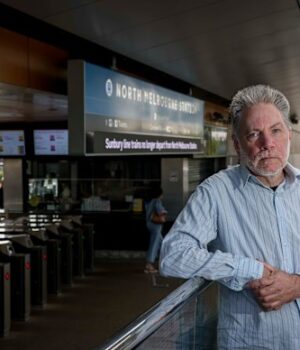
A man who was assaulted on a Metro train has questioned whether passengers can rely on security systems after discovering that the emergency intercom and CCTV in his carriage were not working when he was attacked.
Paul Hughan was travelling from Yarraville to Flinders Street just after 4pm on December 12 when a man acting erratically sat behind him. Hughan said he ignored the man – until he realised he was spitting on him.
“When I realised what was happening, I jumped up and turned around. He looked at me for a moment, then jumped up and punched me in the face,” he said.
The 56-year-old said the punch had all the power of a “wet sock” and that he was not injured.
However, he is more concerned about serious failings in the emergency systems that are there to protect passengers in an emergency, but failed when he needed them.
During the train ride, Hughan tried to activate the passenger emergency intercom in his carriage three or four times. Each time, it responded with a recorded message saying the service was “currently unavailable”.
The intercoms are supposed to connect passengers to the driver, who can then ask Metro’s train control centre to co-ordinate an emergency services response.
When Hughan later reported the assault to police, investigators told him they were unable to access footage from inside the train carriage because of a CCTV system fault.
“You assume certain things are working. If I knew it [the CCTV] wasn’t working, I would have taken a picture of the guy. It’s not just the set-up letting me down, it’s because you rely on the set-up and it doesn’t work,” Hughan said.
“He spat on me, and he punched me in the face. But he was sitting behind me – what if he decided to stab me in the back?”
Safety on the public transport network is in the spotlight again after four teenagers allegedly stabbed 22-year-old Aidan Becker to death at Mernda station earlier this month.
It also comes after the state government announced last year it would re-deploy protective service officers (PSOs) to work longer hours at 32 “high-risk” train stations, with 120 “low-crime rate” stations to be served by roving teams, rather than permanent night patrols.
According to the Crime Statistics Agency, in the year ending September 2025, Victoria Police recorded 381 crimes against the person – including assault, harassment and robbery – on trains, and 1575 at train stations.
Metro later told Hughan it discovered a fault in the unit that powered the CCTV and intercom recording device on his train, meaning there was no footage of the incident, and it could not determine why the intercom did not work.
Metro added that drivers cannot always respond to the intercom if they are busy with driving tasks or are already on a call to the network control centre.
Police were eventually able to obtain CCTV of Hughan’s assailant alighting at Southern Cross Station, but the footage was low-quality.
Hughan said when he gave up on the intercom, he called Triple Zero and had to wait for a police officer to ring him back. By that time, the offender had gotten off the train.
“What I hoped for is that someone would meet us at the platform. Instead, there was no presence … and after the train had left and was almost at Flinders Street, I got a call back,” he said.
“All I got was a call back from an officer telling me to report it to the PSOs at Flinders Street. The whole thing seems so uncoordinated.”
A spokesperson for Metro said emergency intercoms were tested daily, but faults could occur while a train was in service.
“We have over 14,000 CCTV cameras across the Metro Trains network as well as authorised officers and station staff all working to keep passengers safe,” they said.
Metro’s Security Operations Centre monitors station CCTV 24 hours a day and can watch a live feed of on-train CCTV on newer train models. However, remote monitoring is not possible on the oldest Comeng and X’Trapolis trains.
Monash University transport researcher Rumana Sarker said CCTV and emergency intercoms played an important role in making passengers feel safe on public transport.
“We have an impression … that there’s someone who’s looking at us, watching us if anything happens. But it should be working,” she said. However, Sarker said a human presence, such as PSOs, was more effective at making passengers feel comfortable, especially women.
A Victoria Police spokesperson said police dispatchers triage calls from Triple Zero and can request assistance from both police units and PSOs.
Start the day with a summary of the day’s most important and interesting stories, analysis and insights. Sign up for our Morning Edition newsletter.
 Patrick Hatch is transport reporter at The Age and a former business reporter.Connect via X or email.