
source : the age
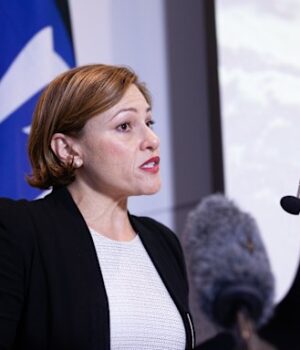
The week after the deal is then reached, Michael Wright – the chief executive of CIMIC Group, of which CPB is a subsidiary – then emails former CPB executive Don Johnson and others through a text message he received from Jackie Trad.
In it, the then-deputy premier describes as “very concerning” the reports she had heard back from adviser Scott Gartrell about a meeting earlier that day of Tuesday, July 2, 2019.
While “comforted” by the financial close of the deal, she says she has been advised that CPB had been “hostile in their approach” and had now given commitments she expected to be kept across the long relationship.
The inquiry is shown a reply Johnson sends to Wright with notes of the meeting in question from he and his team, noting that the delivery authority through its representatives Matthew Martyn-Jones, Paul Inches and Gartell and the CFMEU had raised discussion about “utilising the Queen’s Wharf enterprise agreement as a base document”.
The inquiry has broken for its lunch-hour now, but I’m still playing a bit of catch-up with the blogging duties because that last stretch was quite detailed and probably worth spelling out.
After outlining the time pressure to close a workplace deal to allow the Cross River Rail contracts to be finalised with the government, former CPB executive Don Johnson is taken through the crunch of the final week of the 2018-19 financial year.
While the Cross River Rail Delivery Authority had used contracted advisors in these efforts including Paul Inches and Evan Moorhead, it’s on Tuesday, June 26, that Scott Gartrell – who the inquiry heard was put forward by then-deputy premier Jackie Trad – appears.
Using notes across a series of meetings across that week from Johnson or other members of his team, the inquiry hears delivery authority strategy manager Matthew Martyn-Jones – who Johnson has described as a “conduit” to Trad’s office – advised the direction from the government was there needed to be a “report back today that we are on the right path”.
Former CPB executive Don Johnson details the time pressure to reach an agreement with unions for the Cross River Rail project, to allow the contract to be finalised by the end of June 2018.
The “best practice principles” policy was being used to say a workplace agreement was needed before finalising the contract, and the government and Building Trades Group of unions “were in unison” that a Queen’s Wharf-style agreement was needed to satisfy that.
Without state government intervention, Johnson says the Fair Work Act required either what is known as a greenfield agreement negotiated by the firm and the unions before substantive work started; or it would get into the realms of a brownfield agreement that must be voted on by the workforce.
“So that’s not somewhere that you want to be,” he says.
We’ve now started to get into the substantial elements of former executive general manager at CPB Don Johnson’s evidence.
After going over some of his largely positive interactions with unions including the AWU and, in a more limited capacity, the CFMEU, in NSW and Victoria, Johnson gets to the Cross River Rail talks.
He says the advent of the Queensland government’s fledgling “best practice principles” policy at the time meant it had more of an involvement in the enterprise agreement negotiations than is usual on these types of jobs.
Johnson says by mid-April of 2019 amid negotiations with the unions about an agreement, and government about the contract, the policy seemed to be a “de facto way of [the government] suggesting that the Queen’s Wharf agreement needs to be applied”.
Don Johnson, an executive general manager at CPB from 2018 until earlier this year, is speaking about his roles at the company. For his last few years, he was also its chief operating officer.
He notes he was promoted into the first of those roles “towards the tail end” of CPB’s involvement in bid processes for the Cross River Rail as part of the Pulse joint venture.
By late 2019, the group was negotiating project agreements and closing the contracts, and negotiating enterprise agreements with unions.
Johnson notes the agreement in this project was a “big issue” in the negotiation of, and ultimate signing of, the contract – usually done with support from commercial and legal teams.
“When you get to those situations, there’s bigger problems to be solved. That’s where your executive management gets involved, so I found myself a bit involved in the EA negotiation,” he says.
Counsel assisting the inquiry Edward Gisonda, SC, starts this morning with an outline of the plan for today.
He says he’ll be done taking evidence from witness Don Johnson – who previously worked with major Cross River Rail contractor CPB – by 2.30pm.
Gisonda says the main evidence from Johnson today will relate to the firm’s initial workplace bargaining for the rail project and the 2023 “safety reset”.
After this, Johnson may face cross-examination. The firm’s general manager for Queensland and Papua New Guinea, Vince Sanfilippo, will then be called when hearings return in mid-April – but not until the second or third weeks of that block.
Just jumping into the inquiry? Need a refresher on the ground covered so far? Here’s a recap of the powerful probe’s work to date.
The Crisafulli government launched the $19.7 million probe after reporting by this masthead and 60 Minutes into criminality, corruption and misconduct in the union and sector nationwide.
Due to provide a final report by July 31, the inquiry under Commissioner Stuart Wood has also faced questions of its own amid government attacks against the union and former Labor government.
This month: Current and former Workplace Health and Safety Queensland staff last week laid out their experience of CFMEU influence over the office the inquiry says it is looking into as one of four examples of “regulatory capture” by the union. Earlier, the inquiry held an unusual media conference outside a Gold Coast company with suggested links to Melbourne underworld identity Mick Gatto, and hinted at finding “more than we expected” when asked if they would need a time extension.
Last month: The inquiry held its first (of 10) three-day public hearing blocks for the year, with evidence from a senior civil construction industry figure and the CFMEU administrators’ former corruption-busting barrister. There was much focus on the latter’s recent Victorian-focused report, but also accusations a former Labor minister directed his department to negotiate with the union.
Late last year: Across hearings in November and December, the inquiry heard from government-appointed CFMEU administration figures about the former leadership’s use of violence to expand their “fiefdom” into civil construction. A second hearing block delved deeper into the why, how and who, driven by two union leaders on the receiving end, or in the middle of, the building union’s alleged efforts.
Welcome back to our live coverage of the Commission of Inquiry into the CFMEU and Misconduct in the Construction Industry.
After spending last week probing the “regulatory capture” of Workplace Health and Safety Queensland by the CFMEU, the inquiry this week turns its sights to Cross River Rail.
In opening remarks, counsel assisting the inquiry Edward Gisonda, SC, described the multibillion-dollar inner-city passenger rail project as “one of the biggest and most important case studies” the inquiry will consider.
After a detailed run through of the project’s long history, first on the witness list was the highest-level public sector figure called so far: Cross River Rail Delivery Authority chief executive Graeme Newton.


