
Source : THE AGE NEWS
March 19, 2026 — 11:58am
The US Federal Reserve Board is now officially operating in the dark, leaving US interest rates unchanged while it waits to see how the war in the Middle East unfolds.
As the impact of the war on energy supply and prices has intensified – most recently with Israel’s strike on Iran’s major source of gas, the vast South Pars offshore gas field, and Iran’s retaliatory bombing of Qatar’s giant Ras Laffan LNG complex, one of the world’s most important energy hubs – the Fed has effectively acknowledged it hasn’t a clue what that might mean for the US economy.
“It is too soon to know the scope and duration of the potential effects on the economy,” the Fed’s chairman, Jerome Powell, said.
“The thing I really want to emphasise is that nobody knows.”
He joked that several members of the Federal Open Market Committee (FOMC), which sets the US policy rates and publishes quarterly projections of economic outcomes, had said that, if ever there was a meeting to skip the release of those projections, “this would be a good one”.
With US petrol and diesel prices soaring since the onset of the hostilities, the conflict will have an impact on the inflation rate, which has remained stubbornly above the Fed’s target of 2 per cent for the past five years.
Whether that impact is temporary – “transitory” – or not, depends on how entrenched inflationary expectations become. The Fed thought the impact of COVID on inflation would be transitory, but it took two years for the transition to occur. It will be anxious not to make the same mistake.
The Fed’s quandary is further complicated by President Donald Trump’s tariffs, which Powell also linked to the experience of COVID-era inflation.
“I think we have to be humble about knowing how long it will take for tariffs to go all the way through the economy,” he said, noting that the Trump administration had made it clear that it was “going to get that rate right back up to where it was” before the US Supreme Court deemed Trump’s “reciprocal” and “baseline” tariffs illegal.
The Fed expects the effects of the tariffs to cause a one-time jump in prices, but fade over time.
Powell said much of the increase in the Fed’s preferred inflation, the core personal consumption expenditures (PCE) index, was the effects of tariffs on goods prices that had yet to work their way through the economy.
Uncertainty about the inflationary effects of the war and tariffs and a jobs market that has flatlined over the past year – there was a net loss of 92,000 jobs last month and the unemployment rate edged up to 4.4 per cent – has left the US central bank, which has a dual mandate of controlling inflation while maximising employment, with a dilemma.
Powell said the Fed was “balancing these two goals in a situation where the risks to the labour market are to the downside, which would call for lower rates, and the risks to inflation are to the upside, which would call for higher rates, or not cutting, anyway”.
The uncertainty as to where that balance lies was reflected in the FOMC’s projections.
While 11 of the 12 voting members of the committee voted to hold the federal funds rate steady (Trump’s man inside the Fed, Stephen Miran, predictably voted to cut it by 25 basis points), 12 of the broader group of 19 officials who attend the meeting had one 25-basis-point cut pencilled in before the end of this year, while seven foresee none. There was even discussion within the meeting about the prospect of rate rises.
Outside the Fed, there has been considerable debate about the potential of the tariffs and the big spikes in energy prices to lead to stagflation – a combination of high inflation, low economic growth and rising unemployment.
Powell dismissed that prospect, saying he would reserve the use of the term for “a much more serious set of circumstances” and “that is not the situation we’re in”.
While the FOMC members raised their projections for inflation this year from the 2.5 per cent core PCE rate they anticipated in December to 2.7 per cent, they kept their projection for unemployment steady at 4.4 per cent and raised their expectation for GDP growth from 2.3 per cent to 2.4 per cent.
As the price effects of Trump’s tariffs and the higher petrol and diesel prices seep into US costs and consumer prices, the inflation rate would be expected to rise, consumption, the biggest driver of US growth, could be expected to fall and unemployment to increase, unless those effects are transitory. Stagflation can’t be ruled out.
That may, of course, be someone else’s problem, with Powell’s term as chairman scheduled to end on May 15.
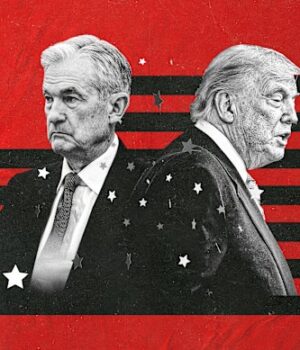
Trump, who detests Powell and wants to insert someone to succeed Powell as chairman who will do what they are told and lower rates, has, however, created the possibility that Powell might stay on as an acting chair and, departing from convention, until a new chair is confirmed by Congress, and remain as a governor until that term ends in January 2028.
‘The thing I really want to emphasise is that nobody knows.’
US Fed chair Jerome Powell says the impacts of the war on the US economy remain a mystery
Trump has nominated a former Fed governor, Kevin Warsh, to replace Powell as chair. Warsh presumably wouldn’t have gained that nomination if he hadn’t convinced Trump that he would deliver rate cuts, although he would be only one of the 12 FOMC voting members and could probably only count on Miran as a locked-in ally.
Powell said he would continue to serve as “chair pro tempore” if his replacement isn’t confirmed by May 15 because that’s what the law calls for. He also said he had no intention of leaving the board until the US Department of Justice investigation targeting him was “well and truly over, with transparency and finality”.
If Powell remains on the board and as a member of the FOMC, he would provide a focus for opposition to any Trump appointees’ insistence on lowering rates significantly while the inflation rate remains elevated and the inflation outlook uncertain.
Last week, a federal judge threw out subpoenas the Department of Justice had issued in relation to cost overruns in the renovation of the Fed’s Washington headquarters, saying the government had provided “no evidence whatsoever” of any criminality. He made it clear he believed the investigation was a pretext for creating the grounds to fire Powell.
The administration has said it will appeal that ruling.
With the Senate Banking Committee saying that it won’t confirm a new Fed chair while the investigation remains afoot, the prospect of Powell’s term being extended is real, as is the likelihood of Powell, angry at being accused of criminality because he hasn’t delivered Trump the big interest rate cuts the president has repeatedly demanded, remaining a governor.
That would deny Trump a board seat he can fill with someone who will do as they are told.
Had Trump not imposed his tariffs – a massive and inflationary tax on US companies and consumers – or initiated the war on Iran, of course, he may well have got the lower inflation and lower interest rates that he so desperately wanted ahead of midterm elections, at which the Democrats are expected to give Republicans a shellacking and take control of at least the House.
The Business Briefing newsletter delivers major stories, exclusive coverage and expert opinion. Sign up to get it every weekday morning.
 Stephen Bartholomeusz is one of Australia’s most respected business journalists. He was most recently co-founder and associate editor of the Business Spectator website and an associate editor and senior columnist at The Australian.Connect via email.

