Source :- THE AGE NEWS
March 19, 2026 — 11:30am
I knew the players hated the sub’s vest. But it wasn’t until a Thursday morning in a busy Gold Coast cafe that I realised the problem was even more significant than I thought.
My breakfast companions were Jed Walter and Tom Berry, two Suns players at different junctures in their football journeys. The conversation must have come to a lull, as the topic turned to the sub.
“You know at three-quarter-time, we don’t even listen to what ‘Dimma’ [Damien Hardwick] is saying. We just watch where Darcie is and which player she is moving towards,” Tom said.
Darcie is the team manager and the holder of the sub T-shirt. Tom won’t mind me saying that he is the type of player prone to being subbed. He played 43 games across seven seasons, kicked six goals and laid heaps of tackles. His teammates loved playing with him.
I asked Jed if he felt the same way, expecting a different answer, given he was picked at No.3 in the draft and the coaches loved him like a son.
“A hundred per cent,” he said. “I look at the team on the board, and I look for Darcie. Until I know who is subbed I can’t think of anything else.”
Yes, players are paid a lot of money, and maybe they should be able to narrow their focus, but this was still an alarm bell for me. I hadn’t been a fan of the AFL sub rule, but my loathing of it went up a level after that conversation.
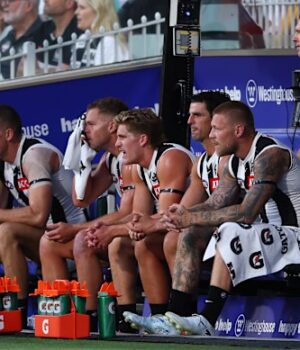
As someone who sat on the bench at Gold Coast for the past two seasons with a direct line to the coach, I saw the anguish it caused. Every single time a player got subbed, Damien would spend up to a minute talking to the player, explaining why they were subbed.
Some messages were easier: “You’re such an important player, and we need to protect you.” On one of those occasions, it still led to Sam Collins giving me a spray.
On other occasions it was much harder. A player hadn’t performed, and you could tell they had so many thoughts going through their mind. Will I play next week? What does this mean for my contract? So in the middle of a game, the coach must become a counsellor and a psychiatrist and a coach. But for that minute, he’s not coaching the team.
How did we get here?
From 1897 to 1930, there were 18 players on the field and if one was injured, the team just played one short. I won’t take you through every iteration of the bench, but that’s a fascinating starting point. Fair to say our forefathers lived in simpler times and didn’t have 17 television shows dissecting every move and facial expression. By my calculation, there have been 11 changes to the configuration of the bench since the VFL began.
Without taking you through every one, it took 100 years for the first three changes and only 30 years for the next eight.
In defence of the AFL, when they changed from a medical to a tactical sub, they were bending to pressure from clubs. We at clubland love flexibility and this easing of the rule was intended to allow for this. But the unintended consequence was the tension over our açai bowls described above. That’s without contemplating the hours spent in match committee choosing which player would start in the vest.
So now we have five on the bench. I love it. It gives enormous flexibility and in an increasingly homogenous game, we will hopefully see clubs deploying it differently.
It’s made selecting the team way more interesting. We saw Sydney’s Tom Papley wait 20 minutes to enter the game in opening round against the Blues. Clearly, the match committee thought he was a little underdone and may battle to get through a whole game. Last year the discussion would have been: “We can’t start him because he’ll run out of puff, and what happens if we get an injury in the first five minutes.” Perhaps he wouldn’t have played.
Hawthorn in round one played two genuine ruckmen. It was a success, so they’ve picked both Ned Reeves and Lloyd Meek to face the Swans on Thursday night.
The expanded bench can also be used to rest a star player. Coaches were previously loath to do this for fear of “cooking” the other 21 players. With an extra on the bench, with the game in hand, Marcus Bontempelli may sit out an extra 10 minutes. It may not sound much, but anecdotally this provides enormous gains in the recovery of older players.
So this flexibility can aid the ruck, the veteran, the underdone and the aerobically challenged. The AFL wants it to be a game for all and this rule helps that.
Now, I’m not proposing this should happen, but why do we actually have to have a limit on the number of interchange players? With a cap on rotations, why can’t clubs have 10 on the bench?
I’ve also never understood why there is a limit on list numbers. I understand a minimum, but if a rebuilding club, like West Coast, has lesser talent and therefore less need to pay the salary cap, why can’t they have 50 players on their list and give more players an opportunity?
Meantime, the vest has gone the way of the super goal and the bounce. It’s good for footy.
Keep up to date with the best AFL coverage in the country. Sign up for the Real Footy newsletter.
 Wayne Campbell is a former Richmond captain and All-Australian, ex-Gold Coast football manager, and the current boss of the Sydney Swans academy.