
SOURCE :- THE AGE NEWS
Images have begun to arrive of the latest Israeli bombardment on Lebanon.
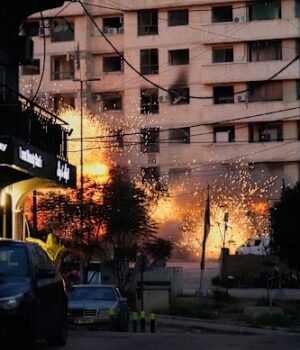
As we reported earlier, the Israeli army issued an evacuation notice for a building in the Bachoura neighbourhood of central Beirut early Wednesday. These pictures appear to show that building coming down.
People on the ground heard gunshots following the notice, a tactic typically used to wake residents and draw attention to evacuate.
Returning now to the Al Minhad Air Base in the United Arab Emirates, which was hit by an Iranian missile earlier today.
This is significant because the Australian Defence Force has a longstanding presence there, along with British armed forces.
The Department of Defence has just released a statement, largely reiterating what we heard from Prime Minister Anthony Albanese a few hours ago.
“No ADF personnel were injured in the incident, and all ADF personnel deployed to the Middle East are safe and accounted for,” the department said.
“The strike resulted in minor damage to an accommodation block and medical facility in the Australian section of the base.”
Australia’s accommodation sector has dealt with widespread and significant cancellations since the US and Israel struck Iran and Iran’s subsequent retaliation.
Many international tourists who planned to travel from or through the Middle East were forced to stay home, Accommodation Australia chief executive James Goodwin said.
“There’s been enormous levels of disruption in the sector,” he said.
Sydney, Melbourne and Brisbane were predominantly affected, but other areas dependent on overseas travellers such as Kangaroo Island, Uluru and the Great Barrier Reef were impacted.
America’s Central Command has announced it has dropped several two-tonne bombs – colloquially known as “bunker busters” – on Iranian missile sites near the Strait of Hormuz, as it attempts to reopen the crucial waterway to global shipping.
“US forces successfully employed multiple 5000-pound deep penetrator munitions on hardened Iranian missile sites along Iran’s coastline near the Strait of Hormuz,” the organisation said on Wednesday morning.
“The Iranian anti-ship cruise missiles in these sites posed a risk to international shipping in the strait.”
Iran has been mining waters in the strait, as it uses global trade and geography as a tool to squeeze the US and Israel. Global travel, fuel and fertiliser markets have all been heavily disrupted since Iran responded to the US and Israel’s first attack on February 28.
The IDF has just confirmed it has begun striking “Hezbollah terror targets” in southern Lebanon, in response to rockets fired towards Israel earlier today.
The Israeli army has issued evacuation notices for a building in the Bachoura neighborhood of central Beirut, a building in the Akaybeh neighborhood of the Sidon district in southern Lebanon and parts of the city of Tyre in recent days.
An Israeli airstrike hit Beirut’s Bachoura neighbourhood not long after the first of these notices.
Earlier, two Israeli strikes on separate apartment buildings in central Beirut killed at least six people and wounded 24 others.
The latest strikes follow Israeli media reporting the sound of explosions in the Gush Dan area in central Israel after the Israeli military sent out an alert about incoming missile fire from Iran.
Israel’s killing of security official Ali Larijani leaves Iran’s wartime leadership largely in the hands of hardliners who may be less likely to seek a diplomatic pathway out of the war.
Larijani was an insider of the Islamic Republic’s establishment for decades. He leveraged his ties to different factions and key figures, including late Supreme Leader Ayatollah Ali Khamenei, to influence important decisions.
He had emerged as the country’s most senior national-security official with a central role in the talks on Iran’s nuclear program, most recently shuttling between Gulf-Arab states and visiting Moscow to meet Russian President Vladimir Putin, in the weeks before the current conflict started.
As the US-Israeli war on Iran intensifies and continues to wreak havoc on the oil-rich Persian Gulf, some fear that the death of a figure like Larijani could block potential diplomatic efforts to end it quickly. US President Donald Trump has not commented directly on the implications of Larijani’s death.
Yousef Pezeshkian, the son of Iranian President Masoud Pezeshkian, wrote on the messaging app Telegram that Israel’s constant killing of top officials couldn’t be allowed to go on.
“We should not have allowed the enemy to be able to carry out another successful assassination,” he wrote.
“If we cannot stop the Zionists’ assassination machine, we will suffer a defeat.”
AP
The US-Israeli war has killed at least 1300 people in Iran, more than 900 in Lebanon and 12 in Israel, according to officials in those countries. The US military says 13 US service members have been killed and about 200 wounded.
See below for the latest updates from around the region:
- Lebanon: Two Israeli strikes on residential apartments in central Beirut’s Basta and Zokak Al-Blat neighbourhoods early Wednesday killed at least six people and wounded 24 others, according to an initial toll by the Lebanese Health Ministry. “Human remains have been recovered from the site, and the identities of the victims will be determined once DNA testing is completed,” the ministry added. The strikes, which came without warning, hit areas far from Beirut’s southern suburbs which Israel has previously warned to evacuate.
- Iraq: The US embassy compound in Baghdad was targeted early Wednesday, two Iraqi security officials said, speaking on condition of anonymity because they were not authorised to comment. The officials said the C-RAM defence system was unable to intercept the attack, which struck inside the embassy. US facilities in Iraq have frequently been targeted by Iran or Iran-backed Iraqi militias since US and Israeli strikes on Iran triggered the ongoing war.
- Saudi Arabia: Saudi Arabia’s Defence Ministry reported early Wednesday it shot down a ballistic missile targeting the area around Prince Sultan Air Base, which hosts American forces and aircraft.
- Israel: Iran acknowledged launching multiple-warhead missiles at Israel early Wednesday, the latest use of a weapon designed to spread maximum damage and evade Israel’s multiple layers of air defences. A statement from the paramilitary Revolutionary Guard reported by Iranian state television said the force launched both Khorramshahr-4 and Qadr multiple-warhead missiles in the attack that targeted an area near Tel Aviv. The Guard described the attack as revenge for Israel killing top security official Ali Larijani.
AP with Alexander Darling
Each state and territory will be asked to select a “point person” to co-ordinate with the federal government on fuel challenges, Prime Minister Anthony Albanese has announced, as he prepares for a meeting of national cabinet tomorrow focused on fuel issues.
“I’ll be asking state premiers and chief ministers to appoint someone, a point person, so that the commonwealth can collaborate in a way to make sure we deal with the challenges which are there,” Albanese said.
“We know that we do have fuel security. All of our ships have arrived at this point, but we’ve had a surge in demand, which is leading to some shortages in some areas, particularly of diesel. We’re very conscious of that, and that’s why we continue to work every day to make a difference,” the prime minister said.
Albanese announced state and territory leaders would meet in Tasmania on Thursday, and flagged measures to promote resilience amid global uncertainty in the lead-up to the May budget.
A certain Joe Kent, a complete unknown to most people until he resigned as director of Donald Trump’s National Counterterrorism Centre, briefly gave Trump-haters some solace as he scorched the earth on his way out today.
The special forces veteran, appointed by Trump to the senior security post last year, alleged that the president of the United States was goaded into declaring war on Iran by “pressure from Israel and its powerful American lobby”.
Read more: Trump, hit by the karma bus, wins on battlefield but loses on diplomacy
Not only had Israel drawn the US into the 2003 Iraq war, said Kent, but its officials had quietly sown pro-war sentiment within the Trump administration to encourage the present conflict with Iran.


