
SOURCE :- THE AGE NEWS
Barry Laycock has spent the past 30 years seeking the truth about who ordered the terrorist bombing that ended his working life. On Tuesday, he finally faced down the man he believed to be responsible as Gerry Adams entered the witness box at the High Court no more than seven metres in front of him.
For the first time, the former Sinn Fein president and one-time MP was forced to answer on oath the question that he has been avoiding for the past half-century: was he ever a senior member of the IRA?
“I was never in the IRA,” he told the court. Nor, he said, did he have any knowledge of its workings beyond what was in the public domain.
“That is not the truth, is it?” asked Sir Max Hill, KC, representing Laycock and others.
“It is the truth,” insisted Adams. He did, though, tell the court that he had “never disassociated myself from the IRA”.
Whatever the outcome of these proceedings, Laycock, together with his co-claimants and fellow IRA bombing victims John Clark and Jonathan Ganesh, has already won a victory of sorts by getting this case to court and forcing Adams to face a public inquisition.
Adams, 77, is being sued by Clark, 82, who was injured in a car bombing at the Old Bailey in London in 1973, Ganesh, 57, injured in the Docklands bombing of London in 1996, and Laycock, 86, injured in the bombing of Manchester’s Arndale Centre in 1996.
They are asking for a token £1 in damages for the responsibility they claim Adams bears for ordering the bombings, but what they really want is answers.
Adams, dressed in a navy-blue suit, wore a Palestine flag lapel pin and a Fainne Oir – a small gold circle denoting an Irish language speaker – together with a sprig of shamrock in his breast pocket.
“A very happy St Patrick’s Day,” he said to Justice Swift as he entered the witness box.
“Oh, that’s very kind,” replied the judge.
It was an incongruous start to a day that was to be spent discussing a terrorist organisation, but Adams was doing his best to present as the retired politician he claims to be, softly spoken and measured in his responses.
“Can I say that I saw Mr Laycock in court today, and I was extremely moved by the testimony he gave to this court,” he said, unprompted. The judge told him to stick to answering the questions put to him by Sir Max, a former director of public prosecutions.
Laycock, unmoved, sat with his arms folded as he stared at Northern Ireland’s most prominent Republican of living memory.
This was a scene that would have been unimaginable in the 20th century: an alleged IRA commander answering questions in a London courtroom about terrorist attacks, one of his alleged victims sitting close by, British Army veterans and at least one convicted former IRA member sitting in the small, cramped public gallery without any need for extra security precautions.
Adams was once considered so dangerous by the British government that his voice was effectively outlawed. From 1988 to 1994, it was illegal to broadcast his voice, meaning that television and radio news bulletins had to hire actors to dub his speeches.
Here, though, he was mumbling so quietly at times that the judge had to tell him to raise his voice, and those in the high-ceilinged, old courtroom were having to strain to make out much of what he said.
This is not a murder trial, not even a criminal trial, but a civil hearing about membership of an organisation, so there are more references to bundles, tabs and paragraph numbers than blood, bone and sinew.
‘I was never in the IRA’
Adams began his evidence by explaining that he joined Sinn Fein when he was 16, “only a pup” in his words, spurred into republican fervour by what he saw as the injustice of the special powers used by the British government, including internment without trial.
Others claim he was a senior IRA commander by the early 1970s, but time and again Adams repeated that “I was never in the IRA” and that he had “always come clean” about his past.
Despite insisting that “I like English people”, Adams became annoyed at times and showed a degree of contempt for Sir Max’s line of questioning.
“You’re going to have to do your best not to interrupt me,” said Adams irritably as Sir Max tried to cut him short at one point.
He also took issue with Sir Max’s terminology, saying “please stop using the term mainland” when referring to the island of Great Britain. “I am from the island of Ireland,” he said, his voice now raised. “That is the mainland, and this is our nearest offshore island.”
He became flippant when Sir Max asked him why he wore a black beret – associated with membership of the IRA – at the funeral of an IRA commander if he was not himself a member of the IRA.
“What’s the big deal?” Adams asked. “I did on a number of occasions wear a black beret, but so did many other people … Benny Hill wore a black beret.”
Sir Max pointed out the obvious about the former slapstick comedian: “That was in rather different circumstances.”
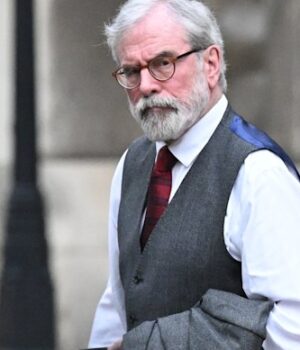
Despite approaching his ninth decade, Adams remains an imposing, broad-shouldered figure who could pass for a man in his late 50s.
His hair and whiskers have faded to grey, but he is otherwise unchanged from the man who, for many, became the face of the Troubles.
Time has been less kind to Laycock, who looks every one of his 86 years. Stiff-jointed and reliant on a walking stick and painkillers, his battered body has never recovered from the terrible back and leg injuries he suffered when a lorry bomb exploded outside Manchester’s Arndale Centre in June 1996.
The 1500-kilogram bomb, the biggest to explode in Britain since World War II, ended Laycock’s working life as a railwayman, leaving him living “hand to mouth” for eight years until he could claim his pension, he has previously said. He blames that hardship, and the wider impact of the bombing, for the death of his wife, Christine, 16 years ago, and has said that it robbed his grandchildren of having a “normal granddad”.
No one was ever charged in connection with the bombing, which injured 200 people, meaning the civil case against Adams is likely to be the closest Laycock ever gets to justice.
Sitting on the upright benches of Court No 16 to listen to Adams give evidence was clearly causing him great physical discomfort, though we can only guess at the mental pain of reliving his ordeal.
Like the other claimants, he is keeping a dignified silence while the case is ongoing. Clark and Ganesh both suffer from ill health and were not in court.
Between them, they stand for more than 540 people who were injured and three who were killed by the three bombings, and to a great extent, they also stand for more than 1700 people killed by the IRA during the Troubles, many of whom have never received justice.
The Telegraph, London
Get a note directly from our foreign correspondents on what’s making headlines around the world. Sign up for our weekly What in the World newsletter.


