
SOURCE :- THE AGE NEWS
March 17, 2026 — 5:00am
Who’s winning the Iran war? The Islamic Republic of Iran is surviving continuous bombardment so far. The ayatollah is dead, long live the ayatollah!
The Israelis assassinated the Ayatollah Ali Khameini in the opening blow of the war. But the new Supreme Leader is to be his son, Mojtaba Khameini.
We’re yet to see any proof of life from Mojtaba. Reportedly, he was injured in the strike that killed his father. But, assuming he’s alive, the war simply has accelerated the regime’s dynastic succession. The new leader, 56, is no reformer.
“Despite donning a turban, Mojtaba is the product of the regime’s national security deep state,” says Washington-based expert, Behnam Ben Taleblu of the Foundation for Defence of Democracies. “Expect him to work with and through the Islamic Revolutionary Guard Corps to keep his hold on power.”
His accession is contested within the regime. According to the London-based Iran International news site, at least two influential clerics want to give executive authority to a temporary leadership council instead of to the Supreme Leader alone.
“Divisions between political officials and ruling clerics on one side and Revolutionary Guards commanders on the other have deepened,” it reports.
We cannot know whether the regime will fracture. But we do know that it continues to fire drones and missiles at Israel and at its Arab neighbours. And we know it uses armed force to control access to the energy export artery known as the Strait of Hormuz. Iran’s tactics are raising the price of oil, LNG and fertilisers. It’s an economic war against the US.
For the regime, mere survival would constitute victory. For now, however, it’s in the balance in a contest of endurance against the US and Israel.
And the US? It’s impossible to know if America is winning. Because President Donald Trump changes his stated war aims day to day. As the headline in the satirical Australian website The Shovel put it, “White House assures public it will develop objectives for Iran war once it is over”.
Trump’s failure to plan is shocking. With the war in its third week, he’s still casting about for a way to reopen the oil flow through the Strait of Hormuz. He neglected even the most fundamental precaution: He launched the war with US strategic petrol reserves half full, even though he’d promised in his inaugural address to “refill our reserves right up to the top again”.
The Pentagon in all its war gaming for the past 45 years has planned for Iran to close the strait. And it has explicitly warned Trump, reports The Wall Street Journal.
“Trump acknowledged the risk,” the paper reports, but he dismissed it. He told his officials that Iran would surrender before it had a chance to shut off the oil. The price of oil is up by some 40 per cent since hostilities began. It continues to rise.
And what’s the point of the entire enterprise? The world awaits a cogent explanation. Asked on the weekend (Australian time) when the war would end, Trump said: “When I feel it in my bones.”
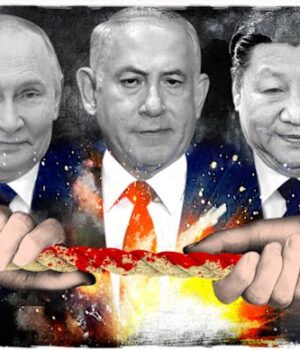
So you can’t really say that either of the two main combatants is winning. But there are some winners already, nonetheless. Three stand out. Israel is weakening its most serious enemy (with political cover and military assistance from the US).
The war, brags Prime Minister Benjamin Netanyahu in a moment of headiness, is turning Israel into a “global superpower”. A poll for the Israel Democracy Institute last week found public support for Israel’s part in the war at 82 per cent, and at 93 per cent among Jewish Israelis.
The second winner is Russia. Trump responded to the surging oil price by relaxing sanctions on Russia’s oil exports. The result? “Russia rakes in $US150 million a day in extra revenue from surging oil prices,” headlined London’s Financial Times. If sanctions remain lax and oil prices high for a month, Russia’s national budget would reap a bonus of $US3.3 billion to $US5 billion to fuel its war against Ukraine. The sanctions, of course, were imposed precisely to starve Vladimir Putin’s war chest.
Trump’s decision to favour Russia was opposed by all the other six leaders of the G7 in a call last week. It was so blatant a gift to Putin that German Chancellor Friedrich Merz hinted darkly at Trump’s motives: “We think that’s wrong,” said Merz, speaking alongside Norwegian Prime Minister Jonas Gahr Støre. “There is currently a price problem, but not a supply problem. And in that regard, I would like to know what other factors led the US government to make this decision.”
Even more startling is that Trump gave Putin this benefit knowing that Russia has been helping Iran to kill Americans. The Washington Post reported, and Trump has conceded, that Moscow is coaching Iran in how to target missiles at US military bases, ships and other assets in the Middle East. Yet Trump rewards Putin anyway.
“Russia is the big winner of this conflict,” oil analyst Sumit Ritolia of trade data firm Kpler told the FT.
Yet the third winner of this war to date is, arguably, the biggest beneficiary of all. With America’s political attention and military forces preoccupied with Iran, China wins serious advantages to operate freely in the Indo-Pacific.
The Pentagon has for years described China as America’s “pacing threat”. Trump’s undersecretary for war policy, Elbridge Colby, told me in 2024 that China was the only nation other than the US that had the potential to dominate the global economy, and, hence it could displace America as global hegemon.
But the two aircraft carriers that the US customarily keeps in the Indo-Pacific have been called away to support the war on Iran. Now Trump is moving an amphibious assault ship, the USS Tripoli, and some 2500 marines from Japan to the Iran war.
Trump also has moved missile batteries and interceptor missiles from Japan and South Korea to the Middle East. And note that China has no oil shortage – Iran allows exports to China to continue under a special arrangement. So Beijing is untroubled by the war while the US is weakened.
US credibility is harmed, its power in the Indo-Pacific drained, and its munitions stocks depleted. Next, Xi Jinping will see Trump in Beijing in a meeting due in about two weeks. He will seek an answer to a crucial question, says Australian retired major general Mick Ryan.
“It may be a key decision point for Xi,” Ryan tells me. “Because he will be getting a sense of ‘will Trump fight?’” against China in a crisis over Taiwan or the South China Sea. “That’s the most important thing for Xi.”
Peter Hartcher is international editor.
Get a weekly wrap of views that will challenge, champion and inform your own. Sign up for our Opinion newsletter.
 Peter Hartcher is political editor and international editor of The Sydney Morning Herald and The Age.Connect via email.

