
SOURCE :- THE AGE NEWS
Beijing: By normal foreign policy metrics, it ought to be seen as a little galling for Washington to demand Beijing’s support to help resolve a Middle East crisis of its own making, let alone one resulting from an attack on China’s friend in the region.
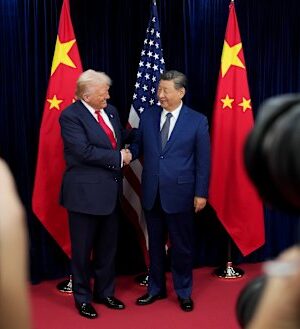
But Donald Trump dispensed with policy norms long ago. And so, without any sense of irony, the US president dangled the threat that he “may delay” his summit with Chinese President Xi Jinping at the end of March unless Beijing helps unblock the Strait of Hormuz, which has been choked off by Iran and its attacks on commercial shipping vessels.
“It’s only appropriate that people who are the beneficiaries of the strait will help to make sure that nothing bad happens there,” Trump told the Financial Times on Sunday, adding “we’d like to know” before the trip whether Beijing will help.
One is left to imagine the bemusement among officials in the Chinese capital at being urged by Trump to get involved in a conflict far from its shores and in a region that has only proved a diabolical quagmire for the US in the past.
“This is not our war. If we send ships there, it seems like we are joining the camp of the US and Israel against Iran. That’s certainly not what China wants to do,” says Wu Xinbo, director of the Centre for American Studies at Shanghai’s Fudan University.
Trump did not have the leverage to play this card, Wu added, because “delaying his trip to Beijing doesn’t do any damage to China”.
Trump’s request found critics in Washington, too.
Asia expert Evan Feigenbaum, from the Carnegie Endowment think tank, posted on X that Trump was essentially demanding Washington’s adversary “demonstrate and deploy more expeditionary naval power”. It’s a move that flies in the face of years of efforts to discourage Beijing from doing exactly that, he argued.
By Monday morning in Paris, after emerging from the latest round of trade talks with Chinese officials, Treasury Secretary Scott Bessent was hosing down Trump’s comments.
It was a “false narrative” to suggest the meeting could be delayed due to China’s unwillingness to assist, he said, while keeping the door ajar for the meeting to be rescheduled due to the war.
Trump soon pivoted to this rationale, confirming the US had requested a one-month delay and saying “I have to be here … we’ve got a war going on”.
Fan Hongda, director of the China-Middle East Centre at Shaoxing University, said he suspected Beijing would quietly welcome the US president’s decision.
“If President Trump were to visit China while the conflict was still raging, it would damage China’s national image, especially given the severe bombing of Iranian civilian infrastructure,” he said.
Beijing has trodden a cautious path since the US and Israel launched strikes on Iran in February and assassinated its China-friendly leader, Ayatollah Ali Khamenei. It has sought to cast itself as a neutral actor and defender of state sovereignty amid the chaos of US interventionism, condemning both the decision to attack Iran and Iran’s attacks on its Gulf neighbours.
It has so far refrained from responding to Trump’s knee-jerk demand to help police the strait beyond a Foreign Ministry spokesman again urging a ceasefire on Monday.
On the surface, it’s easy to see where Trump’s logic was taking him. China heavily relies on the Middle East for its oil imports, so why shouldn’t it help keep the strait open and free from Iran’s attacks on transiting vessels, presumably by leveraging its close relationship with Tehran to do so?
Conflict resolution is a responsibility of great powers – a status China wants to claim.
The question is, whose ships would China’s navy be protecting? Not its own, it seems.
Iran has indicated it will grant safe passage to Chinese tankers and ships whose cargo is traded in Chinese yuan, with officials claiming the strait is closed only to its “enemies” (the US, Israel and their allies).
Secondly, in this instance, Beijing’s involvement would be in service of an American interventionist agenda, and that’s not something it will countenance, says Ahmed Aboudouh, an expert on China’s Middle East strategy at the Chatham House think tank.
Aboudouh sits in the camp of China analysts who argue there is a tendency in Washington to overstate Beijing’s influence over Tehran and to superimpose the expectations of the US alliance structure onto Beijing’s network of partners.
“The Iranians are not going to listen to anyone who tells them not to defend themselves,” he says.
China does not have a US-style alliance with Iran. Their strategic partnership is not built on defence obligations but economic transactionalism, with Beijing buying 90 per cent of Tehran’s oil imports at a bargain price, helping to sustain the regime. China is agnostic about the political survival of the Islamic Republic beyond not wanting a US-backed alternative to take its place. But it does care very much about its economic interests being affected by regional instability.
Strait stays blocked
Trump hasn’t just singled out China for help with the strait. He has appealed to seven nations, including France, Japan and South Korea, to send warships to shepherd vessels through the vital shipping lane, through which one-fifth of the world’s oil passes.
Tehran has attacked at least 18 commercial vessels in the Gulf using explosives and drone strikes since the war started. Meanwhile, China-linked ships have rushed to declare they are “China-owned” on maritime broadcasting channels to avoid being targeted.
Hundreds of fuel tankers and cargo ships are now backed up in the strait and surrounding waters, sending global oil prices skyrocketing by 40 per cent. It’s hitting consumers especially hard at the petrol bowser – no doubt alarming the Trump administration as it gears up for the midterm elections, having reneged on its promise of no new wars.
China is not immune to the global oil shock, despite its cosy ties with Iran. Its energy interests are also being directly threatened by Tehran’s attacks on the infrastructure of other Gulf nations, like Saudi Arabia, China’s top oil supplier in the region.
But Beijing is better insulated than many countries, having stockpiled 1.2 billion barrels of crude or about three to four months’ worth of supplies.
 Lisa Visentin is the North Asia correspondent for The Sydney Morning Herald and The Age based in Beijing. She was previously a federal political correspondent based in Canberra.Connect via X or email.

