
SOURCE :- THE AGE NEWS
Welcome to our rolling coverage of the ongoing conflict in the Middle East, which is now well into its third week and showing no signs of stopping. If you’re just joining us, here’s what you need to know today.
- Israel has escalated its air and ground offensive against the Iran-backed militia Hezbollah, with Israeli ground troops targeting Hezbollah strongholds in “limited and targeted” ground operations.
- Leaders from Canada, France, Germany, the UK and Italy released a joint statement urging against a “significant ground offensive” by Israel, warning the humanitarian outcomes could be disastrous for civilians in Lebanon.
- Donald Trump told media he was “disappointed” that American allies had rebuffed his calls to send warships to escort merchant vessels in and out of the Strait of Hormuz as several European allies including Germany, Spain and Italy ruled out participating in any mission in the Gulf, and Australia ruled out sending a warship to the strait.
- The UAE has temporarily closed its airspace as a “precautionary measure”, following a series of attacks including a drone strike near Dubai International Airport overnight.
- Trump told reporters at the White House that he was seeking to delay a highly anticipated early-April trip to China because of the Iran war. It followed his earlier suggestion that his meeting with Chinese leader Xi Jinping be delayed unless Beijing helped to police the Strait of Hormuz. His officials soon backtracked.
- More than 1 million people have been displaced and 880 killed in Lebanon since the outbreak of war more than two weeks ago, the Lebanese government said.
Australia is not contemplating sending a warship to help reopen one of the world’s most crucial oil corridors amid global economic disruption.
US President Donald Trump has requested a naval coalition comprising different countries to help secure the Strait of Hormuz, which Iran has closed in response to the US-led war to give itself leverage in the conflict.
Shipping has been extensively disrupted, sending global oil prices rocketing.
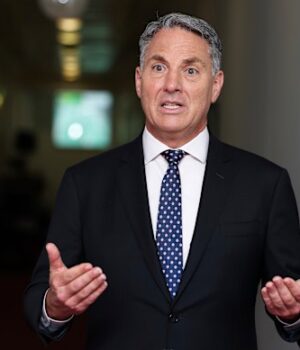
Defence Minister Richard Marles said the government would consider any request to take part in the conflict through the lens of the national interest.
The Reserve Bank of Australia has hiked interest rates for the second month in a row as war in the Middle East compounds inflation concerns.
In a split five-four decision on Tuesday, the central bank’s monetary policy board lifted the cash rate by 25 basis points to 4.1 per cent, following a rise of the same size in February.
The move was tipped by the majority of economists and money markets, which had priced in the chance of an increase at more than two-thirds.
Domestic price pressures, including a tight labour market and strong economic growth, were already pushing inflation too high for the RBA’s liking even before the US-Israeli attack on Iran led to the closing of the Strait of Hormuz and plunged global energy markets into chaos.
An “unknown projectile” has struck a tanker 23 nautical miles (42 kilometres) east of Fujairah, Oman.
The United Kingdom Maritime Trade Operations confirmed on Tuesday the tanker was hit
“whilst at anchor”.
There have been no reported injuries, with minor structural damage reported, according to the UKMTO.
“Authorities are investigating,” it confirmed. “Vessels are advised to transit with caution and report any suspicious activity to UKMTO.”
The United Arab Emirates has reopened its airspace after a brief closure.
The UAE’s General Civil Aviation Authority announced a temporary closure of the country’s airspace earlier today.
The authority said it had imposed the closure as an “exceptional precautionary measure” aimed at ensuring the safety of flights and air crews and safeguarding the country’s territory, Emirates-based WAM news service reported.
The authority has since confirmed air traffic operations have returned to normal after two hours.
Energy Minister Chris Bowen has called the panic-buying of fuel “un-Australian” and said all shipments of fuel bound for Australia through March and April are expected to arrive on schedule.
“Every ship that we have expected to arrive has arrived, whether it’s diesel, petrol or jet fuel,” Bowen told journalists at Parliament House in Canberra.
“The oil companies say to me that they fully expect all deliveries all through March and well into April, but we are in an internationally uncertain time, and that’s why we’re doing such planning at the moment.”
Bowen said that panic-buying of fuel was both “un-Australian” and was the cause of the fuel issue, telling Australians they could be confident that the government was “undertaking preparations, which best see us through the coming period”.
Welcome to our rolling coverage of the ongoing conflict in the Middle East, which is now well into its third week and showing no signs of stopping. If you’re just joining us, here’s what you need to know today.
- Israel has escalated its air and ground offensive against the Iran-backed militia Hezbollah, with Israeli ground troops targeting Hezbollah strongholds in “limited and targeted” ground operations.
- Leaders from Canada, France, Germany, the UK and Italy released a joint statement urging against a “significant ground offensive” by Israel, warning the humanitarian outcomes could be disastrous for civilians in Lebanon.
- Donald Trump told media he was “disappointed” that American allies had rebuffed his calls to send warships to escort merchant vessels in and out of the Strait of Hormuz as several European allies including Germany, Spain and Italy ruled out participating in any mission in the Gulf, and Australia ruled out sending a warship to the strait.
- The UAE has temporarily closed its airspace as a “precautionary measure”, following a series of attacks including a drone strike near Dubai International Airport overnight.
- Trump told reporters at the White House that he was seeking to delay a highly anticipated early-April trip to China because of the Iran war. It followed his earlier suggestion that his meeting with Chinese leader Xi Jinping be delayed unless Beijing helped to police the Strait of Hormuz. His officials soon backtracked.
- More than 1 million people have been displaced and 880 killed in Lebanon since the outbreak of war more than two weeks ago, the Lebanese government said.
British Prime Minister Keir Starmer said that the UK would not be drawn into the wider Iran conflict but did recognise the importance of keeping the Strait of Hormuz open.
He said Britain was working with allies to determine what actions might be taken, but that his priority remained “protecting our people in the region”.
His remarks come as Trump ramps up the pressure on allies to send warships to the strait to provide military escorts to merchant ships as Iran continues to impose a blockade of the critical oil passageway.
Starmer said Britain’s Hormuz strategy would not be a NATO mission, however, so it remains unclear what the leader plans to do.
The UAE’s General Civil Aviation Authority has announced a temporary closure of the country’s airspace.
The authority said it had imposed the closure as an “exceptional precautionary measure” aimed at ensuring the safety of flights and air crews and safeguarding the country’s territory, Emirates-based WAM news service reported.
The measure comes amid increased threats to the UAE, including attacks both at and near Dubai International Airport.
Oil prices are down and stocks are up on Monday (New York local time), though such moves have been quick to be reversed since the war in Iran began.
The S&P 500 jumped 1.2 per cent and was on track for its best day in five weeks. The Dow Jones Industrial Average was up 484 points, or 1 per cent.
The driver for markets once again was the price of oil. A barrel of benchmark US crude fell 4 per cent to $US94.75, easing some pressure off the economy after topping $US102 earlier in the morning.
AP
Despite increasing rumours of Mojtaba Khamenei’s death or injury, Iranian media have carried another statement purported to have been released by the country’s new leader.
He was quoted as saying that all those previously appointed to government positions by his father, the late Ayatollah Ali Khamenei, would remain in their posts.
It follows increased scrutiny on the condition of the supreme leader as reports he was injured during the airstrike that killed his father continue to circulate.
He has not been seen in public since his appointment on March 8.


