
Source : the age
One Battle After Another won best picture at this year’s Academy Awards, in the least surprising win in recent memory. Australia’s Oscar hopes – five nominees and no winners – were dashed. And everyone from US President Donald Trump to self-styled ballet and opera critic Timothee Chalamet came under fire, in everything from the opening monologue to the acceptance speeches.
And yet, in a striking contrast to the prevailing sentiment that awards telecasts are dreary and unending, this year’s Oscar telecast was a zinger. The show’s host, American comedian and talk show legend Conan O’Brien, brought his A-game to the stage and belted out an opening monologue underlined with his cracking wit.
O’Brien welcomed Netflix co-chief executive Ted Sarandos to his “first time in a theatre”; the streaming boss’s ubiquitous platform is seen by many as a harbinger of the end of traditional cinema. “Why are they all together enjoying themselves? They should be home alone, where I can monetise it,” O’Brien said, imitating Sarandos.
He also took the first shot at Chalamet’s recent dismissal of ballet and opera as art forms, which had drifted into irrelevance. “Security is very tight tonight,” O’Brien warned the audience. “There are concerns about attacks from the ballet and opera communities.” And directly to Chalamet: “They’re just mad you left out jazz.”
The Oscars are invariably a pastiche of politics-adjacent protest, heartfelt speeches, big hair and fashion label name-checks, but following studio mergers and related job losses, a local production economy that never really recovered after a year of strikes in 2023, and the coming storm of AI, Hollywood’s existential angst was laid bare.
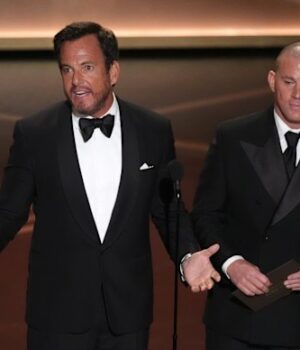
“It’s more than a prompt, it’s an art form that needs to be protected,” said actor Will Arnett on the Oscar stage, to rapturous applause. Arnett was referring to animation, but the energetic response from the audience of 3300 stars, executives, film professionals and their various colleagues and entourages spoke to a much deeper unease in Hollywood.
Yet in many respects, this was a night with few surprises, and no good news for Australia’s nominees. As well as Jacob Elordi’s (Frankenstein) loss to Sean Penn (One Battle After Another), Fiona Crombie (production design for Hamnet), Guido Wolter (visual effects for Sinners), Nick Cave (original song in Train Dreams) and Rose Byrne (actress in a leading role in If I Had Legs I’d Kick You) all came up empty-handed.
Among the winners: KPop Demon Hunters (animated film, original song), Frankenstein (makeup and hairstyling, costume design, production design), Avatar: Fire and Ash (visual effects), Norway’s Sentimental Value (international film), Sinners (best actor, cinematography, original score, original screenplay) and One Battle After Another (best picture, adapted screenplay, film editing, casting). Sinners cinematographer Autumn Durald Arkapaw made history as both the first woman, and woman of colour, to win in her category.
What the Oscars do, of course, is craft extraordinary moments which are etched into pop culture history. Some are not planned, such as the slap heard around the world when Will Smith struck comedian Chris Rock on stage, but many are carefully choreographed.
Dame Shirley Bassey belting out iconic Bond themes. Lady Gaga performing a medley from The Sound of Music in the presence of the film’s beloved star Julie Andrews. And this year, a meta-meeting of fashion empress Anna Wintour and The Devil Wears Prada star Anne Hathaway.
Wintour, the 76-year-old editorial director of Vogue, and the 34-year-old actress presented the costume design and makeup and hairstyling Oscars (both won by Frankenstein), but sizzled in a moment which evoked the enduring cultural power of Wintour’s magazine world, fictionalised (but really, fiction?) in The Devil Wears Prada.
“Thank you, Emily,” Wintour said, intentionally mistaking Hathaway for her co-star Emily Blunt’s character, Emily Charlton. (Hathaway played Andrea Sachs in the film.) A highly anticipated sequel to the film, The Devil Wears Prada 2, will be released in May.
Elsewhere in the telecast, Nicole Kidman and Ewan McGregor presented together to acknowledge the upcoming 25th anniversary of their film Moulin Rouge, and the cast of Bridesmaids – Melissa McCarthy, Kristen Wiig, Rose Byrne, Ellie Kemper and Maya Rudolph – also reunited on the stage to mark the film’s 15th anniversary. Absent: Wendi McLendon-Covey and Rebel Wilson. Also: since when are 15th anniversaries even a thing?
The night was also not without its political moments – though unusually few, given the presently overheated state of geopolitics – as talk show host Jimmy Kimmel, presenting the documentary short and documentary feature Oscars, fired a broadside at the US network CBS, for political interference in its news content.
“We hear a lot about courage at shows like this, but telling a story that could get you killed for telling it is real courage,” Kimmel said. “As you know, there are some countries whose leaders don’t support free speech. I’m not at liberty to say which. Let’s just leave it at North Korea and CBS.”
The traditional “in memoriam” segment of the telecast was long, reflecting a year in which losses in the film industry were deeply felt. The package included acknowledgements of playwright and screenwriter Tom Stoppard, composer Lalo Schifrin, songwriter and lyricist Alan Bergman, and actors Diane Keaton, Catherine O’Hara, Terence Stamp, Sally Kirkland, Claudia Cardinale, Udo Kier, Diane Ladd, Val Kilmer, Robert Duvall and Robert Redford, cinematographer Billy Williams, publicist Nancy Seltzer and fashion designer Giorgio Armani.
Speaking about Rob Reiner and his wife Michele Singer Reiner, who were murdered in their Los Angeles home in December, actor Billy Crystal said: “My friend Rob’s movies will last a lifetime because they’re about what makes us laugh and cry, and what we aspire to be.” (The couple’s son Nick has been charged over their killings.)
After he spoke, Crystal was joined on stage by a group of actors – met with a standing ovation from the audience – who had starred in Reiner’s films, including Cary Elwes, Carol Kane and Mandy Patinkin (The Princess Bride), Meg Ryan (When Harry Met Sally) and Wil Wheaton, Jerry O’Connell and Kiefer Sutherland (Stand By Me).
Rachel McAdams, who starred with Keaton in The Family Stone, fought back tears as she described her friend Diane as “a legend with no end.” And legendary singer (and film star) Barbra Streisand, who spoke of her friendship with Redford, finished her speech by singing the final verse of the song The Way We Were.
The Academy’s 2026 Oscar roster also includes four honorary Oscars, which were announced in November. They were given to choreographer Debbie Allen, production designer Wynn Thomas and actor Tom Cruise, for his “incredible commitment to [the] filmmaking community”. Singer Dolly Parton was given the Jean Hersholt Humanitarian Award for “her unwavering dedication to charitable efforts”.
Want more expert coverage on the world of film? Sign up for our Screening Room newsletter.
 Michael Idato is the culture editor-at-large of The Sydney Morning Herald and The Age.Connect via X or email.