
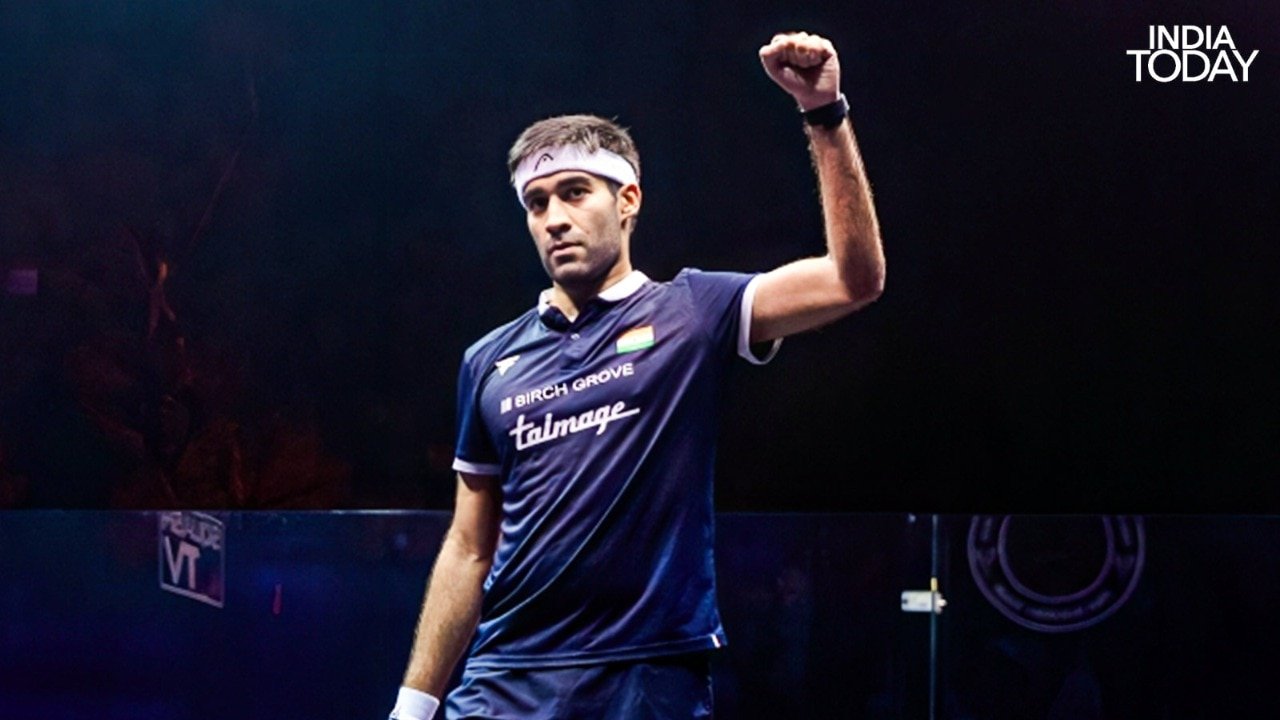
Source : INDIA TODAY NEWS
“I don’t think an athlete ever selects the sport. It’s the sport that selects the athlete.”
When Ramit Tandon said this about being a squash player, there was a beaming smile and a sense of pride in his words. For the 34-year-old, squash came into his life by accompanying his father and watching him play. Today, he is one of India’s finest in the sport, but owes it all to his father for putting that fire in him to take it up as his calling.
advertisement
But even then, the man from Kolkata played squash more for the fun factor than anything else.
“I had the opportunity to play the sport because of my father, otherwise I probably wouldn’t know what squash is, like a lot of people in our country. But after you get exposed to certain things, then at the young age of 5 years, 6 years, it’s not about you selecting it or you choosing to do it. It’s just something that aligns with you. You like it more than other activities, you get into it,” said Ramit to India Today.
“So for me also, the journey was, it wasn’t a thoughtful decision like, ‘oh, I want to be a squash player.’ It was more like, ok this is fun, let me enjoy my time playing squash. While my friends would be playing cricket or football, I would spend my time on the squash courts and slowly that passion turned into a profession.”
Now, Ramit sits at No.38 in the PSA squash tour rankings. He is the second-highest-ranked Indian behind Abhay Singh (World No.27) and one of the stalwarts leading the squash revolution in the country alongside Joshna Chinnappa, Anahat Singh and Velavan Senthilkumar.
But watching Ramit show off his skills inside the squash court was something that almost didn’t happen. In fact, he could have been living a completely different life — one in the world of finance, tackling balance sheets and the ups and downs of the stock market.
FROM CORPORATE CUBICLE TO SQUASH COURT
Ramit’s love for squash made his parents send him from Kolkata to Chennai to train at the Indian Squash Academy. Amid all the training sessions and trials, one thing that never took a backseat for Ramit was his education.
“The directive to focus on studies did come from my parents. Education, you know, I always believe India is a very academic-driven society. Unlike some other countries, where you go to England or the US, there is a place for music, art, sport — it’s given a similar form of respect — but India as a society is more academically driven,” said Ramit.
But despite their strong directive to focus on studies along with squash, Ramit’s parents continued to push him on his journey in sports — something he is grateful for.
“I always say this — on your own, you’re not unique, you’re alone. It’s the team around you that sacrifices dreams for your dream, which is very selfless and not an easy thing to do. As a child you don’t understand that, but growing up you realise what people around you have done for you,” said Ramit.
Ramit went on to excel in his studies and that saw him make his way to Columbia University in New York, where he pursued a BA in Statistics. He was exposed to America’s strong college sports structure at that point, but he never wanted to take things up professionally.
“I just wasn’t comfortable taking on that risk. I was looking at my friends, all of them applying for jobs in finance and different fields and that was the norm.”
“Professional sport is obviously a lot riskier than a secure job where your paycheck is secure month over month and you live a very settled lifestyle. You have a city you call home, you have an office you go to. It’s not like squash where one day I’m in a certain country and the next day I’m in another country.”
“So, at that point when I decided to work in finance, I wasn’t comfortable taking on that risk,” said Ramit.
So the squash dream seemed to have taken a backseat at this point. Ramit joined a hedge fund called Birch Grove Capital in New York as a financial analyst. He worked steadily for a couple of years before the love for squash slowly found its way back into his life.
While he was playing during the weekends, the excitement of being on the court slowly started to triumph over his corporate lifestyle.
“Initially, when you start a new job, the learning curve is extremely steep. So the first year, I was learning something new every day. But over time, you start realising you’re going to repeat the same tasks over and over again for a long period of time. And that is the real world.”
“At the same time I realised that squash, which I had been doing for 15–20 years, still excited me every time I stepped on court. Work I did for one year and I was already feeling bored. So I started realising maybe there is some connection with the sport that I shouldn’t let go of,” said Ramit.
So does he miss the life of being a financial analyst?
“I would say I obviously miss parts of what I used to do. Not necessarily the number crunching in finance, but you miss your friends and the lifestyle you used to live. It’s a completely different life. Wearing a suit and going to the office versus being in shorts running around on a squash court.”
“So there are parts of that world that I enjoy and still follow. I still follow the markets and it’s something I’m interested in. But there are also parts of what I do now that I really enjoy and I’m glad I gave that up to do this,” said Ramit.
SEEING THE OLYMPIC DREAM
While many may say there is a revolution happening in India with squash, Ramit feels it is largely down to the fact that the sport is going to be played in the Olympics. It will be squash’s debut at the Summer Games in Los Angeles in 2028 and the 34-year-old feels that India is riding on this phase.
“We are just in a phase where squash making the Olympics is getting more attention than before. Every generation has had strong players. Before Anahat you had Deepika and Joshna in their prime. Then Sourav Ghoshal, Harinder Pal Sandhu, Mahesh Mangaonkar.”
“India has always been a solid squash-playing country. Maybe not at the very top like Egypt, but consistently among the top five or six. Even today, we have four men in the top 50 and strong women’s players too,” said Ramit.
The World No.38 isn’t getting too ahead of himself like most athletes and is now keeping his focus on the Asian Games 2026. He was part of the bronze medal-winning team in the 2018 edition but missed the last one.
He now enters the JSW Indian Open 2026 looking for redemption.
In squash, the Professional Squash Association (PSA) categorises its World Events into six levels according to prize money and ranking points: Copper, Bronze, Silver, Gold, Platinum and Diamond. Events from Copper to Gold typically feature 24-player draws, while Platinum tournaments include 32 players and Diamond events expand to 48 competitors. The ranking points awarded also increase with each tier, starting from 500 points for Copper titles and going up to 3100 points for Diamond-level victories.
The JSW Indian Open is a Copper event with valuable points up for grabs. Last year, Ramit was the top-ranked Indian player and was within the top 30 in the world. But 2025 wasn’t kind to him as he slipped to 40 in the world and had an unceremonious exit from the competition.
The Indian Open is one tournament that Ramit enjoys a lot and views as a game-changer for the sport. He is also urging for more such events to come to India.
“I think it’s high time India starts hosting more such events. We’ve hosted a lot of smaller tournaments which help at the grassroots level, but bringing top players to India is very important.”
“None of our players growing up had the opportunity at age 8 or 9 to watch the best players in the world because we didn’t host those level events. Now, young kids get to see the best players compete in India. Their goals will go beyond just winning national championships. They’ll want to compete internationally. So it’s very important not just for top players but for the entire squash culture in the country,” said Ramit.
The 34-year-old is someone who is self-critical and realised where he went wrong in a pretty hectic 2025. He maintains that the aim remains to win the crown at the Indian Open in Mumbai, which will be held from March 18–22.
“Last season I realised I got too caught up chasing ranking points and playing too many tournaments. Instead of focusing on solid performances in fewer events, I was competing everywhere. So this year we decided to reduce the tournament load and focus more on quality performances. Last year I went into the Indian Open as the number one seed, this year I’m the number three seed. But if you’re in the top four seeds, you go in wanting to win the tournament. That goal remains the same,” said Ramit.
For the Indian star, all roads lead to the grand stage in LA for the Olympics in two years. While he does his best to keep a straight face and calm down his excitement, the same passion for the sport that made him swap the suit and market data is still clearly visible.
“The Olympics is the biggest sporting event on the planet, so anyone investing time in sport would want to compete there and carry their country’s flag. But at the same time it’s still two and a half years away. I can’t just have the Olympics as my only goal. There are short-term goals that lead to it — Asian Games being the biggest one right now.”
“But if you ask me how I would like to end my squash career, it would probably be by competing at the Olympics,” said Ramit.
– Ends
SOURCE :- TIMES OF INDIA