
Source : the age
The Melbourne International Comedy Festival hits 40 this year, so it feels appropriate to list 40 moments that shaped what has grown to become one of the world’s three largest laugh fests. We’ve also invited some comics to contribute their own favourite memories (40 words or less, please).
1 The birth: Melbourne in the 1970s and ’80s saw an explosion of “comedy cafes” – theatres and bars purveying casual cackles – and by 1987 producers John Pinder and Roger Evans knew the local scene was ready for a dedicated festival.
2 The launch: The inaugural launch was officiated by Melbourne comedy royal Sir Les Patterson (Barry Humphries) and British legend Peter Cook.
3 The veteran: Rod Quantock says he’s “the only stand-up still standing who stood up at the first MICF. The festival’s guest of honour was Peter Cook. (Look him up, young people.) Peter came on one of my bus shows and he grabbed … oops, that’s my 40 words.”
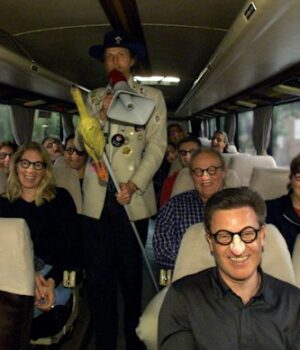
4 The bus: Quantock’s bus tours epitomised the maverick attitude of the early Melbourne comedy scene: punters boarded a vehicle to who knows where, and their host gatecrashed homes, workplaces, restaurants or whatever else caught his eye.
5 The bustout: Festival director Susan Provan remembers the time Anthony Morgan took his audience “from the Lower Town Hall out the front to finish his show because he was running way over. He was just being an idiot and the audience dutifully followed him.”
6 The Mooseheads: Brian McCarthy was 23 when he performed at the first festival, but died the same year in a road accident. His friends later established the memorial trust that has gone on to support some of Australia’s most exciting comedy talent. The Mooseheads (named after McCarthy’s favourite beer) present awards to promising comedians that help them “stretch their creative legs”.
7 The cartoonist: Michael Leunig illustrated the cover of the second MICF guide, and for the next 30 years his distinctive style was associated with the festival.
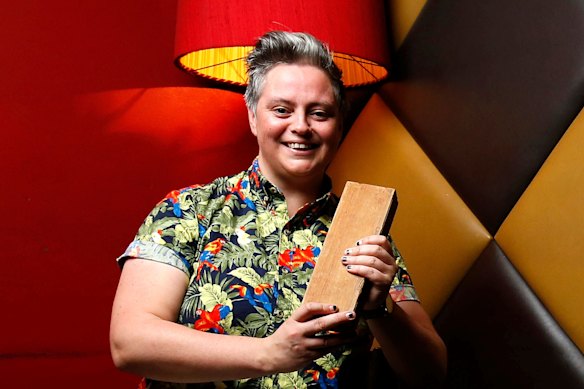
8 The Piece of Wood: The festival began presenting awards in 1998, and comedians decided to get in on the act with the Piece of Wood Award. The hunk of timber is presented to the act other comedians reckon is “doing good stuff n’ that”. Upon acceptance, the winner is expected to bite the thing. Comedy and hygiene have never been good bedfellows.
9 The club: Early mornings have also been a longstanding festival casualty: anyone serious about catching the next big thing will steel themselves for the late-night Festival Club. It’s where top acts try out new material, punters catch themed nights (this year’s include a beauty pageant, lip-sync battle and comics delivering lessons for life) and even big-name acts who aren’t in the program might get up for a tight five.
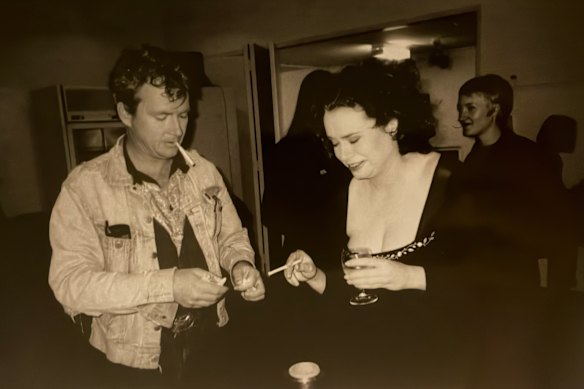
10 The smoke: The days before smoking was banned were a challenge for Susan Provan: “When the Festival Club was in the Lower Town Hall everybody used to crowd in, and the kitchen was the dressing room and everybody would be smoking in there. The ban on smoking inside came in 2004, and I remember that because it was the year my daughter was born. People were smoking all around me, and I just didn’t want to be near them because I was heavily pregnant.”
11 The last laughs: Some comics, including Judith Lucy, have announced their retirement but find it hard to kick the habit. Lano & Woodley have a show in this year’s festival, 20 years after famously breaking up for good. Others have truly had their last laugh: late co-founder Alex Pinder and standup Linda Gibson both have awards named in their memory.
12 The handcuffs: Susan Provan recalls the arrival of Otis Lee Crenshaw: “Linda Gibson did the Late, Loud and Luscious evening show and Rich Hall created his character of Otis Lee Crenshaw to make an appearance. He came in dressed as Otis for the first time, handcuffed to Sue-Ann Post. Linda was freaking out.”
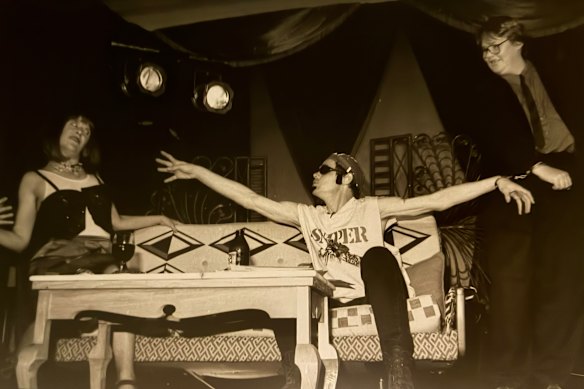
13 The costume: Rich Hall was due to appear on Hey Hey It’s Saturday two hours after arriving in Australia but Qantas lost his luggage. “The costume department gave me polka dot chaps and a purple cowboy hat. I came out on stage and tried to do searing political standup comedy, thinking the audience would laugh at the ridiculousness of the conceit. They actually laughed at the jokes and figured I was a cutting-edge political sniper who just happened to like wearing polka dot chaps.”
14 The trends: The festival has its own fashion cycles. Take the DIY Moment of the late 2000s, when acts like Josie Long, Dmitri Martin and Lawrence Leung somehow wrung serious laughs from craft materials and dinky props. There was the Storytelling Era, in which every show seemed to be an hour-long autobiographical journey, or the Silliness Backlash that responded by running in the other direction from anything resembling a heartfelt lesson.
15 The trailblazers: Some comics seem to come out of nowhere. Acts like Maria Bamford, Daniel Kitson and Dr Brown were all hugely influential on local comedians while also possessing something inimitable.
16 The Boosh: UK duo The Mighty Boosh were virtually unknown when they unleashed their debut show on Melbourne in 2001, but that quickly changed when their brand of absurdism became the word-of-mouth hit of the fest. Those lucky enough to score a ticket were treated to an hour of brilliant sketches, many of which would make their way into the pair’s subsequent TV series.
17 The online influx: In the early 2000s, comedians with massive online followings starting selling out huge venues despite never having performed live. There was a distinct divide between YouTube-famous comics whose virality didn’t translate to a solid hour of yuks, and the many who had developed their craft over decades but didn’t know how to take a selfie.
18 The feeds: That divide shifted with the likes of Aunty Donna: upstarts who knew the comedy scene but were also au fait with editing software. Today’s comics are also expected to be their own media production houses, posting clips and updates across platforms and maintaining a presence in the feeds of fans.
18 The contest: Celia Pacquola first tried her hand at comedy via the festival’s open-mic Raw Comedy contest. Since then, she’s hosted the festival Gala, been nominated for the top award multiple times and become a fixture on Australian TV. She’s not the only household name to have made their debut via Raw: Tom Ballard, Becky Lucas, Rhys Nicholson and more all started out there.
19 The first laugh: Bron Lewis remembers the moment that changed everything: “In 2021 as a 35-year-old mother of three I entered Raw Comedy and found myself on the main stage of the town hall. As soon as I got my first big laugh, I knew life was never going to be the same again. And it hasn’t.”
20 The Deadlies: The festival’s Deadly Funny competition is another way budding comics are introduced to the world. Since 2007 the national contest has been won by the likes of Kevin Kropinyeri, Stephanie Tisdell and Ghenoa Gela, showcasing the Aboriginal and Torres Strait humour and storytelling that has been here for millennia.
21 The winner: Kevin Kropinyeri remembers the “monumental moment” he won the Deadly Funny Grand Final in 2008. “It literally changed my life for the better. It opened doors and I went on to carve a professional career in comedy; 18 years later I am still making people laugh all over Australia and the UK.”
22 The arrival: Janty Blair’s first solo show took place at Melbourne Town Hall in 2025. “In Paul’s Place, named for the doorman who has welcomed patrons for over 17 years. An Aboriginal woman, ready to tell jokes. I walk past him. Into his room. I feel it. Belonging.”
23 The flyers: It wouldn’t be the Melbourne International Comedy Festival without the flyers. It’s a rite of passage to get into the town hall without being swamped by aspiring up-and-comers.
24 The nominees: Those hopefuls are also careful to keep their phones charged on the night awards nominations are announced. The list is traditionally proclaimed in the wee hours at the Festival Club, but the limited capacity means many wannabe Best Newcomers can be spotted desperately refreshing their feeds in the long queue outside.
25 The People’s Choice Award: For a long time after its launch in 2010, it might just as well have been called the Award for Most Popular Wil Anderson, who earned the prize for five of its first six years. Recent years have seen the field open up, however, and with four wins under her belt, Urzila Carlson might well steal the crown someday.
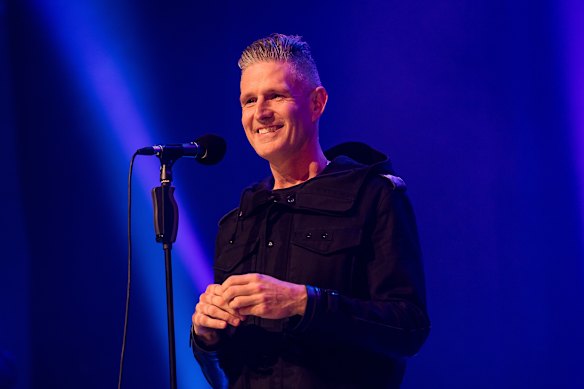
26 The support act: “My first comedy festival experience was as the support act for [Canadian legends] Corky and The Juice Pigs at the Prince Pat Hotel,” recalls Wil Anderson. “Every night they would set me a challenge: for example, fall over 10 times and never mention that it was happening. They would sit up the back each night and laugh either with or at me.”
27 The milestone: Anyone who has ever braved the streets of Melbourne in April will know that MICF is big, but it was in 2010 that the festival became Australia’s largest cultural event, with more than half a million attendances.
28 The punter: The festival’s size has led to the Funny Tonne Award, given to the punter who sees the most shows. Inaugural 2005 winner Nick Taras managed 147, but that’s nothing compared to the 178 that Sarah Trevarthen caught just two years later.
29 The next step: In 2022 Sam Campbell became the third Australian to win the world’s top comedy award at Edinburgh, after Hannah Gadsby and Sam Simmons. All three had previously scored Best Show awards at MICF.
30 The Barrys: For a long time the festival’s awards were called the Barrys, but in 2019 were renamed the Melbourne International Comedy Awards. The name change wasn’t entirely due to the anti-trans comments made that year by its old namesake Barry Humphries, but organisers said those statements “definitely played a part”.
31 The split: 2008 was the first and last time the Barry was split between two acts, Kristen Schaal and Nina Conti. This was also the last time the judging panel had an even number of members.
32 The departure: Another comedy stalwart to fall from grace was Michael Leunig, whose later work included tirades against marriage equality and anti-vaccination screeds. In 2019, he was replaced as long-time program illustrator, though the festival declined to comment on the decision.
33 The cultural shift: “You can’t say anything any more” is the bigot’s lament, but exactly what you can’t say is a moving target. A low point came in the early 2010s, when Jim Jeffries told an interviewer “You can’t do jokes about black people or Asian people, but you can do a rape joke onstage now and there’s not a problem.” Jeffries has also long complained that MICF never invites him to the festival, but for a few years other comics followed his poor example.
34 The sensation: Hannah Gadsby’s Nanette first saw light in the Lower Town Hall, but went on to become a worldwide sensation, making its creator a household name, and challenging other comedians to question their craft.
35 The #MeToo moment: Australian comedy didn’t have the same overt #MeToo moment felt elsewhere, but in private it had an impact, as comics, bookers and venue managers with bad reputations found themselves losing work and friends.
36 The way home: The festival’s Light the Way Home program now offers women, non-binary and other vulnerable performers free Uber rides home after gigs.
37 The unity: Aaron Chen remembers the year Ronny Chieng “won an award the same year as (South Korean ensemble) The Ongals. His speech involved getting everyone to chant ‘Asians!’ over and over again. For one night at the Festival Club, Asians set aside geopolitics and united as one.”
38 The diversity: Melbourne’s cultural diversity has long been reflected in the spread of festival venues, from the Chinese Museum to The Greek to Hofbrauhaus Melbourne. The festival roster matches that range with shows both non-English and bilingual acts. The 2026 festival includes Taiwanese comics performing in Mandarin (Fourplay from Taiwan), Prashasti Singh presenting English and Hindi versions of her show and Ben Richardson teaching his audience “bogan” Auslan.
39 The broom-closet venues: Has there been a cupboard, storeroom, attic or basement in the CBD that hasn’t contained someone with a mic at some point?
40 The discoveries: Glenn Robbins remembers sitting in an audience “of about 30 people” when he saw “a young comedian from the UK with orange hair. I think it was in the same room a couple of years later (with fewer people) I saw another young comedian from Singapore. Both hilarious and so memorable. One was Ross Noble, the other was Ronny Chieng. Every festival has a Ross and a Ronny just waiting to be found.”
The Melbourne International Comedy Festival runs from March 25 to April 19; comedyfestival.com.au. The Age is a festival partner.


