
SOURCE :- THE AGE NEWS
Beirut: Israeli leaders see a chance to wipe out an old enemy with every jet they send over Lebanon.
With every missile, however, they bring more carnage to civilians.
The targets are meant to be the Hezbollah fighters who have fired rockets into northern Israel to show their support for Iran.
But Israel’s target list has expanded to include financial agencies that are linked to Hezbollah and lend money to families, helping the militant group maintain community support.
Those killed include a Maronite priest, Father Pierre al-Rai, who died on Monday when struck by Israeli tank fire in his community in southern Lebanon.
The attacks appear to be intensifying as Israeli leaders seek to destroy Hezbollah after decades of conflict, calculating that the war on Iran will weaken the Iranian regime’s capacity to support its Shiite Muslim allies.
Hezbollah is said to be changing strategy in the expectation of an Israeli land invasion, according to a Reuters report that cited four individuals aware of the militant group’s plan to move towards “guerrilla” fighting.
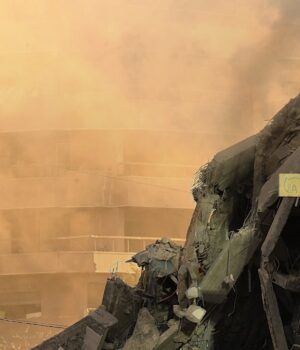
This masthead witnessed IDF strikes in the Dahiyeh district in the southern suburbs of Beirut and on the southern city of Tyre, known in Arabic as Sour.
Israel blames Hezbollah for starting the latest violence when the group fired at targets in northern Israel last Monday.
The death toll since then has climbed to 570, according to the Lebanese government, while another 1444 people have been wounded.
The United Nations warned on Tuesday morning in Beirut (late on Tuesday, AEDT) that the number of people displaced from their homes had swollen by 100,000 in a single day to reach 667,000 who were formally registered as displaced.
Many have moved to stay with family or sought other options, while 120,000 are in government-provided accommodation.
“I have seen first-hand over the past week how this volatile situation and displacement also trigger fear and emotional trauma,” said Karolina Lindholm Billing, representative of the UN High Commissioner for Refugees in Lebanon.
“Children and adults alike, including many older people, are in shock and fear.”
In Israel, the nation’s military said two soldiers were killed in the fighting in southern Lebanon. As well, 11 civilians have been killed since the war on Iran began on February 28, most from an Iranian missile strike on Beit Shemesh near Jerusalem on March 1.
Aiming to destroy Hezbollah’s financial foundations, the Israel Defence Forces struck at least six of the financial offices in recent days.
The institution, known as al-Qard al-Hassan, provides loans in exchange for gold or other assets outside the standard banking system.
Lebanese newspaper L’Orient-Le Jour reported that the Israeli army issued an evacuation order on Monday night for a district in the southern city of Sidon, known in Arabic as Saida, and issued a map showing the building to be hit. The IDF then struck the al-Qard al-Hassan offices in the Aqabiyeh district.
While the strikes are targeted to inflict the greatest damage on Hezbollah and its personnel, the civilian casualties are mounting.
Iranians targeted, civilians in the firing line
In a drone strike in Beirut on Sunday, the IDF killed five people it said were senior commanders of Iran’s Quds Force – the international arm of the Revolutionary Guard. On Tuesday, Iran released a statement describing the attack as a “cowardly terrorist assassination of four diplomats”.
Local authorities said the strike also wounded 10 civilians.
Meanwhile, the Lebanese national news agency reported on Tuesday that eight family members were killed in an airstrike on Namiriyeh, including a father and mother, their son, three daughters and two grandchildren.
Israeli Prime Minister Benjamin Netanyahu has called on the Lebanese government to disarm Hezbollah or face more IDF strikes.
Netanyahu’s demand highlights the challenge for Lebanese President Joseph Aoun in halting Hezbollah when the group operates its own militia and community services – including the loan offices – and cannot be controlled by the Lebanese Armed Forces.
Aoun blamed Hezbollah for launching missiles against Israel on March 2 and triggering the airstrikes in response.
“Whoever launched those missiles wanted to bring about the collapse of the Lebanese state, plunging it into aggression and chaos … all for the sake of the Iranian regime’s calculations,” he said on Monday.
Aoun has not, however, been able to neutralise Hezbollah as a fighting force.
While Lebanese Prime Minister Nawaf Salam said last week the government would ban Hezbollah’s military activities, the group continues to operate in its strongholds among the Shiite Muslim population. This includes Dahiyeh in southern Beirut, the Bekaa Valley in the east of the country and large parts of southern Lebanon.
Hezbollah has, however, been weakened by the pressure on the Iranian regime, which has sent money and arms to its allies in Lebanon over many decades.
The fall of the Syrian regime of Bashar al-Assad, a supporter of Hezbollah over his 24-year rule, also weakened the group.
Syrian President Ahmed al-Sharaa, who fought Hezbollah during his time as an Islamist fighter before gaining control of the country, has emerged as an ally of the Lebanese government in its bid to control the armed militia within its own borders.
“We stand alongside Lebanese President Joseph Aoun in disarming Hezbollah,” Sharaa said during a video conference with Aoun and European officials on Monday.
Get a note directly from our foreign correspondents on what’s making headlines around the world. Sign up for our weekly What in the World newsletter.
 David Crowe is Europe correspondent for The Sydney Morning Herald and The Age.Connect via X or email.
 Kate Geraghty is the chief photojournalist at The Sydney Morning Herald. She has won multiple awards including the Gold Walkley in 2017.Connect via email.