
SOURCE :- THE AGE NEWS
Welcome to our live coverage of the United States and Israel’s war on Iran. Here’s the latest from the Middle East.
- Mojtaba Khamenei, the son of the late supreme leader Ali Khamenei, has been named Iran’s new leader. US President Donald Trump was unhappy with the appointment, according to Fox News. Israel has previously pledged to kill any new leader who threatens the US or Israel, or oppresses the Iranian people.
- Global sharemarkets have tumbled as the price of oil soared as high as $US114 ($162) a barrel and Iranian forces continue to limit oil tanker shipments through the Strait of Hormuz. The ASX closed down 2.85 per cent.
- The United Nations estimates the death toll in Iran has surpassed 1300. In Lebanon more than 300 people have been killed in Israeli strikes, the country’s health minister said. In Israel at least 12 have been killed and seven US military personnel have died in the conflict. At least six Palestinians have been killed by the Israeli military in recent days.
- Australia could help Gulf states protect themselves from Iranian attacks, but Australian troops won’t participate in a ground offensive, Foreign Minister Penny Wong said.
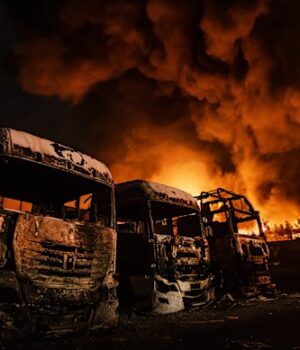
- The Israeli military said it struck and “destroyed” the headquarters of Iran’s air force in Tehran. Israeli and American airstrikes also hit key fuel depots in Tehran.
Welcome to our rolling coverage of the United States’ and Israel’s war on Iran. This live blog is now closed, but our coverage is continuing here.
- Mojtaba Khamenei, son of the late supreme leader Ali Khamenei, has been named Iran’s new leader. US President Donald Trump was unhappy with the appointment, and said he wouldn’t last long. An Israeli official previously pledged to kill any new leader who threatened the US or Israel. Iranian state TV also referred to Khamenei as being wounded in the war when announcing him as the new leader.
- Global sharemarkets have tumbled as the price of oil soared to $US116 (before settling just over $US100), and Iranian forces continue to limit shipments through the Strait of Hormuz.
- The ASX closed down 2.85 per cent after suffering its worst day in 11 months as $80 billion was wiped off the index.
- The United Nations estimates the death toll in Iran has passed 1300. In Lebanon, more than 300 people have been killed in Israeli strikes, the country’s health minister said. In Israel at least 13 have been killed and seven US military personnel have died in the conflict. At least six Palestinians have been killed by Israelis in recent days.
- As long as Iran is attacked by Israel and the US, there is no sense in talking about a ceasefire or “anything but defence and retaliation”, the Islamic Republic’s foreign affairs spokesman, Esmaeil Baghaei, said, according to a Reuters report.
- Australia could help Gulf states protect themselves from Iranian attacks, but Australian troops will not participate in a ground offensive, Foreign Minister Penny Wong said.
- The Israeli military said it had struck and destroyed the headquarters of Iran’s air force in Tehran. Israeli and American airstrikes hit key fuel depots in Tehran.
A man in his 40s has been killed by an Iranian missile strike in central Israel, emergency service Magen David Adom said on X.
The death comes after an 8.08pm (AEDT) alert by the Israel Defence Forces on Telegram warned that an Iranian missile strike had been detected heading for Israeli territory and that the public should “enter a protected space”. That warning came just 12 minutes after the IDF said it was safe for sheltering Israelis to leave bunkers.
This is believed to be the 13th Israeli death in the war. Some 1300 Iranians have died, according the UN, and more than 300 people have been killed in Israeli strikes in Lebanon, according the Lebanese health minister.
Israeli troops have continued to bombard Iran. Soldiers also raided areas in southern Lebanon “to locate and eliminate terrorists and dismantle Hezbollah’s infrastructure”, the IDF said.
As long as Iran is attacked by Israel and the US, there is no sense in talking about a ceasefire or “anything but defence and retaliation”, the Islamic Republic’s foreign affairs spokesman, Esmaeil Baghaei, said, according to a Reuters report.
Israeli, American and Iranian forces have given no clear indication of how long the war may last. US President Donald Trump initially said it may last five or six weeks but could last longer, and later said wars could be fought forever.
Israeli Prime Minister Benjamin Netanyahu told Fox News the war could be “quick and decisive” but also “may take some time, but it’s not going to take years”.
Aluminium hit the highest in almost four years before erasing gains, as escalating hostilities in the Middle East worsened the supply outlook from the region, while copper and other industrial metals fell on falling risk appetite.
The metal rose as much as 2.8 per cent to $US3544 a ton in London, the highest since March 2022, then eased to trade about $US100 lower. The cash to three-month aluminum spread closed at $US47.40 a ton on Friday, also the highest since 2022, in a sign that immediately available supplies are tight.
Aluminium had climbed almost 10 per cent last week as the war curtailed shipments from the Persian Gulf, which accounts for about 9 per cent of global supply. Buyers in the US were rushing to secure alternative cargoes from Asia after at least two major smelters in the Middle East – one in Qatar and another in Bahrain — were forced to suspend deliveries.
A prolonged war would hurt aluminum supplies further, said Gao Yin, an analyst at Shuohe Asset Management. Many people are buying aluminium and selling other industrial metals in the near term, she added.
Bloomberg
The Liberal Party has not considered reviving its failed election policy of halving the fuel excise, despite surging oil prices forcing up the cost at petrol stations.
Halving the fuel excise from 50¢ a litre to 25¢ a litre was a core election policy of the Liberals under Peter Dutton, and was shelved after the party’s disastrous election result last year.
Despite prices increasing at the bowser as the price of oil surpasses US$100 a barrel and the Nationals indicating they want the policy revisited, opposition defence spokesperson James Patterson said the party had not looked into it and it was the Albanese government’s responsibility to ease the financial burden on Australians.
“Are they contemplating any cuts temporary or otherwise to the fuel excise?” Patterson asked. “Only they have the levers available to them to do that.”
Oil prices have soared while sharemarkets have skidded on fears that the escalating war on Iran will squeeze energy supplies and hamstring industries around the world.
The following are actions that Asian governments are taking or plan to take to reduce the impact of the war on their economies.
South Korea plans fuel cap
South Korean President Lee Jae Myung said authorities would cap domestic fuel prices for the first time in nearly 30 years. The country will also look for sources of energy beyond supplies shipped via the Strait of Hormuz, and a 100 trillion won ($95.6 billion) market-stabilisation program should be expanded if needed, he added.
Indonesia to increase fuel subsidies
Indonesia will increase the amount it has allocated for fuel subsidies in its state budget, its finance minister said.
The country has budgeted 381.3 trillion rupiah ($32 billion) for energy subsidies and to compensate state firm Pertamina and utility company PLN for their efforts to keep some fuel prices and electricity tariffs at an affordable level.
China asks refiners to suspend fuel exports
China has asked refiners to halt signing new contracts to export fuel and to try to cancel shipments already committed, sources with knowledge of the matter said last week.
The guidance did not apply to jet fuel refuelling for international flights, bonded bunkering or supplies to Hong Kong or Macau, they said.
Japan tells national oil reserve site to prepare for release
The Japanese government instructed a national oil reserve storage site to prepare for a possible release of crude, Akira Nagatsuma, a member of the Centrist Reform Alliance opposition party said.
Details such as the timing of the release remained unclear, Nagatsuma said.
Bangladesh to close all universities
Bangladesh is closing all universities from Monday, bringing forward the Eid al-Fitr holidays as part of emergency measures to conserve electricity and fuel.
Vietnam to remove fuel import tariffs
Vietnam is planning to remove import tariffs on fuels to ensure supplies amid disruptions, the government said, adding that the measure is expected to last until the end of April.
Reuters
The European Union’s oil and gas supply co-ordination groups will meet on Thursday to monitor security of energy reserves, as the war on Iran sent oil prices surging to above US$100 a barrel.
The groups will monitor the energy impact of the conflict and EU countries’ latest assessments of their oil supplies. EU countries are required to hold oil stocks covering 90 days’ worth of consumption.
Australia holds 47 days’ worth of reserves, as of February 12.
Group of Seven finance ministers will have an emergency meeting on Monday to discuss plans to release petroleum from reserves in an attempt to rein in the surging oil prices, The Finanacial Times reported.
With AP
Iran’s new leader, Mojtaba Khamenei, 56, is a hardline official who largely operated in the shadows of his father and is expected to govern in a similar way, casting doubt over claims the war will lead to regime change.
Like his father, Khamenei is also a cleric. Bloomberg reports that he has an investment empire extending to the Gulf and Europe, and is close to the Islamic Revolutionary Guard Corps.
His appointment also goes against a longstanding belief that Iran should not be run by dynasties.
But Iran was not always run by ayatollahs.
How did Iran get here? What is behind the enmity between it and America? Who are the ayatollahs? And what is Iran’s Revolutionary Guard Corps?
For a deep dive on the country’s modern history and details on the regime’s operations, read the full explainer.
China’s Foreign Ministry said Mojtaba Khamenei’s appointment today as Iran’s new supreme leader is in accordance with the country’s constitution.
This appears to be in opposition to the view of the US and Israel. US President Donald Trump is unhappy with the appointment and said Khamenei “is not going to last long”, a comment also made by an Israeli official last week.
China is trying to balance its relationship with Iran – an ally and key trade partner – with protecting its investments in the region and cultivating a relationship with the United States.
Beijing has repeatedly called for an end to the war, and has billions of dollars on the line due to its trade relations with Iran and other countries in the Middle East.
Today Foreign Minister Wang Yi said he hoped 2026 would be a landmark year for the superpowers’ relationship and that despite differences “the two heads of state have personally maintained good exchanges at the highest level”, AP reported.
On a day of panic on the Australian sharemarket, turmoil has also spread to interest rates on government debt, creating a fresh headache for Treasurer Jim Chalmers.
Interest rates on 10-year Australian government bonds climbed above 5 per cent for a short period before retreating to 4.973 per cent.
Before the war, the interest rate was around 4.6 per cent.
A lift in interest rates will hurt the federal budget, with interest payments already one of the government’s fastest-growing expenses. This financial year, the government is forecasting it will spend $25.5 billion in interest on almost $1 trillion in gross debt.
In the mid-year budget update, Treasury warned that a lift in interest rates would “lead to a deterioration in the underlying cash balance”, which would mean an increase in total government debt.
Chalmers said the Council of Financial Regulators, which is made up of Treasury, the Reserve Bank, ASIC and APRA, is meeting daily to discuss the situation.
“We are continuing to closely monitor the economic impacts of the conflict in the Middle East,” he said.
“We’re already seeing the impact of hostilities on global equity, commodity, debt and currency markets and we are not immune from all this volatility.”
Read the full story here.