
SOURCE :- THE AGE NEWS
March 10, 2026 — 12:37pm
Behind the bellicose language, the Trump administration is reassuring markets that the Iran war will end “very soon”. Overnight, oil prices soared to nearly $US120 ($170) per barrel, their highest since Russia’s re-invasion of Ukraine in February 2022, then dropped back toward $US90. It’s a sign that the Third Gulf War hasn’t caused an energy crisis – yet.
Seen in context, there is more energy capacity today than during the Russian attacks of 2022, when the prices of oil, gas, electricity and coal spiked all at once. Supplies today aren’t being hit with that four-punch combination. The season matters, too. Northern Europe has moved out of the most bitterly cold phase of winter while the Asian summer is still months away. Liquefied natural gas, which is needed for power generation to meet peak electricity loads, isn’t under extreme pressure yet. Even the temporary increase in crude oil to more than $US100 a barrel is less than the record high of $US145.29 set in July 2008.
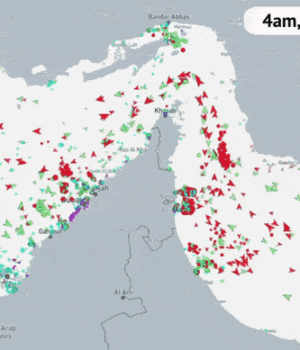
US President Donald Trump has a limited time to end the war – perhaps a week at most – and his objectives are likely to be limited as well. The time limits derive from the situation in the Strait of Hormuz, through which 20 per cent of the world’s crude and refined petroleum passes. The largest oil tankers – known as very large crude carriers – need to pass through the strait to access the Persian Gulf refineries. Storage capacity there is limited, and a production shutdown would harm the global economy.
It’s an open question how successful Trump will be in the long term, but for now, the Iranian military has been mauled; it lacks an effective air force and navy, and it is preoccupied with internal problems.
The US has sunk several Iranian naval assets. The air force, hampered by years-long sanctions, has been sending into combat its ageing aircraft, such as 30-year-old Russian-made subsonic jets, with half the speed of the F-35 aircraft, and Vietnam-era F-4 and F-5 fighters.
Iran’s leaders will need US support for foreign currency and investment to rebuild key infrastructure – support that will be subject to peace negotiations. The US would be satisfied, at least for now, with its elimination of a core group of around 2000 to 3000 Islamic Revolutionary Guard Corps leaders, and their replacement with a new generation of commanders born in the 1960s and 1970s. These new leaders may, the US hopes, be willing to subordinate their foreign and defence policies to US objectives to retain control of their network of lucrative business enterprises. If they aren’t, the US and Israel can and will inflict more damage on them later this year.
The late senator and presidential candidate, John McCain, once sang “Bomb, bomb, bomb, bomb, bomb Iran” – a parody of a Beach Boys song – during his 2008 election campaign. Trump’s language is different – even more colourful, more abusive, more transgressive – more everything. But he is making potent that which was latent in US goals.
Regardless, it isn’t helpful to parse each and every utterance for an indication of his intentions. It is more helpful to think of him and his Secretary of War, Pete Hegseth, as politicians playing ultra-masculine characters from professional wrestling who can say anything, act deceitfully, go against laws and rules, and be outrageous, even mischievously cruel. It’s all part of the culture they embrace and that embraces them. Trump voters in 2024 were less racially and ethnically diverse, older and less likely to have a four-year college degree than those who voted for Kamala Harris. They aren’t turned off by the aesthetics of wrestling, Trump’s visceral language or his over-the-top bragging. To the contrary, some even feel a frisson of glee at the discomfiture of their political opponents.
Behind the aesthetics lies a calculating policy team that knows its appetite for risk and stays on the right side of it. Damage to Iran and its network of allies isn’t a problem for the Trump administration. If it can’t achieve divide and rule immediately, divide and ruin will do for now.
Professor Clinton Fernandes is in the Future Operations Research Group at UNSW. His latest book is Turbulence: Australian Foreign Policy in the Trump Era.
The Opinion newsletter is a weekly wrap of views that will challenge, champion and inform your own. Sign up here.
 Professor Clinton Fernandes is part of University of NSW’s Future Operations Research Group which the threats, risks and opportunities that military forces will face in the future. He is a former intelligence officer in the Australian Army.