
SOURCE :- THE AGE NEWS
Beirut: Thousands of families have fled their homes in Lebanon after Israeli forces warned them of a wave of bombing to target Hezbollah groups, in another escalation of the wider war against Iran.
The alert spread panic through the Dahiyeh area of southern Beirut, forcing people to move north to escape the attacks and search for places to stay, choking highways and overloading shelters.
Airstrikes were heard over Beirut hours later and Israeli Finance Minister Bezalel Smotrich said the conflict would make the southern parts of the city look like another Gaza Strip.
The war on Iran spread into Lebanon on Monday when Hezbollah members launched rocket and drone attacks on Israel in a show of support for the Iranian regime, and then continued the attacks on Tuesday.
The Israel Defence Forces sent troops into Lebanon on Tuesday to try to assert control of the border, while also launching airstrikes.
The mass evacuation on Thursday and subsequent airstrikes have sharply increased the conflict amid political tensions in Lebanon over Hezbollah and growing fears of a long war.
As the airstrikes were underway, French President Emmanuel Macron said on X that he had spoken to Israeli Prime Minister Benjamin Netanyahu and Lebanese leaders to seek a halt to the conflict, saying France would assist the Lebanese government in bringing Hezbollah under control.
Families sought safety in Martyrs’ Square – in the historic centre of Beirut – without knowing if or when they could return to their homes, most of them resigned to sleeping in the square.
A group of Syrian women sat with their children near al-Amin Mosque after walking from the Dahiyeh area.
“It took four or five hours to walk here because of the little children,” said Najah, 27, a mother of five, when this masthead spoke to people in the square.
Another member of the group, Hajar, 25, said they were neighbours who walked together as soon as they heard the Israeli alert and discovered there was no transport available.
While the Dahiyeh is a largely Shiite area, those fleeing include Sunni Muslims such as Rizk Hamza, 42, a mechanic who was in Martyrs’ Square with his wife and four children.
“There’s no difference between what’s happening to us and what happened in Gaza,” he told this masthead.
“This is the result of savage attacks, which were done in Gaza and are now done here.”
Israeli military spokesman Avichay Adraee issued the warning at 2.50pm on Thursday (11.50pm, AEDT) to tell people to leave the area, with messages on social media giving people maps to show them where to move north.
“Save your lives, evacuate your homes immediately,” he posted on X.
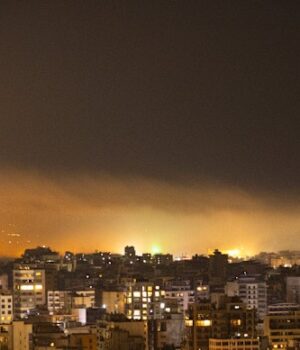
An Israeli strike was reported on social media at 9.16pm (Beirut time) and this was followed by a series of explosions in the southern part of the city over the subsequent hours.
Smotrich, the finance minister and a far-right member of the Israeli government, issued a statement on video that spoke of destroying the Dahiyeh area so that it looked like Khan Younis, a part of Gaza where buildings have been reduced to rubble.
“You wanted to bring hell on us, we are bringing hell on you,” he said on the video from northern Israel, near the border with Lebanon.
The chaos in Lebanon came as parts of central Israel came under attack from Iran, with Israeli forces saying missile fragments and parts of a cluster bomb warhead had fallen on some areas.
The death toll from the strikes on Lebanon this week has increased to 123, according to the Lebanese Health Ministry. This does not include any deaths from the Thursday night strikes.
The Hezbollah attacks on Israel caught some of its own allies by surprise and deepened concerns in Lebanon about the group’s tactics and the threat to the civilian population when Israel responds.
Reuters reported this week that the Hezbollah attacks had strained the group’s ties with Parliament Speaker Nabih Berri, a Shiite politician who has been aligned with the group for many years.
Berri felt he had been “fooled” by Hezbollah because he had been led to expect it would not attack, Reuters reported, citing four political figures who spoke on condition they were not named.
Lebanese Prime Minister Nawaf Salam said on Monday the government would ban Hezbollah’s military activities because of the attacks, but the group has supporters within the government who reject this move.
Macron spoke to leaders in Lebanon on Thursday and declared the Lebanese government was preparing to take control of positions held by Hezbollah.
“Hezbollah must immediately cease its fire towards Israel. Israel must refrain from any ground operations or large-scale actions in Lebanese territory,” he said.
Macron said France would send armoured transport vehicles as well as operational and logistical assistance to Lebanon to assist the government, and he also outlined plans to send medicine and other humanitarian aid.
“At this time of great danger, I call on the prime minister of Israel not to expand the war into Lebanon,” he said.
“I also call on the Iranian leadership not to involve Lebanon further in a war that is not its own.
“Hezbollah must lay down its arms, respect the national interest, prove that it is not a militia acting on behalf of foreign entities, and allow the Lebanese to unite in order to defend their country.”
Get a note directly from our foreign correspondents on what’s making headlines around the world. Sign up for our weekly What in the World newsletter.
 David Crowe is Europe correspondent for The Sydney Morning Herald and The Age.Connect via X or email.

