
SOURCE :- THE AGE NEWS
March 6, 2026 — 11:45am
One day Donald Trump will die, and many evangelical Christians will mourn him. I will think of Alex Pretti and Renee Good, both shot dead by US immigration agents. I will think of Trump’s evisceration of US AID, of immigrant families torn apart and of 160 little girls who went to school in Iran this week and never came home. And I will think Trump’s mourners are very misguided to pray for such a dreadful president. But that will be in their mega-churches and Bible-study groups, and it will be their business.
One day Benjamin Netanyahu will die, and some Jewish people will say Kaddish for him, and I will think of the dead children of Kibbutz Be’eri who he didn’t protect on October 7, 2023, and the thousands of Gazan children he bombed, and I will think they are very misguided to waste prayers on such a leader. But that will be in their synagogues and shuls, and it will be their business.
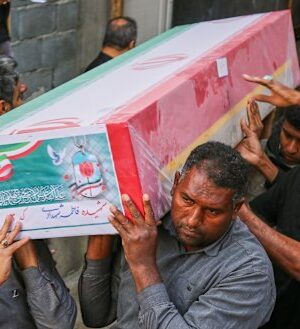
This week, Ayatollah Ali Khamenei died, and a handful of Australian Shiites mourned him. I think of the terrorism he has sponsored and the citizens he has shot, tortured, oppressed and impoverished, and I think they are very misguided. But that was in their husseiniyas and their masjids, and that is their business.
If anyone wondered if our free speech rights have lately become imperilled, the rush of politicians seeking to prosecute people over which dead leader they may pray for offers a depressing answer.
Not even a year after Australians went to the polls and roundly rejected the politics of division, all sides seem in a mighty rush to take sides.
The prime minister calls for social cohesion and then invites a surpassingly controversial head of state, Israel’s Isaac Herzog, to Australia. The NSW premier puts draconian restrictions on protests against that visit then appears ready to excuse police roughing up Muslim men at prayer. Pauline Hanson makes an unspeakably racist statement about Muslims, and the Coalition declines to support a censure motion against her.
And all major parties rushed to side with the United States in a war of choice, one completely absent legal sanction – either domestic, from the US Congress, or international, from the United Nations.
This proclivity of ours for jumping into every foxhole America chooses to dig has made poor sense for Australia even in the years when the US was a robust democracy, a reliable ally and an adherent to international law. It makes far less sense now, when none of those things are currently true.
How little we have learnt. In September 1987, I left Sydney to take up the role of Middle East correspondent for The Wall Street Journal and the first major story I covered was the closure of the Strait of Hormuz. Almost 40 years later, here we are again. Here we are, still. Multiple wars, hundreds of thousands dead, and I cannot point to a single thing in the region that is better than it was in 1987. No strategic stability. No flourishing new democracies. No improvement in human rights.
The US supported Saddam Hussein in those days. The US ambassador looked me in the eyes across her desk in Baghdad and told me: “Saddam is a guy we can work with.” He had invaded Iran and was in the middle of a charnel house of a war that lasted eight years and killed over half a million people.
During that war, Israel and the US provided Iraq with targeting information for missiles that flattened Iranian cities such as Khorramshahr. I walked through debris of that ghost town, and through residential neighbourhoods in Tehran where those missiles had reduced homes to rubble. Iran had no missile program of its own in those days, and no way to answer the attacks. Ayatollah Khomeini, founder of the Islamic Republic of Iran, was forced to seek a ceasefire. An emboldened Saddam went on to invade Kuwait and that “guy we can work with” wound up at the end of a very expensive (lives, treasure) American noose.
No one wanted a nuclear-armed Iran. After tough, skilled diplomacy by the Obama administration and European allies, the Joint Comprehensive Plan of Action appeared to be working. The only party dissatisfied with the nuclear deal was Netanyahu, who interfered in US domestic politics to undermine it and to work for Trump’s re-election.
Trump boasted that he had “obliterated” Iran’s nuclear program after the 12-day war last year. Faced with plummeting domestic popularity and rising clamour over what his administration is hiding in the Epstein files, he moved the goalposts to justify this new onslaught. He declared that Iran must give up its missiles program. The very missile program that America’s tragically misguided Iraq policy provoked.
Iran is an ancient culture with a vibrant young population, two-thirds of whom were born since the Iranian revolution. Many of them could have left to seek more freedom and prosperity. Instead, they have stayed, to fight for the heart and soul of their culture. They risk their lives in the streets, but also in the creation of art and music, literature and film of surpassing humanistic beauty. They deserve better than the ayatollahs. And they deserve better than an illegal war waged by a felonious, feckless president with no plan for what follows.
Rise up, he says. The last time I heard a US president say those words, Iraqi Shiites and Kurds listened. They rose in the south and the north of Iraq, and were slaughtered in the thousands, while George H.W. Bush played golf.
Geraldine Brooks is a Pulitzer Prize-winning author and journalist.
Get a note direct from our foreign correspondents on what’s making headlines around the world. Sign up for the weekly What in the World newsletter here.


