Source : ABC NEWS
As the conflict in the Middle East casts a shadow over the Asian Cup tournament, the Iranian women’s soccer team has shown a subtle but strong act of resistance against the Islamic Republic.
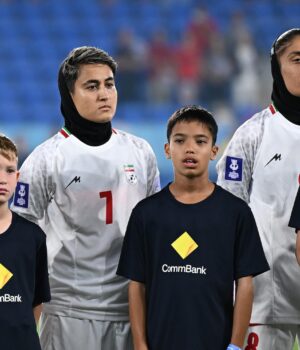
They stayed silent during the country’s national anthem at their Asian Cup game against South Korea on Monday night.
Footage from the match on the Gold Coast showed several members of the Iranian squad staring ahead, not singing, as the anthem played.
Team Melli’s coach, Marziyeh Jafari, was seen subtly smiling.
Loading…
“Most of them had a smile on their face,” said spectator Kimia Minoo, who lives on the Gold Coast and attended the match to cheer the players on.
“They didn’t sing the song — even the coach, and they did it with confidence. They were not scared and not stressed.”
Ms Minoo moved from Iran to Australia in July 2023, shortly after the Women, Life, Freedom movement was sparked by the death in custody of Mahsa Jina Amini.
She said Iran’s regime was sensitive about such symbolic gestures.
“It’s an act of resistance,” she said.
“They [the regime] threaten their [the athletes’] families [to not speak out].
“But they [the athletes] have done it now; it shows they’re not scared anymore.”

Iran will play Australia on the Gold Coast on Thursday. (Getty Images: James Worsfold)
Ms Minoo said there were other small gestures from the players.
“At the middle of the match, they didn’t put their scarf back on for a few minutes and we called for them and cheered,” she said.
“We felt they were doing a good thing.”
She said they were chanting for the collapse of Iran’s regime, which is at war with the United States and Israel.
In strikes over the weekend, several of Iran’s military, intelligence and security leaders were killed, including supreme leader Ali Khamenei.
At the match, Ms Minoo and her friends were also chanting for the return of Iran’s exiled crown prince Reza Pahlavi, who wants to return to Iran and help change the theocratic system in operation since 1979.
“They [the players] couldn’t react to it, but when the match finished, one of the athletes waved at us,” she said.
While soccer is not strictly a political event, journalists covering the Asian World Cup tournament have been asking players about the latest political turmoil in Iran.
Despite the conflict back home escalating, Iran’s team remains in the tournament and is scheduled to face Australia on Thursday night.
The attendance of Iran also brought focus back to how the Islamic Republic has treated its athletes over 47 years, especially female ones, who face severe restrictions on and off the field.
Iranian athletes face strict dress code
When Ava* was a child, she dreamed of being a professional swimmer.
But in the Islamic Republic of Iran, women are forbidden from participating in the sport internationally due to the strict enforcement of sharia-compliant dress codes that are incompatible with competitive swimwear.
The law mandates that women cover their hair with a headscarf and their arms and legs with loose clothing.
“They [Iran’s rulers] are getting involved in my personal life — things that have nothing to do with them is in their control,” Ava told ABC News in Farsi.
“I have lost my dreams and hopes because of living under this regime. I lost out on everything.”
When asked how female Iranian athletes such as those participating in the Women’s Asian Cup handled such restrictions, Ava said it was difficult.
“There’s pressure on them too,” she said.
Ever since the 1979 revolution, when Islamic law was introduced to govern every aspect of Iranian women’s lives, competing on the world stage has been a tricky affair.
Mandatory hijab laws require girls to cover their hair and entire bodies from age nine.
Since they cannot appear publicly in swimsuits in front of men, Iranian women have not competed internationally at mainstream sporting events such as swimming, gymnastics and water polo.
FIFA lifted its ban on the hijab in 2014.
“This regime has politicised everything,” Ava said.
“This is what a totalitarian regime does to its people.”
Loading
She thinks the mandatory dress code can put Iranian players at a disadvantage.
At the very least, Ava argues, “Full clothing coverage can be very annoying when you’re playing sports.”
But beyond the discomfort, Ava’s issue is with Iran’s Islamist rulers controlling what women do on and off the field.
“Which other female football player faces conflict with their government in this way?” she asked rhetorically.
Ava said the regime also would not let its female athletes speak freely, “unless one of them is brave and willing to give up their life to fight the regime”.
She said there were some players who quit before tournaments in solidarity with protesters in Iran, but it was dangerous for them to do so in the wake of the government’s crackdown on demonstrations that swept the country in late December and early January.
And now, following the death of Ayatollah Khamenei and the developing war in the Middle East, there is greater uncertainty.
How ‘gender apartheid’ in Iran ‘crushes Iranian women’s lives’
In 2025, the US-based Center for Human Rights in Iran argued “gender apartheid” was “crushing” Iranian women’s lives and futures, including on the soccer field.
“For the past four decades, Iranian authorities have banned girls and women from sports events in stadiums — arresting, beating, and imprisoning those who defy the ban,” the report noted.
The report states that women and girls in Iran are subject to a system of male guardianship that restricts their rights throughout their lives.
Iranian women must, by law, wear a head covering from age nine. (Reuters: Morteza Nikoubazi)
Before marriage, girls remain under the legal authority of their father or another male relative.
This is the case even after they turn 18. After marriage, the husband assumes many of these legal controls.
This means that female athletes require the permission of their husband to travel abroad to compete in major sporting events.
They also face significant restrictions on social activities, while those who promote compulsory hijabs can receive financial and moral government support.
ABC News could not speak to the Team Melli players before the Asian Cup.
Their interviews are closely watched by Iran’s rulers, but the ABC did approach the world governing body for football, FIFA, as well as the Asian Football Confederation (AFC).
Neither responded to repeated requests for comment before the tournament, though the AFC has since provided this statement:
“We are in close and regular contact with the IR Iran women’s national team and officials on the Gold Coast, and are offering our full support and assistance.
“The AFC will continue to assess the situation carefully in the best interests of all concerned, guided at all times by the wellbeing of the players and the spirit of unity that defines the AFC Women’s Asian Cup.”
When the team arrived in Australia, Iranian-born Sydney councillor Tina Kordrostami told the federal parliamentary joint committee on intelligence and security that people with links to the Islamic Revolutionary Guard Corps (IRGC) might have entered Australia as part of the team’s delegation.
The IRGC is listed as a terrorist organisation in Australia.
“This creates an impossible situation,” Ms Kordrostami told the committee.
“On one hand, we open our doors to sport, cultural exchange and people-to-people diplomacy.
“On the other, we risk inadvertently enabling networks that operate in the shadow of a listed or soon-to-be-listed entity.
“This is not about athletes. This is about the ecosystem that travels with state delegations from authoritarian regimes.”
Player potential ‘not achieved’
FIFA has long drawn criticism for facilitating gender inequality by allowing Iran’s rulers to prevent women from attending football and other sports in the country’s stadiums, as well as not doing enough to speak out against the regime’s human rights abuses of athletes.
Roya Boroumand, executive director of the Washington-based Abdorrahman Boroumand Center, which works to promote human rights and democracy in Iran, believes Iranian athletes “are at a disadvantage athletically” because of the dress code.
“Even though Iranian women try to use every space possible and make the best of what is allowed, their potential is not achieved,” she told ABC News.
She said Iranian female athletes’ fear of the regime was “pervasive” and had been elevated in the wake of the regime’s violence against protesters earlier this year.
While the regime put the death toll from the protests at about 3,000, US-based Human Rights Activists News Agency estimated more than 7,000 people were killed by the regime in response — including 226 children — while more than 53,000 people were arrested.
But some said the death toll was likely higher, including a group of doctors in Iran that reported the number of people killed could have exceeded 30,000 in two days of protests alone.
Numerous media outlets published X-rays, acquired from doctors in Iran, showing protesters shot in the face, chest and genitals.
Loading Instagram content
Dr Boroumand said after years of brutality against anyone who spoke out, Iranian athletes had learned to self-censor.
According to London-based Persian language broadcaster Iran International, Iran’s rulers stepped up their crackdown on women footballers after two players — Zahra Alizadeh and Kosar Kamali — resigned in protest over the regime’s actions earlier this year.
Both players, the media report said, had posted their resignations on their Instagram page but deleted the posts soon afterwards for fear of repercussions from the regime.
A miniature scene shows Iranian fans participating in the Women, Life, Freedom protests. (Getty Images: Allen J. Schaben)
The media report also quoted sources suggesting that security forces had used threats against players’ families and relatives, contract deductions, and exclusion from team training.
It said Iran’s authorities had also sought to pressure athletes by offering incentives to some individuals to monitor their teammates.
Concern for footballers’ wellbeing
In response to the reports, FIFPRO Asia/Oceania, the union for professional footballers of Asia and Oceania, expressed concern for athletes.
Before the weekend air strikes by the US and Israel, president Beau Busch told ABC News his organisation had engaged with human rights groups to better understand the situation in Iran.
“We hold significant concerns for the wellbeing of footballers in the country who have exercised their right to peaceful protest,” he said.
“These concerns reflect a broader pattern of repression in the country. We have expressed those concerns to FIFA and the AFC and have called on them to exercise their leverage to protect all players who may be at risk.”
The reports came after a long history of protests by Iranian citizens regarding restrictions on women attending sporting events.
Women have occasionally been allowed to enter stadiums in Iran to watch sporting events. (AP: Vahid Salemi/File photo)
In September 2019, Sahar Khodayari, a female football fan known as the “Blue Girl” after her favourite team’s colour, was sentenced to prison for attempting to enter a stadium.
In protest, she set herself on fire outside Tehran’s Revolutionary Court and later died in a hospital.
She was one in a long line of women who have faced “arrests, beatings, detention and abuses” for trying to enter football stadiums, leading to Human Rights Watch calling on FIFA to end the “discriminatory ban” in 2022.
Following international pressure, particularly from FIFA, Iran’s authorities have occasionally allowed a limited number of women into stadiums to attend events, but the Center for Human Rights said “this remains an exception rather than the rule”.
Can a human rights lens be applied to the Asian Cup?
The pressure on global sporting governing bodies continues to build.
In 2022, the death in custody of Iranian Kurdish woman Mahsa Jina Amini sparked nationwide and global Women, Life, Freedom protests.
At the time, Iranian activists called on FIFA to kick Iran out of the World Cup due to concerns over human rights violations.
The beating and death of Jina (Mahsa) Amini ignited a wave of protests that spread across Iran earlier this year. (Getty Images: Omer Messinger)
Iranian American journalist and activist Masih Alinejad, with the cooperation of international lawyers, submitted a formal request to FIFA calling out the regime’s violent crackdown.
The letter noted that the regime had for decades “stifled the voices of several athletes in the country and impeded their rights to speak up in the face of the evil”.
Catherine Ordway, from UNSW in Canberra, who specialises in sport integrity issues, said international sport organisations and federations “have a positive obligation to speak out on human rights issues — and particularly where governments are targeting athletes because of their platforms of influence”.
“It is certainly difficult to navigate for sport organisations where there are competing or conflicting positions, but where we have seen governments breach international human rights standards and abuse and kill their citizens, including athletes, then all institutions, including sport organisations, must step up and call out these crimes against humanity,” she said.
Dr Ordway noted previous “horrific examples” of human rights abuses by the Islamic Republic against athletes.
This includes what Amnesty International in 2020 reported as the “secret execution” of 27-year-old wrestling champion Navid Afkari, without prior notice to him, his family or lawyer and “after a grossly unfair trial”.
Dr Ordway said in the context of the current women’s football Asian Cup, “FIFA also carries a legacy of gender exclusion which remains challenging to surmount.”
“Not only were women effectively banned from playing football in numerous countries, most infamously in the UK in 1921, and more recently in Nigeria, [but] in many other nations across Asia, women’s sport, and women’s football is not fully accepted or recognised,” she said.
But FIFA, Dr Ordway said, “has a human rights framework, which must be applied to the Asian Cup”.
Taking subtle aim at regime
While there are cases of Iranian athletes engaging in acts of defiance on the world stage, they are often forced to protect themselves from regime retribution by later claiming such actions were unintentional.
Because of the limitations, athletes often take more subtle aim at the regime.
The Iran men’s team lines up for the national anthem before a 2022 World Cup match. (Reuters: Marko Djurica)
Iran’s male soccer team was heavily criticised on social media for not ditching the World Cup during the Women, Life, Freedom protests in 2022, but showed its support by remaining silent when the national anthem was played at Qatar’s Khalifa International Stadium at the beginning of their match.
Dr Boroumand said it was hard to predict what Iran’s female soccer players would do while in Australia.
“It must be very difficult for these women athletes to represent their country when their state has no legitimacy and has committed mass killings and turned the country into a bloodbath,” she said.
“It must be extremely hard for them to take any pride in representing the government they are representing.
“At the same time, there is a lot of pride to represent the people.”
*Ava’s name has been changed to protect her safety.
Loading…