
SOURCE :- THE AGE NEWS
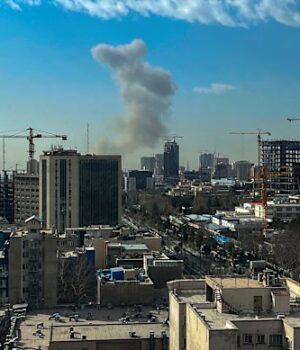
Israel and the US attacked Iran in a joint military strike on Saturday, killing the country’s Supreme Leader Ayatollah Ali Khamenei and attacking targets in Tehran and other major cities.
In retaliation, Iran launched waves of missiles at Israel and a number of other countries in the region with US military interests.
Iranian state TV confirmed Khamenei’s death in the early hours of Sunday morning, hours after it was initially reported by Israeli media and declared on social media by US President Donald Trump.
Khamenei’s Tehran compound was targeted in the initial wave of strikes as Trump issued a call on social media to Iranians to “take back your Country”.
Iran launched counter-attacks, firing drones and missiles at Israel and strikes aimed at US military installations in Bahrain, Kuwait and Qatar. The exchanges of fire continued into Saturday night.
Iranian state media, citing the Red Crescent, said on Saturday evening that at least 201 people had been killed and more than 700 injured.
How did we get here?
Israel fought a 12-day war with Iran last year, culminating in a major US attack on Iran’s key nuclear facilities that Donald Trump said had resulted in “obliteration” of Tehran’s nuclear program.
A series of protests triggered by a currency crisis and cost-of-living concerns then engulfed Iran in January, prompting a violent backlash from the Islamic regime. One US-based human rights group, HRANA, suggested more than 7000 people may have been killed in government reprisals.
The suppression of the protests triggered an intervention from Trump, who told Iranians that “help is on the way” and warned Tehran that the US would intervene if protesters were killed. It was reported in late January that the president had been presented with an expanded list of potential military options aimed at doing further damage to Iran’s nuclear and missile facilities.
Trump then suggested in February that regime change in Tehran “would be the best thing that could happen” and announced he would send a second aircraft carrier to the region.
The countries resumed talks over the nuclear issue, with the US and Israel reportedly demanding that Iran also stop developing ballistic missiles and end support for regional proxy forces such as Hezbollah in Lebanon, Hamas in Gaza, and the Houthi rebels in Yemen.
As a backdrop to this, Washington’s huge military build-up continued, with dozens of warplanes and refuelling tankers heading to regional bases alongside the carrier battle groups.
Why have Israel and the US attacked Iran?
Trump repeatedly suggested in recent weeks that military action was an option unless Iran agreed to his demands to completely end its nuclear program.
A day before the strikes, Trump said he was “not happy” with the progress of talks with Iran’s leaders, as he insisted the regime “cannot have nuclear weapons”.
Trump, posting on his Truth Social platform, said the objective of the strikes was to “defend the American people by eliminating imminent threats from the Iranian regime, a vicious group of very hard, terrible people”.
Trump urged Iranians to “take over your government”, telling them: “The hour of your freedom is at hand.”
What did the strikes target?
Iranian media reported strikes nationwide, from the capital Tehran to cities including Isfahan, Qom, Karaj, and Kermanshah.
Israel’s military said it had targeted a gathering of senior Iranian officials in the opening strikes. It later said that several of Iran’s most senior military leaders had been killed, including General. Mohammad Pakpour, the chief of the Revolutionary Guard, the most powerful force in Iran; the Defence Minister Aziz Nasrizadeh; and Ali Shamkhani, former head of the Iranian navy and a close adviser to Khamenei.
Trump said US forces would target Iran’s nuclear sites, its missile industry, its navy and its terrorist proxies.
Has Iran retaliated?
Constant missile salvos from Iran sent people in central Israel in and out of shelters throughout the day on Saturday. Israeli media reported that one person was killed in a strike on Tel Aviv, and Israel’s ambulance service said 21 people had been injured.
Saudi Arabia, Qatar, the United Arab Emirates, Kuwait and Bahrain – all of which host US troops – also reported Iranian attacks, most of which they seemed to repel.
Al Udeid Air Base in Qatar, Al Salem Air Base in Kuwait, Al Dhafra Air Base in the United Arab Emirates, and the US Fifth Fleet base in Bahrain were targeted by Iranian missile attacks, Fars news agency said, citing the Islamic Revolutionary Guard Corps.
In Dubai, local authorities said four people were injured in a fire at Palm Jumeirah, the man-made island famous for its luxury hotels, resorts and attractions. A luxury hotel was hit by parts of a missile that was either intercepted or knocked off its trajectory.
Saudi Arabia said it intercepted Iranian missiles over its capital, Riyadh, and the eastern region, where most of the kingdom’s oil fields are located.
On Sunday, following confirmation of the death of Khamenei, Iran’s paramilitary Revolutionary Guard threatened to launch its “most intense offensive operation” ever, targeting Israel and US bases.
Qatar’s Defence Ministry says its military shot down several missiles before they reached its airspace.
Loud booms were also heard in parts of Abu Dhabi, according to five witnesses, including two Reuters correspondents.
How long will the conflict last?
Trump described the strikes as a “major combat operation”.
In the US, the power to formally declare war rests solely with Congress, which had not authorised the action.
“No president was willing to do what I am willing to tonight,” Trump said.
A US official told The New York Times the campaign could last several days, representing a far more forceful effort than America’s bombing of Iranian nuclear facilities in June last year.
Trump acknowledged that the US “may have casualties” as a result of the operation. He said General Dan Caine, chairman of the Joint Chiefs of Staff, had warned him that American troops could be killed or injured in a war with Iran.
Israel’s military detected ballistic missiles launched from Iran in response to the attack. American bases and embassies in the region were also on high alert, amid expectations that Tehran and its network of proxy paramilitary forces would strike at US interests.
What is Iran’s nuclear weapons capability?
Iran does not yet have a nuclear weapon, but as analysts from the Council on Foreign Relations wrote this month, the regime has “a long history of engaging in secret nuclear weapons research in violation of its international commitments”.
In May last year, the International Atomic Energy Agency reported that Iran’s cache of near-weapons-grade enriched uranium had increased by 50 per cent in three months. The US and Israel launched strikes targeting Iran’s key nuclear facilities shortly after that.
Why have there been protests in Iran recently?
In late December, protests erupted across Iran, which were initially sparked by economic grievances, with the country’s plunging currency causing skyrocketing inflation.
The protests spread rapidly and morphed into a widespread anti-government push, but the movement ended in January after the regime cut off internet access and authorised violence against those taking to the streets. Human rights activists feared the death toll would top 10,000.
How has the conflict affected flights around the world?
Israel, Iran and Iraq closed their airspace as the airstrikes began.
Israel’s Ministry of Transport said the country closed its airspace and asked citizens to stay away from airports.
It added that it will alert passengers 24 hours before flights can resume.
Virgin Australia partner Qatar Airways has announced “the temporary suspension of its flights to, and from, Doha” due to the closure of Qatari airspace.
“Once usual operations resume, we anticipate delays to our flight schedule,” the airline said.
Qatar, through partner Virgin Australia, provides about 70 flights a week from Australia’s capital cities to Europe and the Middle East through its major hub in Doha.
Dubai-based Emirates has said the conflict has disrupted several of its flights thanks to the closure of the Persian Gulf region’s airspace.
“We apologise to customers affected by disruptions for any inconvenience caused, and we are assisting them with rebooking, refunds, or alternative travel arrangements,” said the airline, which operates 77 weekly services between Australian capital cities and Dubai.
Singapore Airlines, meanwhile, cancelled flights from Singapore to Dubai and Jeddah, in Saudi Arabia.
Germany’s Lufthansa is suspending flights to and from Tel Aviv in Israel, Beirut in Lebanon, and Oman until March 7 following the strikes on Iran, a company spokesperson said.
What has been the global reaction?
Prime Minister Anthony Albanese was among the first foreign leaders to weigh in on the attack.
He said Australia “stands with the brave people of Iran in their struggle against oppression”.
“We support the United States acting to prevent Iran from obtaining a nuclear weapon and to prevent Iran continuing to threaten international peace and security,” Albanese added.
“It has long been recognised that Iran’s nuclear program is a threat to global peace. The international community has been clear that the Iranian regime can never be allowed to develop a nuclear weapon.”
With Chris Zappone, AP, Reuters
Read more on the US-Israel-Iran conflict:
 Tom Minear – Tom is the state topic editor of The Age.

