Source :- THE AGE NEWS
The family of Australia’s most decorated Winter Paralympian is among those stranded in terminals in the Middle East, where one person has been killed and several others injured inside Abu Dhabi and Qatar’s international airports as Iran continues its missile strikes in the region.
The wife and two children of six-time Paralympian Michael Milton, who were due to fly from Doha to Venice, have described the terrifying moment they received emergency warnings to stay inside, while still on the plane.
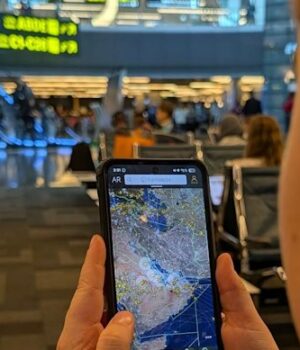
Matilda Milton watches the plane tracker in Doha airport after being stranded there.Credit: Penni Milton
Milton’s wife Penni was looking out the window when she noticed the flight begin to circle over Kuwait.
“The plane banked to the right, and I thought ‘that’s weird’ … So I turned on the flight tracker, and we started doing circles,” she said. “It was about 45 minutes of circling before the pilot came on the mic and said ‘Iraqi airspace is closed, we’re going back to Doha’.”
Without internet connection on the plane, Penni and her children – Angus, 17, and Matilda, 19 – couldn’t figure out what was going on.
“Flying with my two kids, I was a bit like ‘this can’t be good’. And of course, there’s been stuff in the news about America – Donald Trump threatening to bomb the shit out of people. So I was thinking, that wouldn’t be good.”
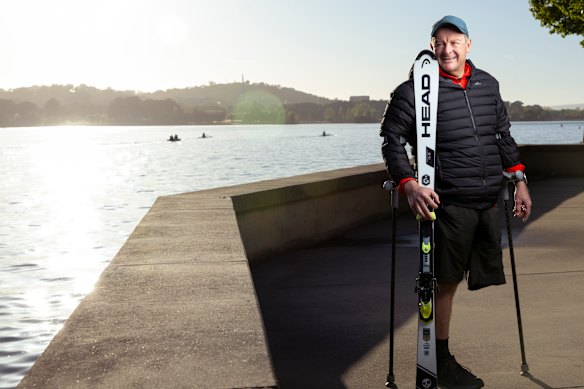
Three-time cancer survivor and Paralympian Michael Milton.Credit: Dominic Lorrimer
Once the plane returned to Doha, emergency alerts started pinging on travellers’ phones across the aircraft, with messages written in Arabic. They read: “Stay at home, stay inside, don’t go out except in emergency situations and wait until the danger has passed.”
“It was confusing at first because it’s not something that we’re used to, and because they were in Arabic so [it] was obviously something scary,” she said.
“I’m thinking ‘sitting in an airplane on a tarmac in a major international airport is probably not a good place to be’,” she said. “People were pretty concerned and pretty keen to get off the plane.”
The effect the conflict has had on global aviation has so far been dramatic, grounding thousands of flights, forcing passengers to take cover at airports, and throwing route networks into disarray. Airlines have cancelled nearly 2000 flights since the hostilities began on Saturday (AEDT).
An Asian national was killed, and seven people were injured at Abu Dhabi’s Zayed International Airport in the UAE, Abu Dhabi Airports reported on X. Emirates media office reported four people were injured during an “incident” at Dubai’s international airport as Iran launches retaliatory strikes.
“All the alerts just keep going off, and they go off on a fairly regular basis,” Penni said from Doha airport. “I haven’t worked out whether they coincide with missiles or whether they’re just random.”
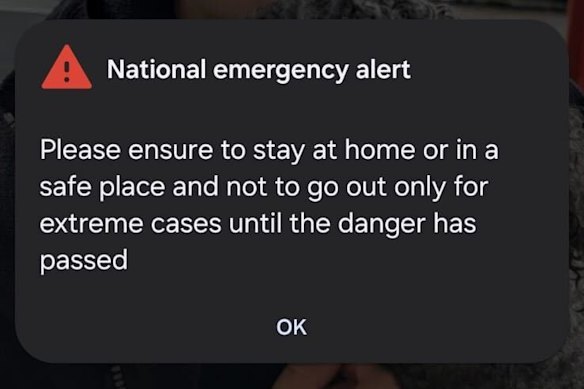
One of the alerts the Miltons received in Doha airport. The first were only in Arabic. Credit: Penni Milton
The Miltons were supposed to spend a night in Venice with Michael before he would travel to the Athlete’s village in Cortina. They haven’t seen him since mid-January because of his training schedule and injury rehabilitation, but have had to abandon that plan and instead spend a second night in Doha airport with no end in sight.
Milton has won 11 medals, including six gold medals, across six Paralympic Games. He won Australia’s first-ever Winter Paralympic gold medal in 1992, before later becoming the fourth Australian to compete at a Summer and Winter Paralympics at Beijing in 2008 in para-cycling.
Angus and Matilda were too young to watch Milton compete in his first six Paralympic Games, and having them travel to Italy to watch was a major factor in deciding to make his Paralympic comeback, 20 years on. It was also a significant financial load on the family and Michael, who has self-funded his return to the Games.
“I’m sure there’s lots of people in the same boat who have lives planned and this just interrupts the good times they have planned, and they’re definitely not having good times at the moment,” he said from Cortina. “It’s tough to have, for example, accommodation paid for in Venice tonight that they can’t use … It’s really a situation nothing anybody can do to change.”
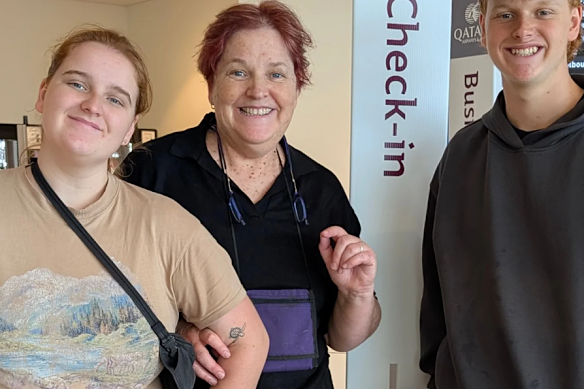
Matilda, Penni and Angus Milton before embarking on the flight to Doha. Their connecting flight to Venice turned around.Credit: Penni Milton
Penni and the kids have spent two nights sleeping on the floor of Doha airport. There are queues for food and spots near power points.
“Hopefully, a hotel, a shower and a sleep in a bed, but I’m not counting those chickens until they’re hatched,” Penni said of what’s next.
“We can’t do anything, we can’t go anywhere until the airspace opens.”
Impacts and warnings for Australian travellers
For travellers, Iran’s willingness to strike civilian infrastructure in response to the US-Israel bombings adds new concern.
“The fact that Iran fired missiles against hotels and the airport in Dubai kind of raises the stakes,” said Justin Wastnage from Griffith University’s Institute for Tourism. “The full impact depends on how long the conflict takes,” he said.
On Saturday, nearly 1000 flights of approximately 4200 flights scheduled to arrive in Middle Eastern countries were cancelled, data from Cirium shows. Adding in scheduled departures, the total number of cancellations exceeded 1800 flights in a day.
“Some flights already en route today were diverted,” said Juliette Alpha. “Most of those were from Middle Eastern carriers. A few non-Middle Eastern airlines had already departed at the time of the military action today.” Emirates cancelled 108 of 269 scheduled flights. Etihad cancelled 80 of 191 scheduled flights. Qatar cancelled 174 of 304 flights.
In Australia, Virgin and Qatar have cancelled flights and urged customers to consult the Australian government for travel advice. Four Virgin Australia flights operated by Qatar Airways made midair U-turns back to Australia on Saturday evening due to the closure of Qatari airspace.
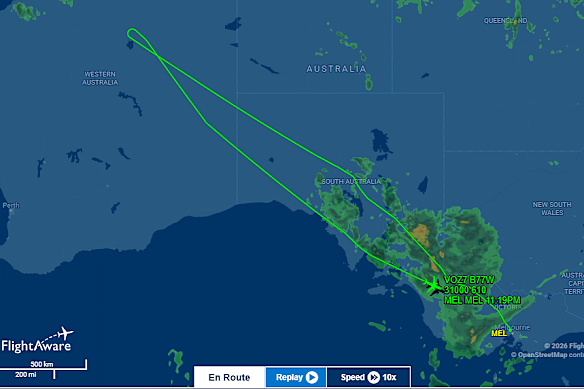
Virgin flight VA7 to Doha, on a Qatar Airways plane, was one of four flights from Australia turned around on Saturday night.Credit: Flightaware
“Guests scheduled to travel on Virgin Australia services between Australia and Doha in the coming days are advised to closely monitor their flight information and visit the Smartraveller website for the latest travel advice,” said a spokesperson for the airline.
Another seven Virgin and Qatar flights were cancelled on Sunday. Qantas has advised that there is currently “no impact” to its flights, “including flights between Singapore and London”. However, the airline was “closely monitoring the evolving situation” and could adjust flights in the near future.
The longer-term impact on Australian aviation, which – like other markets – has grown reliant on transiting through Gulf state airspace for trips to and from Europe, is uncertain.
So far, there had been no major backlash by passengers against Middle East carriers, in part because passengers understand the situation the Middle East is in, said one Australia-based source with direct knowledge of the sector. Yet, hostilities “escalated so quickly” that it will likely “be in the back of minds of customers,” he said.
“What is the next kind of reassurance and communication an airline can give to passengers, who next time would probably consider taking a different route to avoid the Middle East”.
“At the same time, if the price is right, people will still book, knowing the potential for such risks,” he said, noting that it was particularly true for the “visiting friends and relatives” segment of tourism. Some travel insurance policies offer coverage for certain types of force majeure events, which are incidents that impact travel but are out of the control of the travel operator. Most travel insurers exclude acts of war, however, from trip cancellation coverage.
In part for this reason, Australian Travel Industry Association CEO Dean Long said: “Our message to travellers is simple: one, do not cancel arrangements without first seeking professional advice; two, unless you are travelling in the next 48 hours and have not been contacted, please hold off contacting your travel agent right now to allow them to support those currently caught up in the conflict who are stranded, delayed, or dealing with cancellations.
“The situation is evolving rapidly, and experienced travel professionals are best placed to provide up-to-date guidance tailored to each traveller’s circumstances,” Long said.
Adelaide-based Complex Travel Group founder Mark Trim expressed hope that the current conflict would run its course similar to the hostilities in June, which only impacted aviation for several days before going back to normal.
“No doubt this feels a bit more serious though, and perhaps could stretch to a week or two”.
Trim said that generally, tourists like the Middle East route “given the majority of Australian travellers travel through the region to onward destinations.
“Australians are resilient travellers and, for the most part, quite balanced in their decision-making, but at this stage it’s too early to tell if there will be any long-term impact,” Trim said.