Source : the age
The breadth and depth of Lorraine Bayly’s working life – stage actress, soap opera matriarch, TV Week cover star – is almost too much to encapsulate into a sound bite.
But in the annals of cultural history, the one role she will forever be associated with is that of Grace Sullivan, the indefatigable, dependable wife of Dave, and mother of John, Tom, Terry and Kitty in The Sullivans.
That show, which premiered on November 15, 1976, and marks its 50th anniversary later this year, was an institution on Australian television in the late 1970s and early 1980s, and turned Bayly, who has died, aged 89, into one of Australia’s biggest TV stars.
There would be other performances, many of them luminous. On the stage, Willy Loman’s wife Linda in the Ensemble Theatre’s 1997 production of Arthur Miller’s Death of a Salesman at the Sydney Opera House. The play Calendar Girls (2010), with Rhonda Burchmore, Cornelia Frances and Jean Kittson. And the 2015 national tour of The Sound of Music.
And on television, one of the original presenters of Play School, from 1966 to 1978, with John Hamblin, John Waters, and Anne Haddy. The Man From Snowy River and the miniseries 1915 (both 1982) and the 1920s period drama Carson’s Law (1982-1984), as progressive lawyer Jennifer Carson, an often under-credited performance in a show that was much greater than reviewers of the day acknowledged.
But at the heart of Lorraine Bayly’s story is the woman she saw reflected in the mirror, when she was seated in the make-up chair on the set of The Sullivans: Grace Sullivan, the matriarch of a World War II-era Australian family living in the suburbs of Melbourne in the 1940s.
In an interview to mark the show’s 40th anniversary in November 2016, Bayly said she based the smaller character notes of Grace Sullivan on her own mother.
“She had a fantastic sense of humour, yet she could be quite serious,” Bayly said. “Grace’s hairstyle was my mother’s hairstyle, how she used to wear it when she was young. And little mannerisms that she had, attitudes that she had, I wanted the sense of humour to be there, but also the strength and severity.”
The Sullivans, produced by Crawford Productions, the studio founded by the legendary Hector and Dorothy Crawford, was in many ways the story of Australia. The country’s coming of age, but also its loss of innocence.
Though it was set in the 1940s, it was produced in the late 1970s, in the long shadow of the Vietnam War, which was at the time still a contentious topic – the Australian lives it had touched often left to wrestle with grief, pain and loss in silence.
As Grace sent each of her sons off to fight, the emotional impact of those stories elevated The Sullivans from mere a soap opera to cultural institution, a twice-a-week soap which became a crucible through which we explored the complex relationship between the natural ease of Australian life, and the burden of war, pressed upon us often by forces outside our national control.
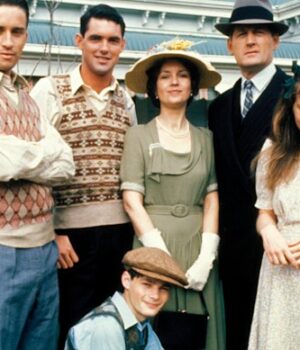
Grace’s family wrestled with duty and sacrifice. Eldest son John (Andrew McFarlane) was opposed to the conflict but eventually joined the medical corps. Middle son Tom (Steven Tandy) served in North Africa, Greece, Crete, the Netherlands and Malaya.
Youngest son Terry (Richard Morgan), meanwhile, dreamed of the air force, had to settle for the army, served and was ultimately imprisoned in Singapore’s infamous Changi prison. And daughter Kitty (Susan Hannaford), later a nurse, lost her husband, a war correspondent who was struggling with battlefield trauma, to suicide.
Through it all, however, Grace Sullivan was propelled by sheer force of will, a reflection of every indestructible Aussie mum, and an always graceful presence who met joy and heartache with both humour and humanity.
Until, of course, Grace herself was cut down, in a season cliffhanger that shocked Australia. Landing in London, in July 1944, Grace was killed when a German V-1 flying bomb struck her son John’s flat. After 598 of The Sullivans′ 1114 episodes, Grace was gone in an explosion of masonry and a fade to black that pierced the nation’s heart.
In television history, you can count on one hand the episodes which have that kind of impact. Later, in 1985, the country watched in tears as leukaemia claimed Molly Jones (Anne Tenney) in A Country Practice. And in 2005, our hearts were ripped in two when Frankie’s (Claudia Karvan) daughter Lou (Alex Cook) died suddenly.
Fame is a strange thing. And television is a peculiar medium. “The most intimate of mediums,” the celebrated writer and director Aaron Sorkin once said. “It’s in your bedroom; it’s in your living room. It’s a member of the family.”
That intimacy is the reason why the character of Grace Sullivan endures so deeply in Australian culture, and the reason why news of the death of Lorraine Bayly leaves us all – every one who looked at Grace Sullivan and saw, somehow, a reflection of their own mother on the television screen – with such a heavy heart.
Find out the next TV, streaming series and movies to add to your must-sees. Get The Watchlist delivered every Thursday.
 Michael Idato is the culture editor-at-large of The Sydney Morning Herald and The Age.Connect via X or email.