
source : the age
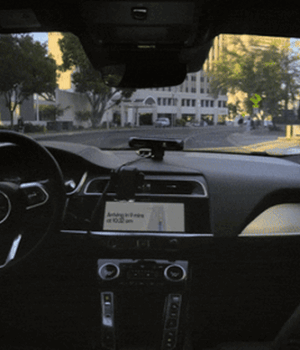
Abu Dhabi: I’m sitting behind the driver’s seat in Uber’s self-driving taxi in Abu-Dhabi, watching the steering wheel spin by itself as the car accelerates and pulls away from the kerb.
As the robo-taxi reaches a set of traffic lights, it slows down and comes to a stop and the indicator flicks on automatically before we turn a corner.
The experience is surreal, but if Uber’s planned deployment of self-driving taxis goes to plan, it is going to become increasingly common.
The ride-share giant already operates self-driving taxis, also known as autonomous vehicles, in several cities in the United States and the Middle East.
By the end of this year, Uber expects them to be available in 15 cities worldwide, including London and Zurich, with 1200 self-driving taxis set to be deployed across the Middle East alone this year.
Australia is in Uber’s sights, but the government is still developing the regulatory framework with limited deployment of self-driving cars potentially available from 2027.
Uber is not the only operator jostling for position, with Google’s parent company, Alphabet, getting ready to bring its Waymo self-driving taxis to Australian roads and Tesla’s “supervised self-driving” cars already able to follow routes from start to finish, handle intersections, change lanes, and respond to traffic lights.
Sarfraz Maredia, Uber’s head of autonomous mobility and delivery, joins me for my trip in Uber’s robo-taxi in Abu Dhabi and says he wants this experience to feel unremarkable.
“The technology has come so far that what would have felt like science fiction in the past very quickly feels like any other trip,” he says.
An Uber robo-taxi pulls up to the kerb, pauses in front of us, and then silently drives off.
Have we just been rejected by a robot? Turns out it’s not our ride – a minute later, the correct robo-taxi pulls up.
Uber expects to ultimately operate a “hybrid network” around the world, with driverless cars offering continuous supply alongside human drivers and couriers coming online for times of peak demand.
“We already have almost 10 million drivers and drivers and couriers on our platform around the world, and we have that supply on top of which we can add,” Maredia says. “That’s where the magic of a hybrid network comes in.”
Maredia says by 2029 Uber will be the largest facilitator of commercial driverless car trips in the world by a considerable margin, and he is keen to start operations as soon as possible in Australia.
“What we’re really looking for is a clear regulatory framework from the government, and we’re having conversations there,” he says. “If you were to tell me it could happen next year, I would believe you, if you told me two years from now, I’d believe you, if you told me five years from now, I’d be surprised and disappointed. We’re hoping it’s sooner rather than later.”
A spokesperson for the federal government says it is working with the state and territory governments and the National Transport Commission to develop a regulatory framework to manage the safe use of driverless cars on Australia’s roads.
This framework will enable conditional deployment of automated vehicles in select locations by 2027, as a first step, ahead of the automated regulatory framework being put in place across all states and territories.
The framework will include a new Commonwealth Automated Vehicle Safety Law, along with changes to the Australian Road Rules and state and territory laws.
A spokesperson for the Victorian government says it is working closely with the federal government and its state and territory counterparts to consider how autonomous vehicles can operate on Victoria’s roads in a safe and controlled manner.
However, Swinburne University transport engineering professor Hussein Dia says Australia can learn from other countries where self-driving cars are already on the roads.
“The technology is really not 100 per cent ready yet,” he says.
Dia says self-driving cars make mistakes that humans would not, such as driving into floodwaters or freezing in place during a major power blackout in San Francisco in December and jamming major intersections across the city when traffic lights went dark.
Dia warns driverless cars are vulnerable to “phantom braking”, and subsequent crashes are often not recorded as they are seen as the fault of the driver behind the driverless car.
“These vehicles have very sophisticated sensors, and sometimes they are too good,” he says. “If a leaf is blown across the windshield, for example, the sensors might pick that up as an object that needs to slam on very, very hard brakes and people run into them. So that is not only the fault of the driver behind, it is also because there is something wrong with the driverless car.”
Dia says once these sort of problems are ironed out, self-driving cars are likely to be as safe as or safer than cars driven by human drivers.
“They’re not going to drink and drive, they’re not going to text behind the wheel, they’re not going to do some of the silly things we as humans do when driving,” he says. “Any reduction in crashes, in injuries and fatalities, would be a good outcome.”
Uber’s chief product officer, Sachin Kansal, says the ride-share giant has a safety team dedicated to self-driving cars that tracks metrics like how many kilometres a car has travelled without any intervention or incident.
“Our expectation is that it is way, way, way higher than what the human record is right now,” he says. “We call it super-human safety.”
At the end of their robotaxi trip, Kansal says passengers can give the trip a star rating just like a standard Uber trip.
“You don’t have to give any tip because there is no driver,” he says.
I ask him whether the self-driving cars will rate us as passengers as well.
“I love the idea,” Kansal says. “AI may be able to detect if someone is slamming the AV [autonomous vehicle] door, for example, or not buckling their seat belt. There’s many, many factors that can automatically generate some sort of rating.”
The self-driving car pulls up to the kerb in Abu Dhabi and the door opens to let me out before sliding closed automatically.
I’m relieved there’s no chance I will accidentally slam the door and impact my Uber rating.
Just as I weigh up the benefits of driverless cars, they will be silently assessing me.


