Source :- THE AGE NEWS
You used to be able to set your watch to Matildas mania. Everywhere the team went, the town would lose its mind for the duration of their stay.
We all remember the afterglow of the 2023 World Cup. How Sam Kerr and Mary Fowler were the most Googled Australians that year, and every player became phosphorescence personified.
This was no clearer than in Perth that November. It was the first time the team had returned to Australia since the tournament, and the three-match home series of Olympic qualifiers was a fitting study of the sports team as celebrity.
The Daily Mail stalked Mary Fowler and new boyfriend Nathan Cleary everywhere they went. Throngs of fans waited for hours outside the team hotel, poised to snag a selfie every time the front doors slid open. The word “blockbuster” was used far too many times by broadcasters and newspapers, who printed the rare front page-back page Matildas double whammy.
Everybody was obsessed with getting two words out of Sam Kerr. About her left calf. Then, unexpectedly, her right calf. Along with literally any other topic – related or unrelated to football. The sport’s newest facility in Perth was officially named the Sam Kerr Football Centre, and she and Caitlin Foord scored a hat-trick apiece in front of almost 60,000 at Optus Stadium.
That 8-0 win over the Philippines was one of 16 consecutive sellout Matildas matches during this heady time when Australian (women’s) football cracked, then overtook, the mainstream. Most sold out in record time. State governments fought to outbid each other for the right to host the next.
Mary Fowler makes some fans happy after the Matildas defeated Taiwan at Perth’s HBF Park in November 2023.Credit: Getty Images
Mackenzie Arnold’s penalty-shootout mastery created such high demand for goalkeeper jerseys that Nike finally released some in February 2024, timed specifically timed so spectators could wear the purple kit to the Matildas’ 10-0 rout of Uzbekistan in Melbourne that sealed their Olympics spot.
Even in Kerr’s absence, Australia had fashioned themselves into genuine medal contenders. The country at large finally learned who Michelle Heyman was. And Amy Sayer. And Kaitlyn Torpey. Book publishers started thinking about Paris 2024 gold-medal editions. That historic World Cup fourth could surely only mean one thing at an Olympic Games with a third of the teams and no Great Britain or Sweden.
This was, during the peak of the Eras Tour, the closest thing Australia had to Swiftie-mania (apart from when Taylor Swift was actually here).
Less than three years on and the World Cup fever has faded, just in time for Australia to host another major women’s football tournament. We are back in Perth, but this is not the same Perth as it was in November 2023. Two days out from the opening match, again facing the Philippines and again at Optus Stadium, the fanfare is minimal.
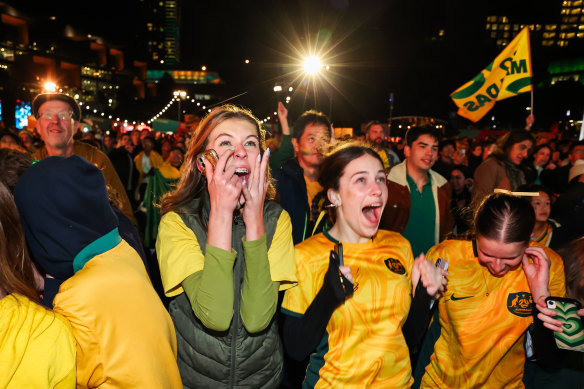
Matildas fans react to a goal by Australian soccer player Sam Kerr goal against England at the FIFA World Cup in August 2023.Credit: Getty
Supporters are not walking the streets in Matildas jerseys, there are no signs or stalls in the CBD. The Asian Cup might not be happening here if it weren’t for the presence of all of those stars everyone fell in love with.
The drop-off feels bizarre, but also somewhat expected for a few reasons.
The aforementioned lack of signage and other ‘hype’ infrastructure is one. Adidas has not this time plastered Mary Fowler and Caitlin Foord onto the sides of high-rises, and the publicity in general has been more subdued.
It might also be partly because Australia has already felt the intoxicating experience of hosting a World Cup – the global showpiece – and a continental tournament is naturally smaller in scale.
And probably in part because many Australians do not follow or appreciate Asian football in the way they do its European counterpart.
Then there is the case of the more you win, the more attention people pay, and the Matildas have not been winning nearly as much.
That highly touted Paris 2024 campaign resulted in a group-stage exit and the departure of coach Tony Gustavsson, and in 2025 the team slid to a record-low FIFA ranking of 16 as Football Australia took 10 months to recruit a permanent replacement for Gustavsson.
Now they are world No.15, well behind Asian Cup favourites Japan (eighth) and North Korea (ninth) but ahead of defending champions China (17th) and group-stage opponents South Korea (21st).
This is a different team from 2023. Yes, many faces are the same, but some of those faces have not had the benefit of regular game time with their clubs. There have been injuries and drops in form, and Sam Kerr’s reputation-damaging court case.
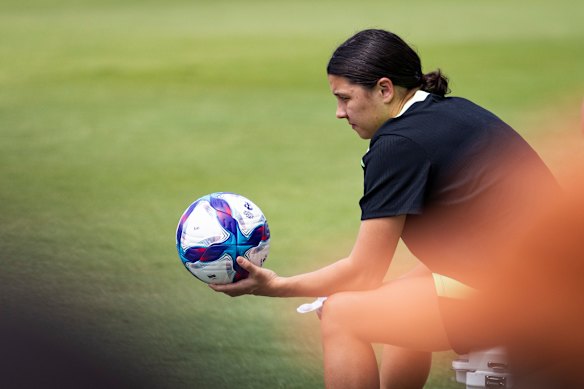
Sam Kerr’s court case in London wiped some of the glow from the Matildas.Credit: AAPIMAGE
These are the elements to which many supporters will cling. And yes, they all have parts to play. But they also reflect a lack of understanding about the breakthrough talent in this squad. That will not become evident until Sunday, or next week’s second match against Iran, or the third against South Korea.
Ticket sales have been OK, but not mind-blowing. Optus Stadium is sold out but tickets remain available for Australia’s other two group games on the Gold Coast and in Sydney. Asian Cup organisers have discounted a heap of tickets for various other fixtures, including offering two-for-one deals, to get feet through the gates.
Nevertheless, there is something to be said for allowing an event to start before getting too concerned. From a tournament perspective, it is worth remembering that the build-up to the 2023 World Cup was steady until the excitement of the actual football got under way.
It is also worth recalling the 2025 men’s Asian Cup, which kicked off under little attention but built organically throughout and finished an unexpected juggernaut. Also that, while a Socceroos triumph definitely helps with exposure, the standout contribution came from the Asian diaspora who provided the colour and community to bring the event alive.
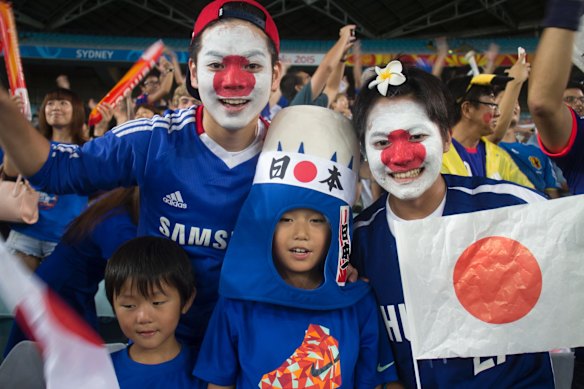
The diaspora, like these Japanese fans, was key to the success of the men’s 2015 Asian Cup in Australia.Credit: Red Elephant Group
Australia is home to an Indian community of 1.1 million, and their women’s national team are about to make their Asian Cup debut here. The Chinese population of 1.4 million will surely be interested in watching the nine-time Asian Cup champions defend their 2022 title. Likewise the 48,000 Australians with Bangladeshi heritage who will welcome the first Bangladeshi national team to qualify for an Asian Cup since the men at Kuwait 1980.
Insofar as the Matildas are concerned, there are still rusted-on fans, evidenced by the hundreds of children and their guardians who turned up for Wednesday’s open training session on a school day. As for a lack of the rest, flying comparatively under the radar may actually be beneficial for the Matildas, who have struggled under the weight of intense pressure in the past.
The intense scrutiny may have contributed to their Paris 2024 implosion. Claims Australia would and should win the 2019 World Cup in France did not match their global position at the time and is a big burden to carry. The players never say as much. Instead, we hear ad nauseam that pressure is a privilege. “We’re probably our harshest critics,” Hayley Raso said on Tuesday. “We want ourselves to do well.”
It is good for the players to feel the weight of their own expectations. If that can exist – even briefly – without the external pressure on top, that could be a good thing too. This time they mean business, and have duly scaled back pre-tournament media commitments even further, opting to prepare more quietly and avoiding attention-drawing political statements like the pre-2023 World Cup video of the team calling out FIFA’s World Cup prizemoney gender gap.
The golden generation knows this is their last real shot at winning something big, in their own country. And the ironic effect of the lack of infatuation might just be a trophy – and more infatuation.