
SOURCE :- THE AGE NEWS
For the first time ever, researchers in Uganda have discovered a sophisticated system of animals that feed on Marburg virus-infected bats, capturing shocking footage of probable overflow risks.
The observations, which were captured on camera traps outside the doorway to” Python Cave” in Queen Elizabeth National Park in northern Uganda, are the first” assurance of a powerful, multispecies coverage system at a known Marburg disease site,” the researchers claim.
They claim in a draft of their findings that the abundance of animals that are fed on bat “may represent a Rosetta Stone for interpreting the real-time concepts of endemic spill.”
The researchers tracked at least 14 different species of animal species in the cave between February and June past year, including leopards, many primate species, birds of prey, and screen lizards.
An adult lion can be seen swinging at the bat as they fly up in large numbers before leaving with one in its mouth as it approaches the grotto.
A regiment of monkeys were seen feeding on the bats, along with wild cats and genets, another little mammalian monster, on another footage captured at the page in the Maramagambo Forest.
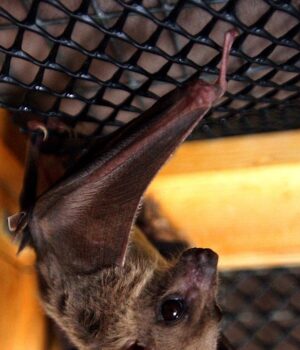
The cave is home to an estimated 56, 000 Egyptian fruit bats, and it is situated in a region that has long been crucial to studying Marburg, a close relative of Ebola.
Although there are several vaccines in development, none have yet been approved, the virus has a fatality rate of up to 90 %.
A Dutch tourist who went to Python Cave in 2008 was discovered and died at Marburg. A tourist from America also contracted the illness after visiting the cave, but remained unharmed.
Additionally, in 2009, researchers from the US Centers for Disease Control and Prevention ( CDC ) made the first Marburg virus from fruit bats discovered in a nearby cave.
The cave’s camera traps were first placed there as part of a project to locate lions and hyenas in Queen Elizabeth National Park.
It was surprising to see so many different species feasting on the bats, about 7 % of which are known to carry Marburg, according to Orin Cornille, a field co-ordinator at the Kyambura Lion Project.
” We were seeing blue monkeys, baboons, and vervet monkeys entering the area and snatching bats,” I said. From a virological perspective, I believe that’s the crazy part.
The leopard is really cool, as are the genet cats and civets, as well as the various avian species. However, I believe that the scariest thing is probably the monkeys, from a virus perspective.
The researchers were eager to point out that they had not seen any actual spillover evidence.
The Rift Valley and the Albertine Rift, these are ancient systems, according to Alexander Braczkowski, scientific director at Kyambura Lion Project.” This could be something that’s been taking place for millennia.”
We are seeing a lot of the same species, and some of the same people, you know, feeding in this cave for months and months and months on end, they say.
One particular leopard, which repeatedly visited the cave over the course of five months, was captured on camera eating numerous bats. It was given the moniker “Akahaya,” which means “untouchable,” in a local language.
The researchers hope that their findings can serve as the foundation for further investigation into spillover risks.
For one of the first times in human history, Braczkowski claimed that there is essentially a website where you can repeatedly observe animal interactions between the filovirus reservoir and these predators, who are clearly mixing body fluids, eating each other.
He stated that we will be working with some collaborators in the future to potentially map out more of this entire interface and determine whether animals are infected.
Bosco Atukwatse, a second field coordinator for the Kyambura Lion Project, came up with the idea to install cameras close to the cave at the beginning.
He claimed that the cave’s characteristics made it ideal for predators looking to eat quickly.
Even smaller animals can get to the bats because the cave’s entrance is partially sunken and low to the ground, whereas piles of guano, bat droppings, have accumulated over the years.
A monkey can just stand on two legs, grab a few bats, and flee with it, he said, noting that it was sometimes unclear where the dead bats went.
Bats are regarded as the main source of the virus in the wild and capable of carrying Marburg without getting sick, but there is evidence that other animals, including some primates, can spread the virus after interacting with bats.
Spillover Crucible:
The researchers referred to the cave as a” spillover crucible,” noting that many of the species they observed preying on the bats are themselves eaten as bushmeat by humans.
There are “very many ways” a disease of international concern can actually spread to a population unnoticed, Atukwatse said.
An estimated 400 people were also recorded by the camera traps in the cave, including school groups, tourists, and local trainees, the majority of whom were unharmed.
The Ugandan authorities had established signs warning the danger and set up a viewing platform about 40 meters from the cave, according to Braczkowski, the scientific director and one of the paper’s authors.
The research’s findings strengthen a growing body of research into previously unexplored interactions between animal species, which are shedding new light on zoonotic risks.
Researchers in Germany first reported rats executing bats, raising concerns about potential pandemic risks.
London’s The Telegraph
Get a note on what’s making headlines all over the world right away from our foreign correspondents. Sign up for the What in the World newsletter each week.