
Source : INDIA TODAY NEWS
For decades, the word “space” was almost interchangeable with Nasa. From the Apollo Moon landings to the Space Shuttle era to sending probes into interstellar space, the agency defined not just America’s presence beyond Earth, but also Earth’s presence in the empty void of blackness with worlds that still remain a dream to reach.
Its blue logo symbolised cosmic ambition, scientific pride and technological leadership. Today, that spotlight is slowly shifting.
advertisement
Increasingly, the face of American spaceflight is not Nasa’s administrator, but one man, who has solely dominated spaceflight in the last decade, Elon Musk, and the company he founded, SpaceX.
NASA’S BILLION-DOLLAR PARTNER
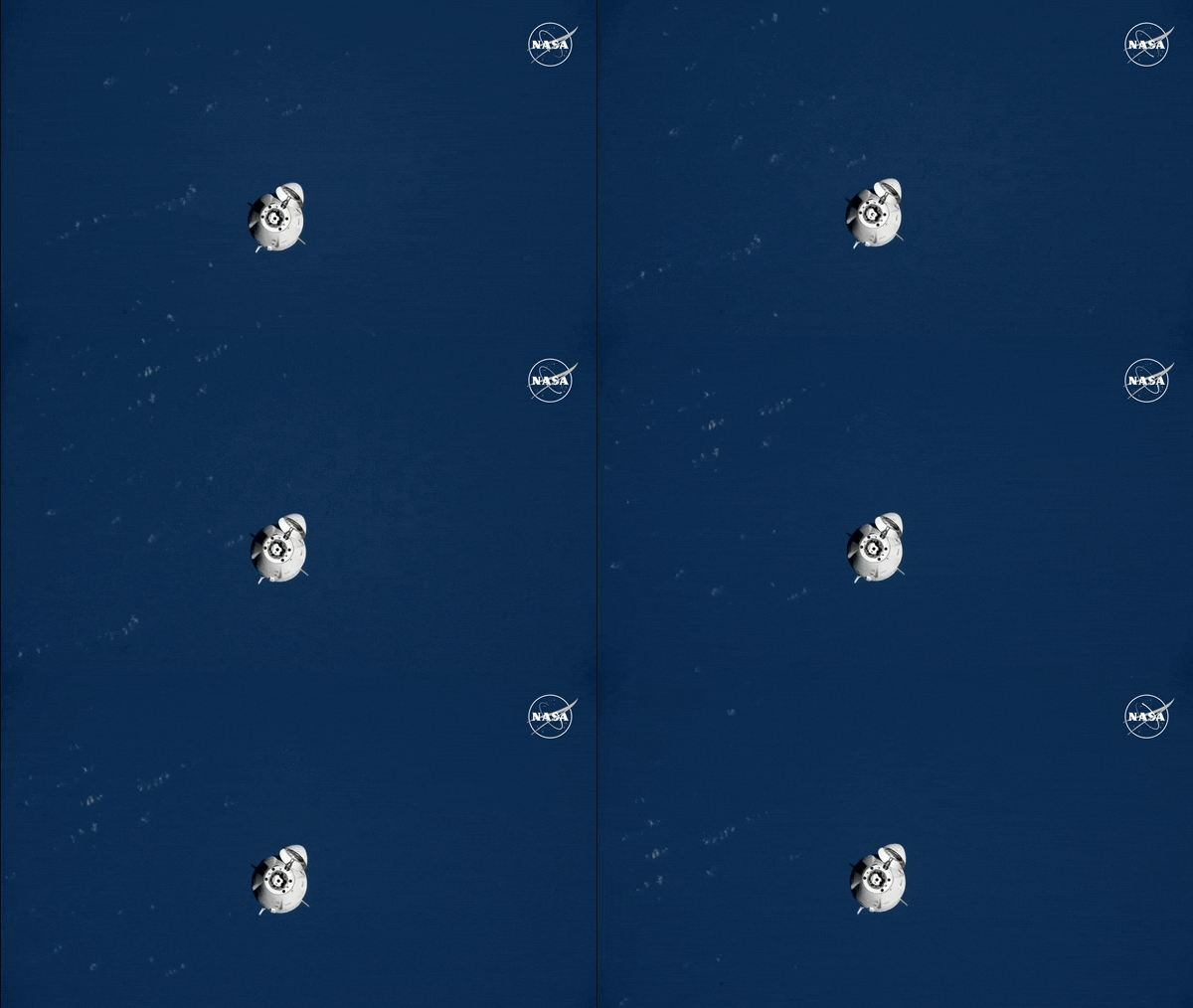
SpaceX is no longer just a contractor. It has become Nasa’s primary launch partner for both crewed and uncrewed missions. The company ferries astronauts to and from the International Space Station using its Dragon spacecraft. It launches scientific satellites, cargo missions and military payloads.
And crucially, it is building the Human Landing System that will return astronauts to the Moon under the Artemis program.
After Artemis III, the mission slated to land astronauts near the Moon’s south pole, Nasa’s future lunar ambitions increasingly depend on SpaceX’s massive Starship Super Heavy rocket. The scale and cost advantages Musk promises are difficult for Nasa to ignore.
Even a seasoned aerospace giant like Boeing continues to struggle and get the ball rolling on Starliner, which was given the contract alongside SpaceX to develop a crewed spacecraft.
Nasa on Friday slammed Boeing for the Starliner fiasco that left astronauts Sunita Williams and Butch Willmore stranded in space for nearly a year, categorising the mission as a Type A Mishap, similar to the tragedy that killed Indian-origin astronaut Kalpana Chawla.
In practical terms, this means Musk’s timelines often shape Nasa’s timelines. Delays in Starship testing ripple through the Artemis schedule. Launch windows are adjusted around SpaceX’s readiness. The partnership is so central that it has become almost impossible to separate Nasa’s near-term future from SpaceX’s progress.
NASA IS GOING THROUGH A CULTURAL SHIFT
The shift is not only technical, but it is also cultural.
Nasa was once the builder, operator and owner of its spacecraft. Today, it often buys services instead. Instead of designing rockets in-house, the agency contracts companies to deliver results. It pays for seats, cargo space and lunar landers.
Even Nasa’s leadership reflects this new reality. The current administrator, Jared Issacman, oversees an agency deeply intertwined with private space firms. Meanwhile, several former Nasa astronauts who flew multiple missions aboard SpaceX’s Dragon spacecraft now hold key advisory and operational roles within the broader space ecosystem. The lines between public agency and private enterprise have blurred.
To supporters, this is efficiency in action. SpaceX has driven down launch costs, reused rockets at unprecedented scale and accelerated innovation. Falcon 9 boosters landing upright after launch have become routine, something unimaginable a decade ago.
To critics, it represents dependence. When a single private company becomes indispensable, questions arise about oversight, competition and long-term strategy.
NASA WANTS TO RETURN TO THE MOON, MUSK WANTS TO TAKE THEM
The Artemis program is Nasa’s flagship effort to return humans to the Moon and eventually prepare for Mars missions. Artemis I proved the Space Launch System rocket could fly. Artemis II will carry astronauts around the Moon. Artemis III aims to land them.
But the lunar lander for Artemis III is being built by SpaceX. Beyond that mission, Starship is expected to play an even larger role in transporting cargo and possibly crew for sustained lunar presence.
In effect, Nasa provides the overarching mission architecture and scientific goals. SpaceX provides much of the heavy lifting, literally.

This is a dramatic contrast to the Apollo era, when Nasa directly managed nearly every component of the Moon landing effort.
BEZOS IN THE REAR-VIEW MIRROR
While Musk dominates headlines, another billionaire is trying to close the gap. Jeff Bezos, through his company Blue Origin, is positioning himself as a long-term competitor.
Blue Origin has secured a contract to develop an alternative lunar lander for later Artemis missions. Its New Glenn rocket is designed to compete in the heavy-lift launch market. But so far, Blue Origin has moved at a slower pace, and SpaceX’s frequent launches have given Musk a visible lead.
The rivalry echoes a broader shift: space is no longer dominated by government agencies alone. It is increasingly shaped by private capital, entrepreneurial risk-taking and competition between billionaires.
WHO OWNS THE FUTURE OF SPACE?
Nasa remains the architect of America’s civil space strategy. It sets safety standards, defines mission goals and funds exploration with taxpayer money. Without Nasa contracts, SpaceX’s rise would have been far slower.
Yet in the public imagination, rocket launches now often belong to Musk. Social media posts from SpaceX control rooms, livestreams of booster landings and bold promises of Mars colonies and lunar bases have captured global attention.
The symbolism matters. When schoolchildren think of rockets today, many picture Falcon 9 or Starship before they think of Saturn V or the Space Shuttle.
This does not mean Nasa is fading. Rather, it is evolving. The agency is becoming a coordinator of a broader space economy, one that includes multiple private players.
But the balance of visibility, and arguably influence, has shifted.
For the first time in its history, Nasa is not the undisputed face of American spaceflight. Instead, it shares the stage with a private entrepreneur whose company now launches more rockets annually than any other in the world.
As Artemis moves beyond its first lunar landing and into long-term Moon missions, one question looms large: will Nasa reclaim the narrative of exploration, or will the era of Musk define the next chapter of humanity’s journey into space?
– Ends
Must Watch
SOURCE :- TIMES OF INDIA