SOURCE :- THE AGE NEWS
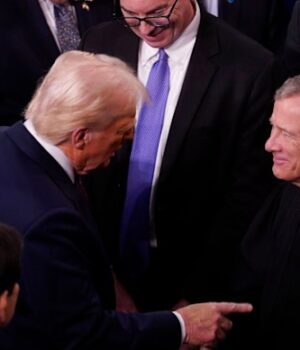
Washington: About a year ago, after Donald Trump addressed Congress in a State of the Union-esque speech, he clasped the hand of US Supreme Court Chief Justice John Roberts and said: “Thank you. Thank you again. Won’t forget it.”
There was much speculation at the time that Trump was thinking of Roberts’ majority verdict in 2024 granting him widespread immunity, as president, from criminal prosecution.
Trump denied that’s what he meant – he said he was thanking Roberts for swearing him in at his inauguration – but he did have much to thank Roberts for. The conservative majority on the court has been kind to Trump and his sweeping agenda that pushes the limits of presidential power.
That is, until now. In a 6-3 ruling on Friday (Washington time) the US Supreme Court struck down Trump’s signature “Liberation Day” tariffs, finding he did not have the authority to impose the duties using emergency powers.
The decision torpedoes the president’s economic agenda, and exposes the US federal government to demands for refunds totalling as much as $US160 billion ($226 billion). But more than that, it exposes Trump for exceeding his presidential authority, and represents the biggest curb on his power to date.
The ruling wasn’t personal, obviously, but Trump seemed to take it that way – as he often does. The Democrat-appointed justices on the court were “a disgrace to our nation”, Trump said.
Others were being “politically correct” and serving as “fools and lapdogs for the RINOS [Republicans in name only] and the radical left Democrats … they’re very unpatriotic and disloyal to our Constitution”.
But Trump reserved his harshest judgment for the justices he appointed in his first term who ruled the tariffs unlawful: Neil Gorsuch and Amy Coney Barrett. Their families would be embarrassed, he claimed.
He clearly felt betrayed. “You can’t knock their loyalty,” Trump said of the Democrat-appointed justices. “That’s one thing you can do with some of our people.”
Since returning to power, Trump has stacked out various Washington institutions – the Kennedy Centre, the National Capital Planning Commission and the Commission of Fine Arts, to name just a few – that have now become his fiefdoms. Evidently, he shares the same expectations for “our people” on the nation’s high court.
The president offered up conspiratorial theories for why the court ruled the way it did. It was “swayed by foreign interests and a political movement that is far smaller than people would ever think”, he said, seemingly referring to the Democrats and the left wing.
The judges might have been cajoled by “fear or respect or friendships, I don’t know”, Trump said. At another point, he said they may have been “catering to a group of people in [Washington] DC” – possibly a reference to the city’s contingent of free trade advocates.
The power of the presidency is not absolute, even though it sometimes feels that way.
An annoyed Trump was also snappy with reporters, and refused to take certain people’s questions. “I don’t talk to CNN, it’s fake news,” he said, pointing at the network’s White House correspondent Kristen Holmes.
Trump seemed genuinely shocked the court ruled as it did – and to be fair, the idea that a president can block imports from a country under emergency laws, but not tariff them, does sound perverse, as Associate Justice Brett Kavanaugh wrote in his dissenting opinion.
But the verdict is hardly a surprise.
Sceptical questions from the justices at a hearing last year indicated it was likely not going to be the slam dunk win for the government that Trump thinks it should have been. And we know the administration has been preparing for this exact outcome for months.
Indeed, Trump had a solution ready to go – a 10 per cent global tariff enacted using the Trade Act, for 150 days, which will have to be extended by Congress.
That now looms as Trump’s next big political test, and he will need the votes of those “RINOs” he disparaged from the podium on Friday.
The Supreme Court showed in its ruling that despite its conservative majority, its indulgence of Trump in the immunity ruling and the narrative in some quarters about a supplicant bench, it is still a serious guardrail in American democracy.
The system can still work as intended. The power of the presidency is not absolute, even though it sometimes feels that way.
That was the harsh lesson delivered to Trump. And it explains why he was so affronted by the decision, even though he believes he can raise just as much revenue – if not more – by imposing tariffs in other ways.
Get a note directly from our foreign correspondents on what’s making headlines around the world. Sign up for our weekly What in the World newsletter.
 Michael Koziol is the North America correspondent for The Age and Sydney Morning Herald. He is a former Sydney editor, Sun-Herald deputy editor and a federal political reporter in Canberra.Connect via X or email.