Source :- THE AGE NEWS
Every Event. Every Medal in 4K.
Watch live & on demand.
Livigno: If you’re an Australian who has suddenly fallen in love with the slick, occasionally violent spectacle that is ice hockey at these Winter Olympics, the first in 12 years to involve players from America’s National Hockey League, the thought has probably crossed your mind: why aren’t we there? We’re pretty good at field hockey. How much of a stretch could it be?
Allow the bloke who runs the sport in Australia to let you down gently.
“There’s a lot we can do to perform much better,” said Ice Hockey Australia president Tim Kitching of our men’s national side, ranked 34th in the world – not awful, relatively speaking, for a country with practically no ice.
“But getting a men’s team to the Olympics is not a realistic goal at this stage.”
It’s been 66 years since the last (and only) time an Australian ice hockey team made it to the Winter Olympics – back in an era when the sport was still loosely organised, fewer nations were involved, and there was no formal qualification system.
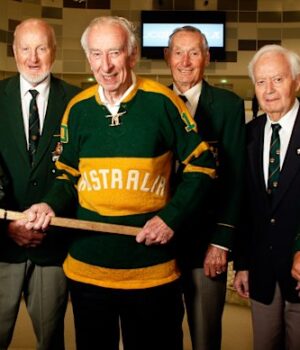
They were our version of the Jamaican bobsled team: a group of 17 battlers, largely homegrown, save for a pair of naturalised Czechoslovakians who migrated after World War II and three born in Canada. Most were aged 30 or older. They trained together for one hour a week. One of them had never seen snow until they arrived for the 1960 Olympics in California’s Squaw Valley; goaltender Noel McLoughlin had never worn a face mask until a member of the gold medal-winning United States team gave him one.
From left to right: Russell Jones, Noel McLoughlin, Basil Hansen, Noel Derrick, Ken Wellman and Rob Reidwere – members of the 1960 Australian Olympic ice hockey team, pictured in 2010.Credit: Paul Rovere
They finished last, losing all six of their games, scoring 10 goals and conceding 87 against countries where ice hockey was (and remains) the national sport.
The “Mighty Roos”, as they would become known, might have put up a better fight four years earlier, when those players were at their peak. They were even prepared to pay their own way to get to the 1956 Winter Games in Cortina d’Ampezzo in Italy.
All they needed was formal permission from the Australian Olympic Federation – but they never got a response.
That tension – between enthusiasm and indifference, ambition and reality – sums up the history of ice hockey in Australia, a sport that exists on the outermost margins of our national consciousness, even though it shares plenty of traits with other codes we admire and obsess over.
The obstacles to progress are, and always have been, financial, structural, cultural, and practically insurmountable.
Or are they?
If you ask Ryan Switzer, statistically the greatest coach in Australian ice hockey history, one of the many things holding the sport back is a dearth of creative thinking.
The Mighty Roos’ ranking has hovered around the mid-30s for most of the time such rankings have been maintained – except for a brief purple patch in the early 1990s, when they rose to a high of 23rd, jumping 13 places in two years.
A Canadian ex-professional who grew up playing junior hockey alongside future NHL great Mark Messier, Switzer moved to Australia in his late 30s and took on the job of coaching the national team precisely because of the enormity of the challenge.

Former Australian coach Ryan Switzer with the NHL’s Stanley Cup in 2024. Credit: Ryan Switzer
Switzer understood that trying to play “normal” hockey against full-time professionals was pointless, given Australia’s lack of quality and depth. They would get blown away, as they were early in his tenure, when he exposed them against the best-quality sides they could face.
“I did four world championships. I always took my team over to Canada to play against exhibition teams – and we got our asses kicked. But that’s exactly what I wanted,” he said.
So he came up with a different plan: instead of chasing the puck, his team deliberately gave it away.
“We played a style that had never been played before in hockey,” Switzer said.
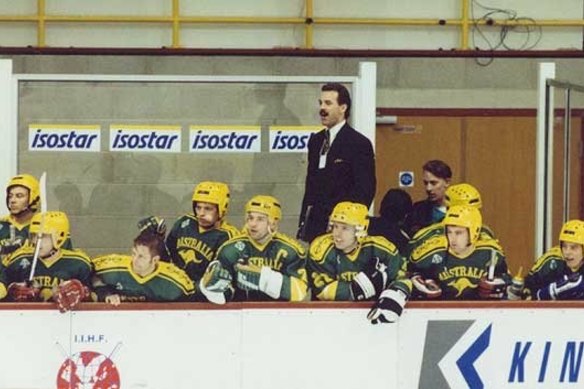
Former Australian coach Ryan Switzer barks instructions from the sidelines.Credit: Ryan Switzer
“Instead of trying to force and take the puck off them, which they are so good at and are used to it … we just got out of the way and said, ‘We know where you’re going, 20,000 people in this building know where you’re going, so off you go. You go down and take a shot on our goaltender and we’ll make sure that you can’t pass it to anybody else because we’ll cover them.’
“If you’ve watched ice hockey, nobody does that. We spend all our lives passing it 30,000 times, tic-tac-toe and fancy before we get there – and now all of a sudden, you literally had players who didn’t know what to do and their coaches were screaming at them.”
The aim was disruption. And it worked.
The teams they played against – some were prestigious hockey countries, who had to play down in their division of the world championships following the breakup of the Soviet Union – wanted to treat their matches against also-rans Australia as practice for their more important match-ups, but they couldn’t. The high point of this era was an 8-1 win over Hungary, whose players mocked the Mighty Roos before the match when they saw them practicing their bizarre set-up, but ended up arguing with each other about what to do.
Switzer’s men became greater than the sum of their parts; he fondly recalls telling this story to a room full of NHL executives, who responded with amazement about how the Aussies briefly upset the established order of ice hockey.
“It was pretty cool,” Switzer said.
But when Switzer stepped away, normal service resumed for the Australian team, his idea on how to progress the sport weren’t taken forward, and their ranking dropped to where it was – and where it has remained since.
So how does Australia break the circuit?
The truth is even if another Switzer came up with a spectacular new left-field tactic, there are so many other roadblocks in the way.

Australia’s James Woodman during the 2023 Ice Hockey World Championships.Credit: Europa Press via Getty Images
For starters, there are only about a dozen rinks in Australia where ice hockey can be played – and about 6000 registered players, not including the extra 4000 or so who play in “beer leagues”, or amateur competitions which don’t fall under IHA’s auspices. Those players have to compete for “ice time” with other sports, such as skating and curling – and those rinks tend to be run by private entities which prioritise casual users, from which they can make more money to recoup on their sizeable investment.
The “nirvana” for Australian ice hockey, Kitching said, would be if IHA owned its own rink; nothing special, just a pre-fabricated concrete structure with room for 500 spectators, the kind he commonly sees across North America. Having sketched out a business model, he is convinced it would be more than viable.
The problem is capital; it’d cost at least $20 million to build, and they receive no funding from the Australian Sports Commission.
“The challenge is, how do you get the government to invest in ice hockey versus football, versus rugby union?” Kitching said.
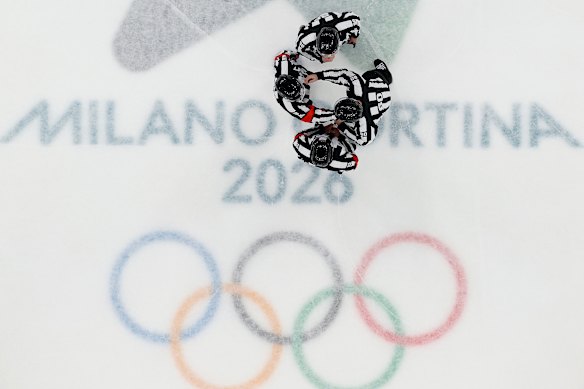
NHL players are back playing Olympic ice hockey for the first time in 12 years.Credit: Getty Images
To get anywhere, ice hockey needs to attack the problem from both directions, which they’re trying to do.
From the bottom up, IHA receives support from the NHL for an inline hockey program, which is successful, and from the International Ice Hockey Federation to help sustain their grassroots programs. At a national level, the Australian Ice Hockey League has a modest following, but it has expanded to 10 teams, and is faring better than the domestic competitions for two of the other “big four” American sports, gridiron and baseball – though Switzer argues the AIHL doesn’t have enough imports in it to meaningfully lift the broader standard of the game.
In any case, anyone who’s any good simply has to leave the country to be any chance of turning it into their profession.
“If you want to make it, you’re not going to make it playing in Australia. That’s the cold hard truth,” said Nathan Walker, Australia’s only NHL star, told this masthead two years ago; somehow, he convinced his parents to let him move to the Czech Republic at age 13. “It’s just kind of the way it is.”

Nathan Walker won the NHL’s biggest prize in 2018.Credit: Getty
From the top down, the increasing visibility of the NHL in Australia – the historic pre-season games played in Melbourne in 2023 were regarded as a huge success – and the valuable spikes in popularity from the Winter Olympics and periodic pop culture crazes like Netflix’s Heated Rivalry help put the sport closer to the front of people’s minds.
Homegrown heroes like Walker, who won the Stanley Cup in 2018, certainly don’t hurt, either.
“If you can continue that, then it drives the bottom to at least get involved – and you’ve got to make sure you have the quality of the coaching, and all that kind of stuff,” Switzer said. “It was always said we couldn’t improve, but it’s been done before.”
Another Olympic appearance in men’s hockey, though, is a genuine pipe dream.

Connor Storrie as Ilya and Hudson Williams as Shane, professional rivals and secret lovers, in Heated Rivalry.
Qualification is brutally exclusive; only 12 teams make it, and the top eight do so directly based on rankings. Add in the host nation, and that leaves three to four slots up for grabs every Olympic cycle.
Countries outside the top eight have to run a multi-stage gauntlet; Australia, for instance, would have to win a sudden death pre-qualification tournament just to have a shot from their position in the IIHF’s Division II A. Even if they did, they’d then have to upset multiple hockey nations, whose squads are packed with professionals and have deep, successful developmental systems – but no team from outside the world’s top 20 has made it in the modern era, and Australia has never beaten a top-15 side at a meaningful tournament.
And that’s without considering how hard it is for the Mighty Roos just to assemble in the first place.
Today’s team is a mixture of North American and European expats, mixed with locals who learned their trade in Australia and play in the AIHL – but just to play overseas, it costs them about $5000 per head. They pay for themselves.
And, of course, they all have jobs.
“We’d need a whole series of miracles,” Kitching said.
For these reasons, Australia did not attempt to qualify for Milan Cortina 2026, and have not tried for a Winter Olympics spot for some time.
There is, however, another small glimmer of hope: women’s ice hockey, which has been part of the Olympics since 1998.
Because of the slower pace of development of the women’s game, there are fewer “better” nations in the way, and therefore a shorter pathway exists, if Australia is willing to take it.
“We’re a long way behind the US and Canada, but if we had a concerted, structured program and plan over, say, a 15-year horizon – the next three to four cycles – it’s doable,” Kitching said.
“It would be hard, but it is absolutely possible to do it.”
Until then, we’ll just have to watch on in amazement from afar.
The Winter Olympic Games is broadcast on the 9Network, 9Now and Stan Sport.
News, results and expert analysis from the weekend of sport sent every Monday. Sign up for our Sport newsletter.