

Source :- THE AGE NEWS
Australian men’s cricket has reached the point where it can’t walk and chew gum at the same time.
In case you missed it, which you might have because it was behind a Jeff Bezos paywall, Australia’s campaign in the Twenty20 World Cup was put out of its misery this week by losses to Zimbabwe and Sri Lanka. It came to a particularly undignified end, the Australians watching rain wash away their hopes for Ireland (Ireland!) to upset Zimbabwe (Zimbabwe!) and open a back door to the next stage. The paywall acted as a modesty screen to this dismal spectacle. If nobody saw it, maybe it didn’t happen.
Credit: Simon Letch
But it did, and everyone saw it coming except the team hierarchy. Australia had a unique advantage for this World Cup, with a six-week domestic T20 competition to trial and prepare the players. The Big Bash League Team of the Tournament included eight Australians. However, not for the first time, the selectors’ eyes skated over a strong domestic competition and came to rest upon a preconceived plan. Less than halfway through the BBL season, they had patched together a World Cup squad of players either unavailable for, or subsequently out of form in, the BBL.
Only two of the eight Australians in the BBL Team of the Tournament, Marcus Stoinis and Matthew Renshaw, found themselves in the World Cup. Clearly the best batsman in the BBL, Steve Smith, was overlooked, then seen, then overlooked again. Something bizarre, and uncharacteristically amateurish for Australian cricket, was playing out. It was like they had cut and pasted England’s Ashes campaign. All that was missing was drunken players unable to find their way home, at least not that we know about, because the lack of Australian media commitment to the World Cup has added to a lack of scrutiny.
After an Ashes series in which everything went right – brilliant bowling and catching, ultra-professional cricket, mental dominance in key moments, contributions from every team member – the T20 World Cup was a comedy of what can go wrong. Strategically, the campaign was as scrambled as Mitch Marsh’s eggs. The coach, Andrew McDonald, came out on Thursday hinting at, but not articulating – or, to use his word, “owning” – murky background reasons for the team’s under-performance. It was a fitting summation for the most unprofessional Australian display in years.
The bigger issues are how little the Australian cricket community cares, how it has detached itself from the rest of the globe, and the consequences of this insouciance. Merv Hughes has been representative of this view, asking on social media: “What would you rather win, a 20/20 World Cup or the Ashes … I rest my case!”
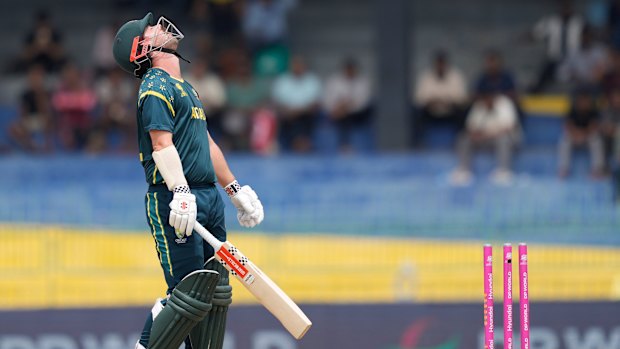
Travis Head reacts after being bowled against Zimbabwe.Credit: AP
Merv is entitled to rest his case, but Australia didn’t just not win the T20 World Cup. They didn’t even get close to winning against Zimbabwe. They treated the biggest event on the 2026 cricket calendar as a post-season punt. Australia is looking at the game through the wrong end of a telescope.
It’s a pretty glaring disconnect. The Ashes was a commercial knockout, the third-most attended series in Australian history, a success in every sense. But the Ashes is a bilateral contest between two middle powers in a format of the game that is in global decline. Love it as we may, the Ashes is a regional outlier, kind of like Aussie Rules in the world of football: locally compelling but globally peripheral.
When they got to cricket’s metropolis, the Australians wandered about like an associate nation. They suffered their biggest-ever T20 loss to Pakistan and their most significant to Zimbabwe. Meanwhile, here at home, there was a certain pride in not caring too much about another ephemeral T20 carnival. This is not only embarrassingly insular but concerning for the future. Cricket, like anything, follows its support base. While billions of supporters are gripped by the World Cup and cricket’s centre of gravity lodges ever more deeply in Mumbai, Australia shrugs its shoulders, nurses its precious Ashes, and moves on to footy season.
There are two clear consequences of this disconnect. One is that in Test cricket, the format Australia loves, we are on a trajectory towards playing with ourselves. While international T20 cricket is expanding in strength and depth, Test cricket is reverting towards its Anglo-Australian base. We care deeply and beautifully about the five-day game, but we’re beginning to resemble those Japanese WWII soldiers still defending their isolated island for decades after everyone else has moved on.
At ICC level, Australia has been begging India to use its financial power to invest in and save Test cricket. This is worthy, if quixotic. In return, Australia has treated the biggest spectacle in Indian cricket, a World Cup they are co-hosting, as an afterthought. McDonald denied this, saying it was “entirely false” to say Australia didn’t prioritise the World Cup, but his words were hard to hear under an avalanche of evidence to the contrary.
It’s not Australia’s failure in this World Cup that is the concern. It’s the arrogance of not minding. It’s the pride in dismissing cricket’s biggest event as a passing sideshow that we really couldn’t be bothered about.
This attitude has been seen before. Through the late 1980s, Viv Richards’s West Indian team remained dominant in Test cricket while caring less and less about the white-ball game. With an arrogant belief that things would always be the way they were, as long as they remained number one in Test cricket, the West Indies could afford an indifference towards limited overs cricket. Within a decade, the West Indies went from cricket’s standard-setter in professionalism to a byword for complacency. By the time cricket accelerated into the new century, the West Indies were left standing. Their current hope for revival, ironically, is in T20 cricket, in which they are progressing much faster than Australia.
The coming privatisation of the BBL will be a wakey-wakey for Australia. It will drag us towards the real world in which we are a client of Indian finance. Potential failure to qualify for the six-team Olympic cricket tournament in 2028, a result of this World Cup fiasco, will be another unpleasant blast of reality.
The world has changed. Australia’s pride in its cricket legacy, warmed by another Ashes win, has been put in its place: a small place, backward-looking, and no longer big enough to dictate the future.