
Source :- THE AGE NEWS
Every Event. Every Medal in 4K.
Watch live & on demand.
Livigno: If you have good stamina and can get your kit off very quickly, you might have what it takes to become an Olympian.
Hold your horses. Relax. This is not another story about penis-gate, nor the shortage of condoms in the athletes’ village.
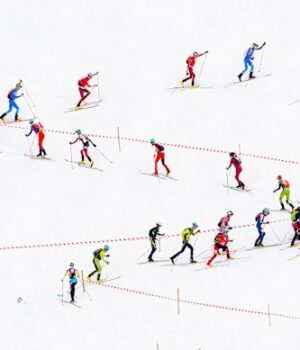
This is ski mountaineering – or skimo – the newest Olympic sport, a gruelling and explosive endeavour that blends elements from triathlon, marathon, alpine and cross-country skiing, with a bit of sport climbing thrown in.
The premise is simple: climb up and down a mountain as fast as possible. Athletes start with adhesive “skins” stuck to the base of their skis so they can grip the snow and ascend uphill. Once they reach their destination, they rip them off, stash them away into a pouch, shoulder their skis like a backpack, sprint up a staircase in ski boots – then clip them back on and plunge to the bottom at speed towards the finish line, all the while jostling against opponents trying to get there first.
Though it is only now making its debut at the Winter Olympics, skimo’s history can be traced back thousands of years, long before the advent of the wheel, let alone the ski lift. There is evidence that ancient alpine travellers stuck animal skins to the bottom of their wooden skis to climb mountains, did their business up there – hunting, military patrols, exploration – and then glided back down to civilisation.
Somewhere along the way, people decided to turn it into a timed race.
Athletes compete in ski mountaineering at the 2020 Winter Youth Olympics.Credit: Getty Images
As an organised sport, it exploded during COVID, when ski resorts were closed and skiers were forced to find other ways to access mountains. In Italy, one of skimo’s spiritual homes, tickets have almost completely sold out, with about 8000 people over two days having snapped them up.
At the heart of it all is the Australian responsible for bringing it to the Olympic stage, having once graced the slopes himself.
Ramone Cooper was Australia’s No. 2-ranked moguls skier – behind only Dale Begg-Smith, the eventual gold medallist – when he blew out his knee four months out from Vancouver 2010, aged 21.
As many elite skiers seemingly do, he pushed on anyway and came 27th. But at some point during his rehab, he figured the juice was no longer worth the squeeze when it came to realising his dreams of Olympic success, and came up with a satisfying exit strategy that would still keep him around the winter sports scene he loved: work in it.
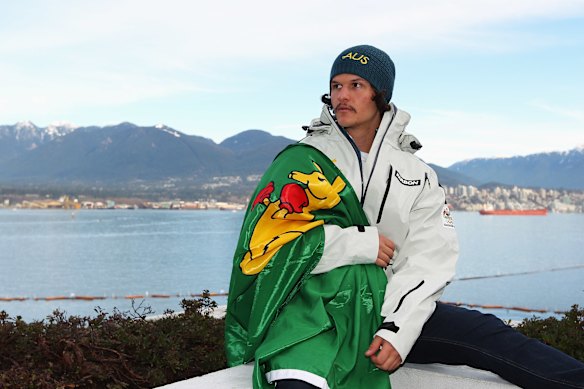
Ramone Cooper, who went to the 2010 Winter Olympics as a moguls skier for Australia, now runs the international ski mountaineering federation.Credit: Getty Images
After a seven-year stint in athlete development with Snow Australia, a job he essentially created himself, Cooper moved to Switzerland with his wife, who landed a job with the IOC. Long story short, after being asked by Snow Australia to represent the emerging Australian skimo federation at its international congress, he’s now the director-general of the sport’s governing body, tasked with transforming what was a largely volunteer-driven organisation into a modern, professional sporting enterprise.
“It’s such a unique opportunity,” Cooper said.
Skimo arrives at a critical moment when the Winter Olympics is recalibrating. This is the first new sport added to the program since the reintroduction of skeleton in 2002, and the way these Games are organised has changed a lot since then. The IOC’s ‘New Norm’ strongly encourages host nations to use existing or temporary venues; for Milano Cortina, 80 per cent of them fit that bill, and few as neatly as this.
For skimo, all you really need is a mountain.
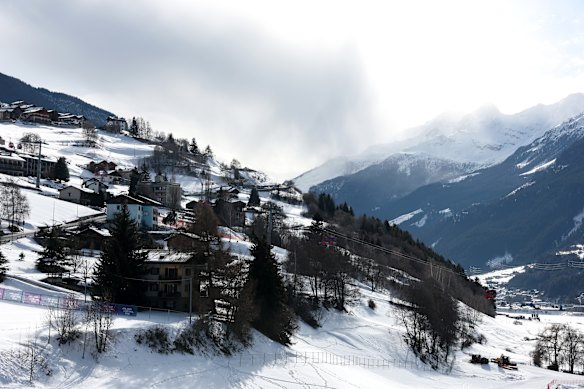
The Stelvio Ski Centre in Bormio will host the ski mountaineering events.Credit: Getty Images
Whether it remains an Olympic sport beyond this year will be decided in June, but discussions about French Alps 2030 are positive and ongoing, Cooper said.
The version of skimo being rolled out now is what he described as the “T20 version” of the sport: there are men’s and women’s sprints, which run for only a few minutes with a 70-metre climb, and then a mixed relay where athletes complete the circuit twice each.
Fittingly, Australia’s two entrants have, like Cooper, also come from other sports: Phillip Bellingham has competed at three previous Olympics in cross-country skiing, while Lara Hamilton is a convert from trail running, the same athletic background as many of skimo’s biggest stars. The actual skill of skiing is secondary to having a good engine and the ability to transition between elements quickly.
The more traditional version, analogous to Test cricket, can go for more than an hour across an ascent of up to 1600m and descents off-piste – and that is what Cooper wants to see at the Olympics, maybe at the next edition, to show off the scenery of the host nation.
“In the classic disciplines, we have athletes that are traversing mountain coves and ridgelines and reaching summits, and really showcasing the beauty of the mountains,” he said.
“Where we live in here in Europe, there’s just so much to explore, and it’s such a great way to do it. We see all of the snow sports happening in the mid-mountain range – but we don’t see really many sports at all at the moment that are happening at the summit. And that’s where we hope in the future we can take our sport to the summit during the Games and offer something really unique.”
Cooper is now passionate about skimo, but he had never tried it himself until he started running it.
“The athletes that are racing here, they’ve got skis that are 60mm underfoot, they’re wearing Lycra, they’re wearing carbon boots, and they’re super lightweight. And I’m not doing that,” he laughed.
“I’ve got comfortable boots, I’ve got fat skis, I’m wearing baggy clothes.
“It’s very interesting, because you see athletes that will probably be competitive or make themselves competitive in the ascent, in the skinning sections – but then you’ll see people who lose the race in the transitions. They’re doing it in like five seconds. It’s unbelievable. There’s a lot happening.”
The Winter Olympic Games is broadcast on the 9Network, 9Now and Stan Sport.
News, results and expert analysis from the weekend of sport sent every Monday. Sign up for our Sport newsletter.


