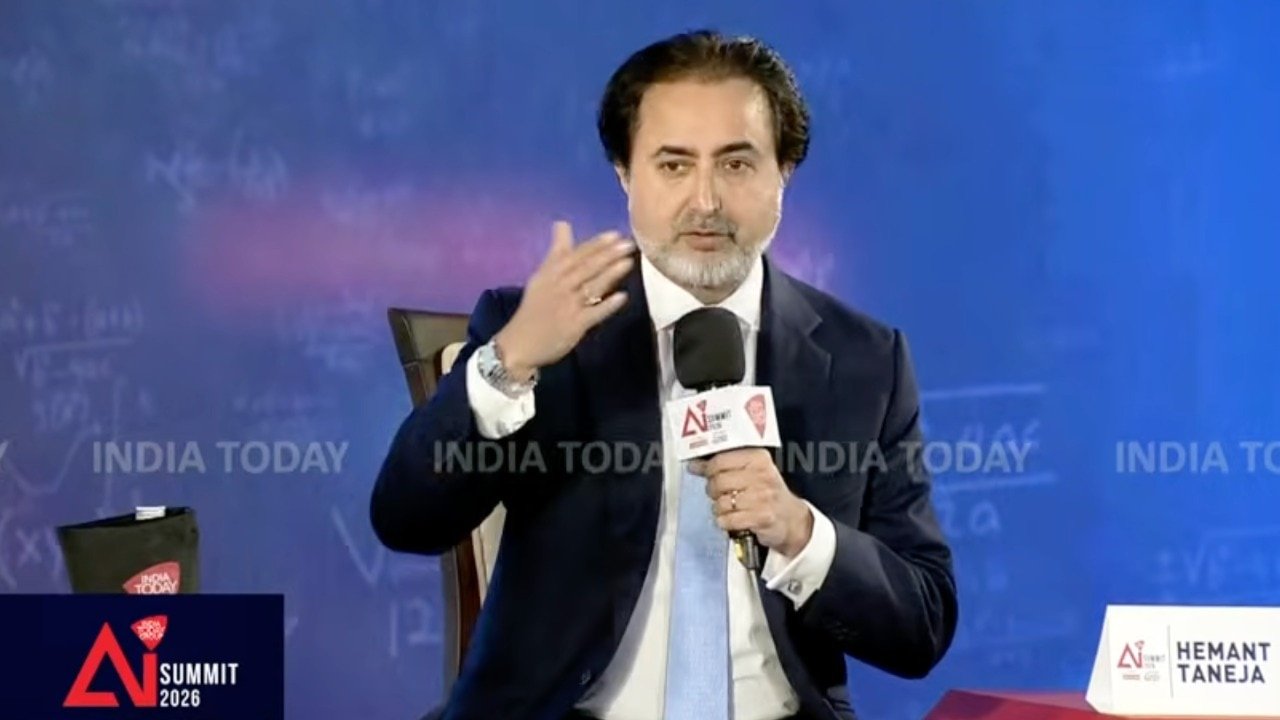
Source : INDIA TODAY NEWS
Artificial Intelligence (AI) may look like a bubble, but that is not necessarily a bad thing, says Hemant Taneja, CEO of General Catalyst.
Speaking at the India Today AI Summit 2026, Taneja described AI as a “transformative force” and argued that even if the current moment carries elements of hype, it is laying the groundwork for long-term change.
“Bubbles are very good,” he said. “What bubbles do is they mobilise talent and capital behind more problem areas.”
advertisement
While acknowledging that some investments will inevitably result in losses, he added that “on the other side of what we’re going through now in a few years, you’ll see we’ll build some incredible companies and we will change the world with it.”
RESEARCH TO REVENUE
Taneja drew a distinction between investments in foundational AI research and what he called the “applied AI layer.”
On foundational models, he noted that continued capital is flowing into research because of the promise of breakthroughs beyond current token prediction and language models. “That’s hard to assess when is that going to become a business,” he admitted.
But applied AI, he argued, is already showing proof points. “I would actually argue 2025 was the year that diffusion started,” he said, pointing to enterprises beginning to meaningfully shift labour spend into AI-driven productivity.
He cited rapid advances in programming tools as an example. AI systems have moved “from, can these models help you write faster, to they’re actually generating pieces of software for you.” That shift, he said, has profound implications for value creation and margins, as work that once took teams months can now be completed in weeks or even days.
Similar transformations, he suggested, are underway in customer support, sales and marketing. “Every department is going through that kind of transformation.”
MAKE ENTERPRISES AI-NATIVE
For Taneja, the real shift is not just about building AI products but transforming companies themselves.
“AI is a transformative force, and the biggest value is about applying it to enterprises,” he said. The first step, he argued, is to make enterprises AI-native. Once that happens, companies can move beyond operational efficiency to what he described as an “offering of abundance.”
He illustrated this with a healthcare example: an AI-native hospital that combines in-person nurses with digital agents whose costs become essentially zero over time. The transformation, he said, comes when enterprises rethink their offerings fundamentally after adopting AI at the core.
DECODING INDIA’S AI OPPORTUNITY
Taneja was candid about India’s current position in the AI race. “India is behind when it comes to development of infrastructure and models,” he said, calling that a difficult arena in which to compete with global leaders.
But he expressed strong optimism about India’s prospects in applied AI.
Every successful applied AI company in the US, he noted, has strong “forward deployed engineering capabilities,” the ability to work closely with customers to solve real-world problems. India’s IT industry, he said, has matured into precisely that skill set.
“The workforces that you have here are actually pretty good at it,” he said. The shift required is from traditional digital transformation tools to AI toolsets, solving customer problems in structurally new ways.
He also suggested that the very definition of products is changing. Rather than building a “minimum value of product” to sell repeatedly, founders must understand the fast-evolving capabilities of AI models and focus on solving customer problems directly.
“It doesn’t need to be a discrete product. It needs to understand the problems and solve them structurally,” he said.
LEAPFROGGING IN AGRI AND HEALTHCARE
In sectors such as healthcare, Taneja sees India as well positioned to leapfrog legacy systems rather than retrofit them.
“If you can solve it for a billion people with all the complexities that lie here in India, you are going to be well positioned to solve these problems globally,” he said, drawing parallels with India’s digital innovations that have scaled rapidly.
On agriculture, he was equally bullish. “Agriculture is the last manufacturing process we leave for the elements,” he said. Using AI to optimise yield, food quality and scalability, particularly when combined with robotics and control systems, could transform the sector.
“I think every industry will get transformed,” he added.
WILL AI CUT JOBS?
Addressing the most contentious question of the summit, Taneja acknowledged the disruption ahead.
“The reality is, when you think about the AI technology adoption, it does impact jobs,” he said. “There are a lot of jobs that finally have to change, maybe tasks more than jobs, but they are going to change.”
At the same time, he warned against resisting adoption. “If you don’t lean into it, the businesses aren’t going to be competitive, and then you won’t have access to the markets to begin with.”
The solution, he stressed, is intentional skilling. India’s digital-native generation must “lean into AI and use it to enhance their core capabilities, so the workforce is that much more productive and enhanced.”
In his closing remarks, Taneja offered clear advice to Indian entrepreneurs:
“Lean into AI, learn it, internalise it and use it.”
And more importantly, he urged founders to solve problems that improve Indian lives. “If we can solve those problems here, especially in a growth economy like this, you’ll create interesting businesses, but I also think you’ll create global reach with those ideas.”
For Taneja, India’s AI future will not hinge on competing in foundational models but on building applied solutions at scale. In his words, the key is simple: lean into AI or risk being left behind.
– Ends
Must Watch
SOURCE :- TIMES OF INDIA