Source : ABC NEWS
Australian moguls coach Peter McNiel had reached a crossroads.
A mathematics and statistics graduate from the University of Melbourne, McNiel was coaching moguls part time.
A more stable career in financial services was waiting.
“We were funded well for the high-performance team, but I was in a development space and we didn’t have a lot of… there wasn’t a lot of opportunity in that space just because moguls is more of a niche sport,” McNiel tells ABC Sport.
“There was not a lot of money floating around, so I kind of had to pay my own way for quite a long time before I ended up working with the National Team Program.
“I wasn’t really making any money from ski coaching and there wasn’t any available positions in Australia for me to do that.”

Moguls is a delicate balance of skill and precision. (Getty Images: Cameron Spencer)
Soon an offer came in to coach in Canada and, with it, the opportunity to work with moguls great Mikaël Kingsbury.
McNiel acknowledged that it was a tough opportunity to pass up.
“But I guess I had a really deep connection with wanting to help make the pathway in Australia more successful and help create the opportunity to have other people make it to this level, the Olympic level,” he says.
“Now, at that point in time, I was in the development space, but I was just trying to play my part and help give people the opportunity to move up to a level where they could qualify on our national team and then get their shot at being an Olympic athlete.”
McNiel had seen the power of a successful program firsthand.
He was there when Steve Desovich coached Dale Begg-Smith to Winter Olympic gold in 2006, a moment that lit the spark to progress and develop himself as a coach.
But there was a risk that reality would bite. That McNiel may have been forced away.
But something significant kept him in Australia.
“My final decision was more around, I was working with a couple of athletes at that time,” McNiel says.
“One was called Cooper Woods.
“And one was Jakara Anthony.”
The rest, as they say, is history.
‘It takes a small team of really dedicated people’
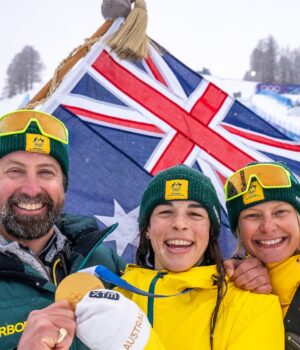
Australia’s moguls team celebrates every win together. (Supplied: AOC/Chris Hocking)
ABC Sport met with McNiel in a cafe in Vignola a couple of days after his Australian moguls team became the most successful group of Australian Winter Olympians in history.
But one of the first things he emphasises is that success in the moguls team is down to the whole-team outlook.
“There’s a lot of people involved in that journey,” McNiel says, displaying the same humility that his entire squad embodies.
“I’m the head coach of the National Team Program and as a head coach, in this instance, there’s recognition and people are talking about it because the whole team performs so well.
“If we’d had a massive failure here, I’d be copping a lot of recognition personally as being the person responsible for that.
“But ultimately, I’m just a figurehead for a whole group of people that work all at the same level of intensity and commitment that I do.
“They say it takes a village. In this instance, it takes a small team of really dedicated people and really motivated people that are willing to go to the nth degree.”
McNiel is, of course, absolutely right.
Alisa Camplin-Warner (front centre) praised the entire moguls coaching staff after the team’s success. (Supplied: AOC/Chris Hocking)
Australia’s chef de mission Alisa Camplin-Warner and Snow Australia president Daniel Bosco were both effusive in their praise for the coaching team.
“Pete McNiel, Kate, they spend 320 days of the year away from home on the road with the athletes, totally invested in what they’re doing,” Bosco said.
“They leave no stone left unturned when it comes to technical outcomes.
“I’m almost a believer that those guys could pick up anyone off the street at a young age and turn them into good athletes, they’re so good at what they do.”
Camplin-Warner, meanwhile, described the whole coaching set-up as “elite” but still offered particular praise for McNiel.
“He leads with his heart,” Camplin-Warner said.
“He’s a really passionate and committed coach … I’ve talked about the great humans in this team, it’s not just about the athletes that are remarkable role models, but it’s the coaches.
“The investment and the cohesiveness and collaboration of all the staff that have to work in these bubbles.
“It’s been pretty special.”
Australia’s moguls success is incredibly special. (AP: Lindsay Wasson)
And while McNiel is being exceptionally humble, it took ABC Sport just half an hour with him before being willing to strap on a pair of skis and point them down a 28 degree gradient slope — and we were only sharing a cappuccino with him.
“Coaching’s a funny thing,” McNiel says.
“You’re talking about people, working with people.
“When you do a sport like moguls or any of these winter sports, you’re putting yourself out there, you’re doing really hard things against other people in the world that are trying to beat you and be the best in the world — you’re all trying to be the best in the world.
“You have to do the work, you have to have the skills, all these things, but you have to have the self-belief to be able to push yourself to your limit or beyond.
“And it’s hard to carry that self-belief on your own.
“Some people can do it and hats off to them, but I think coaches and the team can help you believe in the moments of doubt, keep maintaining that self-belief and even build it to a higher level to give you the belief that you need to go and execute your skills and your performance in the critical moments.
“Why? Because you’re not just out there on your own. You’ve got a whole team of people holding you up and helping you get there.
“That’s kind of my philosophy for coaching.
“I’m just one person … but the group of people that we’ve amassed around the athletes and that we work together with are able to all bring that kind of mentality to the table.”
Moguls-ball
Australia’s moguls team has taken Livigno by storm. (Getty Images: Michael Reaves)
McNiel’s enthusiasm is simply infectious.
It’s what got him into coaching in the first place.
“I was really inspired by some opportunities I had as a junior coach, someone who was doing it just because I enjoyed the sport,” McNiel says.
“I wasn’t a great athlete but I kind of had this pull towards moguls skiing and I wanted to give back a little bit.
“I never saw myself as a coach. Somewhere along the way, it kind of snowballed into a passion.
“I think from those experiences I had with getting to see someone like Dale Begg-Smith work with Steve Desovich … I got to watch a gold-medal coach, coach a gold-medal athlete and I think at that moment, I was like, ‘Oh, this is amazing.’
“I never thought for a second I’d be sitting here.
“Some people have known what they want from the start. I didn’t follow a conventional path.”
Given McNiel’s mathematical background, it’s perhaps only natural that he pays a lot of attention to the stats, but to reduce his coaching style to the study of a numerical equation, a moguls form of Moneyball if you like, is simply inaccurate.
Peter McNiel is analytical in his coaching, to a point at least. (ABC Sport: Simon Smale)
“I think the taking of really good statistics gives you an opportunity to make data-driven decisions,” McNiel explains.
“See where you’re falling short, where you might be able to make gains, where your opportunities are.
“It can’t change the coaching, but it can highlight maybe things that you’re missing or areas where you’re doing well that you don’t realise because you’ve got hard evidence.
“You don’t rely on them, coaching’s more organic, but it’s just another check for you to make sure you’re on the right track or to make sure that you’re working towards the goals that you’re trying to achieve.”
Given moguls is a judged sport, the analysis of the numbers could almost lead to madness, attempting to assign the rational to what can still be an irrational way of thinking, where unconscious or semiconscious biases are an occupational hazard.
Cooper Woods kickstarted Australia’s Winter Olympics gold rush. (Getty Images: Michael Reaves)
“I have a strong belief that if you’re not getting the scores that you need, then we have to go away and improve your ability level and skill level to be able to execute to get the scores that you need,” McNiel adds.
“I think it’s really easy to get hung up on whether the judges gave you the right scores or not.
“But the only thing you can control is what you do yourself, your execution of your skills, the performance that you put together.
“If you get too caught up all the time in wanting to fight against the scores someone else subjectively gave you, there’s no real benefit to that — it’s never going to get you anywhere.
“Some people will try and game it to a whole other level … I think it’s getting a little bit too serious about things.
“I’m more about the human performance.”
‘You have to do the work’
Jakara Anthony claimed duals gold after suffering a crushing loss in the singles. (Supplied: AOC/Chris Hocking)
McNiel’s coaching credentials were certainly put to the test after Anthony missed a medal in the singles event.
The very first medal up for grabs for the Australian team was, for many people, Anthony’s to lose.
Her error at the top of the middle section ended her chances of being the first Australian to defend a Winter Olympic title.
But despite her obvious disappointment, she rallied to not only handle herself impeccably, but to come back to win gold in the duals event a couple of days later.
“I was very proud,” McNiel said.
“I think the team’s proud. She represents a lot of things that we stand for as a team.
“I think in that moment we were all devastated, but you also understand the moment’s now passed.
“It will leave, maybe, some scars and some wounds that will heal, but there’s nothing you can do in that moment that’s going to actually change what just happened.
“We all digest things differently, but certainly I’m proud of how she handled herself. I think she carried herself very professionally.
Another of McNiel’s charges who performed so well in the face of adversity was Matt Graham, who McNiel describes as “a great ambassador” for moguls skiing.
Matt Graham is one of the best role models for Australian moguls skiing. (Getty Images: PA Images/David Davies)
“He really embodies the values of hard work and grit,” McNiel says.
“I think the resilience that Matt’s shown and just pure toughness is phenomenal, and you can see that filter through our team because it’s infectious.
“Everyone feeds off the positive energy and the joy he brings.
“It makes you want to be out there. It keeps you accountable. It makes you — on a day when it might be raining and you’re thinking, ‘Oh, this sucks’ — think that this day’s an opportunity, this day’s a gift.
“He brings that to the team. It’s a phenomenal energy.”
It’s not unlike the energy radiating from McNiel as he speaks so expressively and demonstratively, putting the now empty cappuccino cups at risk.
“I don’t even know if I try and live by that,” he says thoughtfully when it was pointed out that he was being so effusive about the sport and what he has experienced within it.
“I think it’s one of those funny things, it’s like a cold fusion.
“Once it starts, once the team starts, the energy continues and it builds.
Matt Graham and Cooper Woods celebrate their successes. (Getty Images: Hannah Peters)
“You could see it out there. Everyone’s really into what we do, and the rest of our staff, the coaches and all the support, we feed off each other and we feed off that.
“It means that although we’re away from home 300 days in the year but it makes it worthwhile.”
McNiel says that there is no use in shirking from hard work — he himself joins his team in the gym every day — but gaining enjoyment from that hard work is just as important as doing it in the first place.
“Hard work doesn’t have to have a defined look,” McNiel says.
“I’d say a good way to think about it, in my view, is the word fulfilment versus the word fun.
“Things can be fulfilling — and I personally think as you get older, you’re driven to find fulfilment in things — but doing the actual hard work might not be specifically fun.
“But the feeling that you gather from it has a deeper meaning.
“I feel like fun is in that moment and fulfilment is lasting
“When you watch these guys at training, sometimes things are hard and hard things don’t always feel fun. I can’t imagine the guys when they’re squatting 150 kilos thinking that that’s fun.
“But the moment they put the weight down, the fulfilment you derive from achieving something — you can see it on their face.
“And the energy that it creates is amazing.”
Energy enough to create Australia’s most successful program at the Winter Olympics in history, with more to come in the not-too-distant future.