Source : ABC NEWS
Moguls star Matt Graham could have been paraphrasing just about everyone stunned by Australia’s success at the 2026 Winter Olympic Games when he uttered a statement on the side of a mountain in Finland late last year.
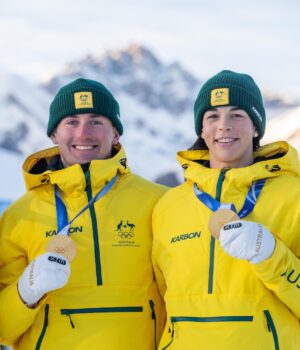
Graham and teammate Jakara Anthony had both just won FIS World Cup gold on the same day at the start of the season in Ruka, a stone’s throw south of the Arctic Circle.
“We’re not a skiing nation. We’re a beach nation,” Graham said.
“So how the hell does this happen?”
As it has turned out, plenty of people are now asking that exact question.
Moguls leading from the front

Two-time Olympic champion Jakara Anthony is leading the way for Australia. (Supplied: AOC/Chris Hocking)
Australia is in the midst of its greatest Winter Olympics campaign.
Everywhere around these Winter Olympics, people from outside the Australian bubble are wondering how on earth the land of surfing and Summer Bay is ahead of their nation on the medal table.
Curious observers have stopped and stared in the street at the seemingly endless procession of Australian medallists flaunting their new glittering neckwear while standing next to the Hotel Touring, surrounded by cameras and journalists.
And, with two gold medals and a bronze, the Australian moguls program has led the way.
Cooper Woods won gold in the singles, with Graham and Jackson Harvey also making the top-eight super final.
Cooper Woods told ABC Sport four days after he won gold that he still didn’t believe it. (Getty Images: NurPhoto/Ulrik Pedersen)
Anthony won gold in the duals, a stunning story of recovery after heartbreakingly missing out on defending her 2022 singles title.
Then Graham added a bronze in the men’s duals to claim his second Olympic medal.
Incredibly, if Australia’s moguls program was its own nation, it would be sitting ahead of the likes of China and Finland all by itself.
Moguls is now, with seven total medals — four golds, two silvers and a bronze — Australia’s most successful Winter Olympic sport, overtaking aerials.
So, to quote Graham once more, “How the hell does this happen?”
‘Elite’ coaching the key factor
Peter McNiel (left) and Kate Blamey (right) are a key part of Australia’s moguls success. (Suppledi: AOC/Chris Hocking)
One of the biggest reasons Australia is leading the way across the world is the “elite” coaching panel.
Led by Peter McNiel, now a three-time Winter Olympic gold medal-winning coach, and his assistant Kate Blamey, the Australian set-up is the envy of the world.
“It’s 100 per cent related to the coaching team and the coaching staff and just their total investment in the outcomes,” Snow Australia president Daniel Bosco told ABC Sport in Livigno.
“If you look at Pete McNiel, Kate [Blamey], they spend 320 days of the year away from home, on the road with the athletes, totally invested in what they’re doing.
“They leave no stone unturned when it comes to technical outcomes.”
Peter McNiel leaves no stone unturned in preparation with his athletes. (ABC Sport: Simon Smale)
Chef de mission Alisa Camplin-Warner agreed, saying the biggest reason for that was the environment they had established.
“He [Niel] and the whole coaching staff, physios, strength and conditioning, coaches coach … the way they operate is so elite,” Camplin-Warner said.
“Their highest values are good character, good ethics, work hard.
“They’ve just built a culture of strength and support around one another.
“It’s been phenomenal to watch what’s been going on behind the scenes.
“That’s often not appreciated, but I can’t tell you the number of little things people have been doing every day to be moving people forward and keeping opportunities open and joy and levity in the team bubble.
“It’s enabled these amazing performances to come through.”
Reckon there’s a good culture in this moguls team? (Getty Images: Michael Reaves)
The culture within the team is on display for everyone.
Whether they have had the performance they wanted or not, every athlete has shown clear delight in the achievements of others.
The only person whose excitement could compare to that of Woods when his result was revealed was his “big brother” Graham, who flew out to his mate and picked him up onto his shoulders.
The same was true when Graham himself won bronze, with Woods riding every bump on his way down the course.
“Team culture is awesome in the moguls team,” Anthony said after winning her gold.
“We’re on the road together all the time, we’re an individual sport but we train and practise together, live together, everything.
“I spend more time with them than I do with anyone else and they become my family.”
The program is undoubtedly delivering incredible results.
But the current iteration was built on the foundations set almost two decades earlier.
How Australia ensured success would breed success
Canada-born Dale Begg-Smith won Australia’s first moguls gold in 2006. (Getty Images: Vladimir Rys)
Moguls was first contested at a Winter Olympic Games in Calgary in 1988 — albeit as a demonstration sport — with American Steve Desovich finishing in fifth place.
The year after, Desovich turned his hand to coaching, working with the Canadian team through to the Nagano Games of 1998.
After that, Desovich moved to Australia thanks to the newly formed Olympic Winter Institute of Australia, the dream of the great winter sports advocate Geoff Henke.
That sparked the start of Australia’s rise.
The addition to the program of Canada-born Dale Begg-Smith elevated Australian skiing even further, as Begg-Smith earned a gold medal in Torino — 20 years to the day before Graham won his bronze at these Games.
Begg-Smith followed that up with a silver in his hometown Games in Vancouver four years later.
At the Beijing Games of 2022, soon after Anthony claimed her maiden Olympic gold medal, then chef de mission Geoff Lipshut said Begg-Smith’s standards instantly rubbed off on the next generation.
Jakara Anthony overcame some significant demons to claim gold. (Supplied: Chris Hocking/AOC)
“Dale coached and helped Matt Graham, Britt [Cox] saw a lot of Dale and grew up with Matt and all of a sudden you had a great core of moguls competitors,” he said.
Anthony noted that it was seeing Cox compete at the Vancouver Games that really sparked in her the desire to pursue an Olympic dream herself, just as Woods has been led by Graham.
Lipshut described it as a great core, but that group ended up becoming more of a self-pollinating flower, with new talent sprouting out of the Australian snowfields like fast-learning weeds.
“This is the beauty of our sport, we’re on the same field of play,” Bosco said.
“Our young under-12s kids who are having a bash for the first time train on the same course as the Olympians who were training on Topper’s Dream and Mogul Matt’s course at Perisher, or out at Mount Buller on Jakara’s Run.
“They just give so much back. I can remember when Britt Cox was a little bit younger, she was always so generous with her time with the younger kids.
“It becomes so inspirational for them to see where they could get to if they continue with the sport.
“And I know that’s been very motivating for a lot of athletes — Jakara was motivated by Brit and now you have Charlotte and others who are motivated by Jakara.”
The ‘crown jewel’ program that’s the envy of the world
Gold tastes so sweet for Jakara Anthony. (Getty Images: Cameron Spencer)
Those snowfields are incredibly well-populated, contrary to the belief of just about everyone from outside the system.
The biggest factor in that is a program that was described as the envy of the world by Snow Australia — inter-schools, which celebrated its 25th anniversary this year.
“I can’t bang on enough about how important that program is to winter sports and these results that we’ve had here,” Bosco said.
“Just to get the facts down, we have something like 54 athletes here now in total at the Winter Olympics. Forty-four of those roughly are out of Snow Australia and around 33 are ex-inter-schools athletes.
“All five medallists so far are ex-inter-schools athletes.
“It’s just such an important program for the delivery of these results.
“It’s not an accident. It’s 25 years in the making that gets us here for this.“
Bosco noted that, without the breadth of talent coming through inter-schools, it’s unlikely that Australia would be in this position at all, particularly in the moguls scene.
“The way people get introduced to moguls in particular is really interesting in Australia,” Bosco said.
“We have 6,000 to 7,000 students coming together every year for the inter-schools program.
“They’re team events where you have four in each team … but the extra element to that is while they’re down there, they’re not just doing the Alpine race, they think, ‘Let’s do the ski cross as well and, oh, well, we’re here, let’s do this other sport called moguls.’
Cooper Woods (left) personifies the great culture within the moguls team. (Getty Images: Hannah Peters)
“I remember even with my family, when the kids wanted to do moguls for the first time, we had no idea what the rules were, how to do a jump.
“They just entered the race, skied down the best they could in the moguls and really loved it.
“And then next year we’re in a moguls program, because the kids are loving it and having so much fun, because there’s the music playing and the fun events and all the rest of it.
“But when you’re drawing on a pool that large in Australia, which is a small nation, something good has to come out of it.
“A lot of other countries are totally envious of what we have in that space in terms of inter-schools.
“It’s the crown jewel of winter sports.”
Investment in facilities key
The Brisbane water jump has been a game-changer for Australian freestyle skiers. (ABC Sport: Simon Smale)
None of the success that Australia’s skiers have enjoyed would be possible without considerable investment in facilities.
And the Geoff Henke Water Jump in Brisbane and the National Snowsport Training Centre in Jindabyne are among the best in the world.
Coupled with support from some of the best on-snow mogul facilities around in Mount Buller and Perisher, it is a recipe for success.
It’s that support, both with infrastructure and financial backing, that Anthony credits for the team’s success.
“We’ve already shown that we are so successful,” Anthony said.
“We’ve had our best Games ever and a lot of that’s due to the continuous support we’ve had from people like Annika Wells, the minister of sport.
“Without that funding to get the facilities that we have in Australia, we wouldn’t be where we are today.
“That continued support is what’s allowed us to keep progressing and to get here to where we’ve had our most successful Games ever and, hopefully the next one’s going to be even better.
“With that support I think we can keep showing the world that we aren’t the underdogs in winter sport and we really can take them on head on.”
Matt Graham was able to banish the bad of Beijing with a bronze. (Getty Images: PA Images/David Davies)
But what’s next?
For Bosco, it’s just more of the same.
“I’ve always been very ambitious for the sport and I still remain very ambitious,” he said.
“I said last night … let’s not look back at this as being the golden years.
“Let’s imagine what’s possible and get out there and do it.
“I spoke to the coaches eight years ago and said we should aim for two-by-three in ’26 — and that was to have a men’s super final with three Australian competitors and a women’s super final with three Australian competitors at these Olympics.
“And the coach, Pete, messaged me and reminded me of it and said, ‘Oh, we came so close.’
“We got five, not the six in the super finals and that’s just such a brilliant outcome for the sport, like, let’s not beat ourselves up about it.
“But if you can imagine big, you can achieve, big.
“And I’m challenging everyone around the sport now to come back to us and tell us what does success look like in 10 years time for their discipline … let’s figure out what resources we need, what infrastructure we need to achieve it.”