
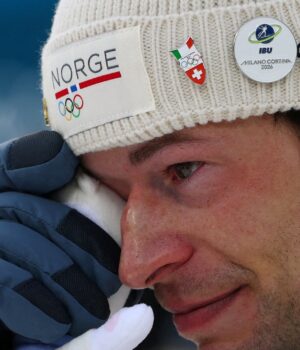
Source : ABC NEWS
Norway is the home of many magical children’s fairy tales, always with a moral fable buried deep at their centre.
Stories that are woven around gruff billy goats and trolls under bridges, stories that frighten and amuse, warn and admonish — cautionary tales wrapped in the powdery snow and lit by the twinkly stars of a Norwegian wood.
So, draw near, children, and on this Valentine’s Day hear this new Nordic moral tale: the story of the sad little skiing prince who lost his princess, but thought an international press interview and a tearful, uninvited confession would bring her back.
Did she return to him? Did the Prince slip the missing ski boot back onto her slender, aggrieved foot?
Read on…
Once upon a time, there was a handsome, champion Norwegian skier who met a woman he described as “the world’s most beautiful and nicest person” and then, not more than three months later, he lost her because he couldn’t keep it in his pants.
Sorry kids, this is not your usual fairy tale. But there is still a moral waiting for us, right at the end.

Sturla Holm Laegreid from Norway used his post-race interview to try and win back his ex-partner. (Getty Images: picture alliance/Hendrik Schmidt)
The mistake of his life
No doubt you’ve already heard — and maybe even watched in horror through your fingers — the post-bronze medal confession of the champion biathlete (two sports, one person) Sturla Holm Lægreid. He used his moment at the Winter Olympic Games in the blinding Cortina sun to spill, unbidden, a tearful confession to the world about the “mistake of his life”.
(The 24 hours following that confession might have altered how he now organises the hierarchy of his greatest mistakes… but we’ll leave that until later.)
In tears, he told an unsuspecting Norwegian TV reporter — who until then had been caught up in the joy of her country winning both gold and bronze medals in Lægreid’s 20km event — that after meeting this woman and falling in love six months ago, “three months later I made the mistake of my life and cheated on her, and I told her about that a week ago”.
Nothing catches a good camera operator by surprise, so the shot quickly zoomed in on Lægreid’s sodden face. “This has been the worst week of my life,” he wept. “I’m taking the consequences for what I’ve done. I regret it with all my heart.
“I hope that committing social suicide might show how much I love her,” he said.
Ah, nothing quite says love like having your romantic humiliations shared with the largest television viewing audience of the year. It’s a tenderness of which the Snow Queen could only dream.
I have spent many amusing hours imagining the conversations young Sturla might have had with his friends and family as he enthusiastically shared his brilliant plan to win back his cheated lover: “And THEN, when I win, I’m going to ask her to forgive me on live television!”
I can see them, as if in slow motion, desperately trying to persuade him: “Nooooo!”
It was unwatchable in its rawness. It was hugely mistaken in its strategy.
It was kind of magnificent.
His declaration would have frozen solid the ovaries of any woman listening.
The only — only — woman I can imagine being moved by this is Carrie Bradshaw, as she stumbled back into yet another of her countless bad-choice relationships.
(Where most of us see red flags, she sees red roses.)
Loading
The princess responds
It was a new high, or low, in performative relationship management: a social hari-kari for the TikTok generation for which a flipped screen and a full-face confession of “accountability” can solve any problem.
In a narcissistic age, just saying what you feel is enough to bring about the reality you desire and according to Sturla’s strange, internal world, he thought it might actually bring his princess back to him.
Dearest, gentle reader — it didn’t.
Instead, the princess picked up her abandoned slipper — and chucked it at him.
In a statement that could have been made by anyone who has felt guilted, strong-armed or publicly shamed back into a relationship, Sturla’s mercifully still-unnamed girlfriend basically sang him the famous, unofficial refrain to the chorus of The Angel’s “Am I ever Gonna See Your Face Again?”
(No way. Get F***ed. F*** off.)
Elegantly invoking her patriotic best, she noted that the day should have belonged to the gold medallist in Sturla’s event, Johan-Olav Botn and coldly declared her regret that she had ever been dragged into this.
“It’s hard to forgive him … I didn’t choose to be put in this position, and it’s painful to have to endure it.”
In developmental psychology, there is a key moment in cognition which is termed the attainment of “theory of mind”: this is when, often around the age of four, a child realises that another’s mind is separate from their own.
Up until this age, if they can’t see it, neither can you. It’s not selfishness, but a cognitive blind spot: the classic hide-and-seek game where covering a child’s eyes makes them invisible, because out of sight truly means out of mind.
But then they learn that their mother, their friend does not actually know what is going on in their mind; that what they know and what they see and think is specific to them. It’s a turning point in a child’s growth.
Sturla Holm Lægreid made the confession after winning his first individual Olympic medal in the men’s biathlon at the Milano Cortina Games this week.
(AP: Andrew Medichini)
The moral of our story
As younger generations of men and women struggle to find real romantic connection, and lament what they describe as the juvenile, immature and often selfish romantic attachments they end up abandoning, I wonder if part of humanity’s ongoing devolution is skipping this developmental step.
Perhaps, rather like the tail we once had, evolutionary biology has simply decided to drop theory of mind and instead retain the childish state of inhabiting a world that’s utterly, unapologetically our own: adults with the egocentrism of the toddler, where every gaze, every whim, assumes the universe bends to our singular view.
It appeared Sturla simply couldn’t conceive of a reaction from his girlfriend that didn’t accord with his own: she would surely be thrilled for him and his win; she would be impressed — and she would therefore want to be back with the man who humiliated her and had now humiliated himself. Sturla had the plan of a cheerful three-year-old.
When smartly rebuked by his ex, Sturla finally woke up from his fairy tale sleep: public acclaim and a live-to-air reconciliation had all been a dream. “I deeply regret sharing this personal story on what was a day of celebration for Norwegian biathlon,” he said.
“I am not quite myself these days,” he added miserably.
One can easily sympathise, and here is where we find the moral of our story. To err is, of course, very human: but it takes a true prince to stuff things up so badly that they turn themselves into an actual frog.
This weekend would you please join me in remembering and celebrating the beautiful man and wonderful cartoonist, Jon Kudelka, who died last week. He had an effortless, artless line and like all great Australian cartoonists, he had a better grasp of public policy and politics than most reporters. I simply loved the wit, insight and often deep kindness of his cartoons. Any chance to chat with him was a joy. My condolences to his family in Tasmania. We have a tribute to him here.
Have a safe and happy weekend: as a proud Tasmanian, I think Jon would love this from local band Luca Brasi. Fair warning — there’s a little strong language, as Jon would appreciate. Go well.
Virginia Trioli is presenter of Creative Types and a former co-host of ABC News Breakfast and Mornings on ABC Radio Melbourne.