
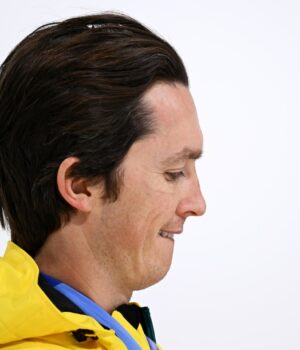
Source : ABC NEWS
As Scotty James stood on the podium his eyes began to water, the suave and confident 31-year-old collapsing under the enormity of his own disappointment.
The medal hanging around his neck was the wrong colour.
The award-winning script had a fatal flaw.
This was not the fairytale ending he had hoped for. Dreamed of. Attempted to manifest through hours of relentless training and personal advancement.
Never mind that this silver medal made James the first Australian to win three medals at the Winter Olympics.
Never mind that.
“It’s a bit numb,” a more composed James told media in the aftermath of the result.
“Like, I don’t really know how to feel.
“I think that it all happens, and then you get a medal, and then you’re walking around here, and I mean … “

Scotty James has now stood on three Olympic podiums, but the top step still evades him. (Getty Images: Adam Pretty)
It is no surprise that James was so stunned.
For so much of this past olympiad James has been absorbed by the desire to claim the one prize that has eluded him, riven by a desire for gold that not even Tolkein’s Smaug could match.
It has dictated his entire life.
But James should and will take solace in knowing that there was little more he could have done to realise his dream.
Wednesday’s qualifying run promised a final for the ages and snowboard’s greatest collection of talent in history duly delivered.
The threat was always going to come from the legion of dominant Japanese riders who have pushed the sport to greater heights than seemed possible.
Yuto Totsuka. Ruka Hirano. Ryusei Yamada.
All three laid down runs that just 12 months earlier would have seemed impossible to achieve, with Totsuka opening with back-to-back 1440s — that’s a trick with four full rotations — and an eye-catching switch backside double alley-oop rodeo 900 stalefish, which feels difficult even to write, let alone perform as flawlessly as Totsuka managed to do.
But even Scotty James was skating at a level beyond anything he would have previously thought capable.
Scotty James may end up chasing the end of the rainbow for his whole career. (Getty Images: Nurphoto/Federico Manoni)
“It’s been crazy. Watching the progression over the many, many years and the Olympics that I’ve gone to has been amazing,” he said.
“And tonight, yeah, I mean, I don’t think the progression has been that rapid in 12 months ever.
“There’s times where I was like, ‘I hope it slows down.’ But it didn’t.
“And look, I’m pushing it myself as well. I’m pushing it, so they’re pushing it, so I’m as equally responsible.
“But it’s been cool to be a part of it.”
Pushing the boundary was a necessary requirement for James — or indeed anyone — to win gold.
But perhaps James was pushing too much, wanting his gold, sure, but wanting an emphatic statement to underline his superiority and ensure that everyone knew that he deserved it more than anyone else.
It could have cost him.
Only a minor execution error on an otherwise stunning second run perhaps denied him that golden finish.
Scotty James’s second run was not flawless enough for him to win gold. (Reuters: Imagn Images/Nathan Ray Seebeck)
But that he had to rely on the second run was down to a miscalculation on the final hit of his first and third runs, and the final run ended with an extravagant attempted backside double cork 1620 Japan grab that he just couldn’t stick when he needed to.
“I think my first run, if I landed that, I think the medal would have been a different colour,” James said, almost wistfully.
“And then the last run was kind of for me, but … yeah, it’s hard to kind of look at it like that because I can’t change the result, but it is what it is.”
Had James kept that last hit to a 1440 instead, four full rotations instead of that extra half, maybe things would have been different.
“Potentially [I] could have done it with a 14,” James said.
“But., for myself, I had to do the 16. I wanted to push it and that’s what I was here to do, regardless of the result.
Scotty James knew his mistake on his final run was going to ensure he would not make the grade. (Getty Images: Cameron Spencer)
“I think … from myself mostly, but we obviously all knew what I was coming here to do.
“And I wasn’t really thinking about that so much. I was thinking about that run, that last run that I tried to do, and I wasn’t able to land it, and it was really going to be for me that run.
“But I’ll have to keep pushing it in the future, I guess.”
The future. James is adamant that he can continue on to the French Alps in 2030.
But another four years of pushing the boundaries, now with a young son at home, may feel optimistic given the extraordinary talent coming up behind him.
But that’s for another day.
The immediate future is far more certain.
“The next 24 hours I’ll probably have a bit of a cry, but I’ll be happy as well because representing the country and winning a medal is unbelievable and I’m really proud of that,” James said.
“I think what I can live with is that I tried my best.”
In the end, that’s all anyone can ask. James’s silver medal is the silver lining on a personal disappointment that only serves to illustrate the extraordinary standards to which he holds himself.
Those may be unobtainable standards for now.
But never say never.