
Source : the age
Long says the former Labor government didn’t meaningfully respond to industry concerns raised about a key policy almost six years ago.
A July 2020 letter from multiple industry groups to the premier flagged fears BPIC could “affect business and negatively impact on workers”.
The premier’s office responded a month later, saying it had “noted” the concerns.
“Apart from ‘noting’, there was no response verbally or otherwise that looked like they were going to engage with our concerns,” Long told the inquiry.
“I found it quite insulting that [to] a group of industry heads that represented such a large part of the economy, there was no courtesy to even pull together even a small working group with the government to run through our concerns.”
And we’re back on for the final session of the day.
Damian Long is taking questions again, more than three hours after he first took the stand.
The chief executive is now talking about prequalification conditions, which he earlier suggested effectively meant that “if contractors wanted the government work, they had to comply with BPIC”.
The public gallery in the Brisbane courtroom has thinned out a fair bit since this morning, but there’s still an hour-and-a-half of testimony to go.
Geoffrey Watson SC is also due to front the commission of inquiry this week, but it’s unclear if he will make an appearance today.
Long says his organisation raised concerns with the government about BPICs “strong contravention” of federal workplace laws around coercion and adverse action.
This particularly related to the requirements to “force it down the supply chain” and effectively force contractors to comply with its terms to get government work.
Long says, through a solicitor, his organisation had sought the opinion of the then Australian Building and Construction Commission, which was “there was potential non-compliance”.
After raising that concern, Long says the Department of Housing and Public Works advised it had sought Crown Law advice which said “it was legal”, but refused to release this to him.
Following this, Long says the words “not mandatory” started creeping into government talk about the policy.
“So this is an ‘aspirational document. What we want you to do is use your best endeavours to comply with this, and also your usual best endeavours to make sure the supply chain also complies with this’,” Long says.
Crown Law advice about other elements of the BPICs policy were also raised by Australian Workers’ Union state secretary Stacey Schinnerl in the last public hearing – which the government also refused to outline.
And with some more talk about proposed “demerit points” for contractors under the policies, the inquiry now breaks for lunch until 2pm.
Wood is now taking Long to his evidence that BPICs amounted to a “pattern enterprise agreement”, or an industry-wide approach to workplace agreement making.
Wood makes the point that enterprise-level agreement making had been a bipartisan mainstay of Australian industrial relations for decades as part of efforts to avoid the wage explosions of last century.
Why was this being moved away from, Wood asks Long.
Long says: “The only reason was that it was being driven by the CFMEU. The CFMEU wanted it.”
“We could see within those agreements that the funds, the superannuation funds, redundancy funds, were all CFMEU-aligned. I think it was an opportunity to get the CFMEU onto civil construction sites.”
The government consultation process was a “sham” during the formulation of best practice industry conditions (BPIC) policy, the inquiry has heard.
Witness Damian Long says industry leaders were kept in the dark early in the process, and unable to give feedback about the proposal.
“I think it was a sham,” he tells the court.
“The collaborative process and consultation process was nothing more than tabling documents to show where the government was going.
“There was no acceptance of any feedback from industry.”
Long’s testimony has focused heavily on the government policy, of which he says industry figures were concerned about potential improper influence by the CFMEU, and that it could drive up prices.
Pressed by Commissioner Stuart Wood on comments about CFMEU officials being involved in departmental negotiations, Long says he heard this from public servants as well as contractors.
Wood asks why he considered this inappropriate, to which Long answers that a contractor submitting a tender would expect it to be a confidential commercial negotiation without a third party involved.
“Members of the CFMEU were a party to those negotiations, specifically around ensuring that contractors had those agreements with the CFMEU,” Long says.
While contractors were seeking to engage with the Australian Workers’ Union as the major civil construction worker group, they were being told they needed to make a “genuine effort to engage with the CFMEU”.
Wood asks Long why this was the case.
“Senior members of Department for Main Roads conveyed to me it was a ministerial direction to negotiate with the CFMEU,” Long says.
He specifies this direction came from then-transport minister Mark Bailey, through to the department’s director-general at the time, Neil Scales, and one of his deputies.
The CFMEU believed the Queensland government “had done a deal with them” as a key government policy drove up the cost of construction and caused industrial unrest.
These were among the allegations listed in a Queensland Department of Transport and Main Roads document from April 2023, made public for the first time by witness Damian Long on Tuesday.
Long, the Civil Contractors Federation Queensland chief executive, has tendered the notes, which he says were shared with him after the department began speaking to contractors to do its own research into the impacts of BPIC.
“[There were reports of] CFMEU officials stating … ‘it doesn’t matter what the cost of the project is, you’re going to get paid for it anyway. We’ve done a deal with the government’,” Long tells the inquiry.
“‘You will have an agreement with us, and that’s just the way it’s going to work.’”
The document – titled Transport BPIC lessons learned meeting – lists several other allegations raised by industry insiders, including that union officials behaved so aggressively in meetings it put contractors’ mental health at risk and that BPIC read like a CFMEU document.
The inquiry is now going through Long’s resume.
Wheelahan describes him as “very well credentialled” across his 30 years in the civil construction industry in Queensland.
In addition to his role at the Civil Contractors Federation of Queensland, Long has served as a member – and since last year, the chair – of the board of QLeave, which manages the portable long-service leave for industry workers.
Long’s statement, which the inquiry is now working through, notes he worked as a builder’s labourer and site manager while completing his bachelor of civil engineering from La Trobe University.
Commissioner Stuart Wood KC notes the time, and calls recess. The inquiry will return in 15 minutes.
CFMEU influence over government policy and a previously unseen department document have been foreshadowed as the first witness takes the stand.
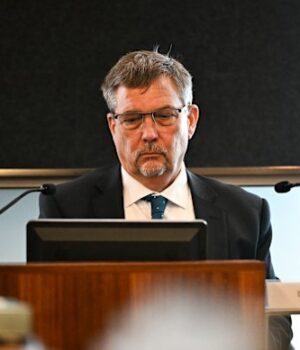
Sitting in the packed Brisbane Magistrates Court, Civil Contractors Federation Queensland CEO Damian Long begins his testimony, speaking purposefully into a microphone when sworn in.
“In his opinion, BPICs has been the most damaging policy for the productivity of the construction industry, and affordability of capital works, in Queensland that he has come across,” Counsel assisting the inquiry Patrick Wheelahan KC says.
“He considered that the CFMEU … was the driving hand behind the decision of government to implement [BPICs].”
Wheelahan adds that a Department of Transport document revealing public service concerns about BPICs and the CFMEU will form a central part of the testimony.
He does not say how the document has been secured.
Meanwhile, during an address to parliament on the other side of Brisbane, Deputy Premier Jarrod Bleijie has shared his open glee at the resumption of the CFMEU inquiry, taunting a Labor MP who he said should be “in the dock” being probed by legal counsels.
Bleijie says the 30 planned hearing days for the powerful probe into the union and construction sector is “going to be better than the top 10 on Netflix”.
“It will be bingeworthy,” Bleijie says.
The deputy premier, who also serves as industrial relations minister, uses the resumption of the inquiry to mock his opposing portfolio rival, Grace Grace.
“I’m surprised to see the member for McConnel joining us today. I thought she’d be over there in the dock answering serious questions that she should answer,” Bleijie says.
The minister is forced to withdraw the comments after a protest from Grace, but Bleijie continues his tirade at the former state government.
“It was a disgrace what the CFMEU were doing to construction sites, to women and children across the state, and allowed to get away with it by former failed Labor policies,” he says.


