
Source : THE AGE NEWS
February 10, 2026 — 11:58am
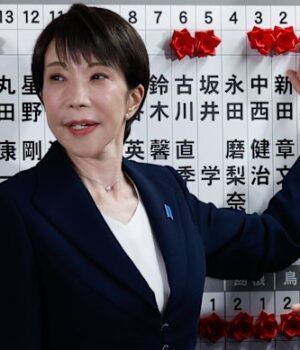
After Sanae Takaichi’s extraordinary win in Sunday’s Japanese election, there’s no doubting her ability to pursue her economic agenda. The question is whether “Sanaenomics” will work to revitalise the sluggish Japanese economy or lead to a confrontation with the bond market.
The initial market reaction to Takaichi’s resounding victory, which gave her Liberal Democratic Party an unprecedented super-majority in the lower house, was positive.
The Japanese sharemarket jumped 3.9 per cent and, after an initial sell-off in the bond market, the spike in bond yields subsided. The yen, which had been volatile in the lead-up to the election, prompting talk of intervention, strengthened slightly.
The largely positive reaction may be because the sheer scale of her victory means that she can be more measured in implementing her plans to revitalise the economy by boosting investment, wages and defence spending.
The newly gained dominance of her party in parliament, and the personal authority that flows from the size of its win, has given her the mandate to implement her pro-stimulus economic agenda, which involves a big dose of fiscal stimulus and structural reforms to try to ignite a shift from saving to investment.
Nicknamed the “Iron Lady”, Takaichi wants to normalise an economy that has had abnormal monetary and fiscal settings for decades to one with more normal and sustainable foundations.
The major check on the degree to which she can implement expansionary policies is Japan’s bond market.
Last year, when Takaichi announced a ¥21.3 trillion ($192 billion) stimulus package, including a plan to exclude food from Japan’s 8 per cent consumption tax, there was an immediate pushback from bond investors, with yields spiking and injecting volatility into the global financial markets, where Japan plays a major role.
Since then, she has been at pains to stress the importance of fiscal sustainability, referring to “responsible stimulus” and “responsible proactive fiscal policy” and promising that any tax cuts won’t be funded with new bond issues.
Takaichi’s economic plans have been likened to those of her mentor, Shinzo Abe, whose “Three Arrows” plan of aggressive monetary expansion, fiscal flexibility and incentives for private sector investment was only partially successful in achieving his objective of generating sustainable long-term growth.
Her challenge is achieving the same end-goal in an environment where there has been above-target inflation, where wages growth hasn’t kept pace with inflation, where economic growth has been modest and where Japanese government debt and its reliance on the bond market disciplines her ability to act.
Japan’s government is often referred to as the world’s most indebted, although the reality doesn’t quite match the simplistic headline debt-to-GDP ratio used to make that claim.
That headline ratio peaked above 230 per cent of GDP last year, but has fallen to something about, or below, 210 per cent. However, the government owns more than half its bonds on issue and has massive holdings of Japanese exchange-traded funds and real estate investment trusts, acquired over the past decade and a half as it pursued its highly unconventional monetary policies.
The net debt-to-GDP ratio is below 120 per cent, potentially well below, given that the ETF and REIT holdings have risen dramatically, and have continued to rise, since they were acquired in a program that dates back to 2010. Those holdings, with an estimated market value of about $340 billion, are equivalent to about 8 per cent of Japan’s stock market’s capitalisation.
Takaichi could perhaps use proceeds from the sale of those securities, which are held by the Bank of Japan, to fund her programs. There’s also about $2 trillion of foreign exchange reserves (most of it invested in US treasuries) whose income, or even principal, could be drawn on as an alternative to debt funding.
The foreign exchange reserves, however, while theoretically accessible, are primarily held to maintain currency stability and the volatile and vulnerable state of the yen, which has been sufficiently weak to prompt hints of intervention, make them an unlikely source of permanent funding.
Moreover, Donald Trump (with whom Takaichi has a good relationship) would be most unhappy if Japan started selling down its $US1.2 trillion ($1.7 trillion) of US Treasury bonds.
Takaichi will be wary of the bond market response to her agenda because, if yields – which have risen steadily over the past five years and which hit 25-year highs late last year – were to spike significantly, they could spark a large-scale repatriation of the funds Japanese financial institutions and households have invested offshore to take advantage of the arbitrage between Japan’s interest rates and those (higher rates) available elsewhere, particularly in the US.
That would force the yen to appreciate, potentially materially, which would depress Japan’s exports and cause turbulence in asset markets in the rest of the world.
The major check on the degree to which she can implement expansionary policies is Japan’s bond market.
It might also bring her into conflict with the Bank of Japan, which wants to normalise interest rates, control inflation and, very incrementally, unwind the extraordinary monetary policies Japan has pursued over the past couple of decades.
The positive response from the sharemarket to her electoral success and the absence of a material negative reaction from the bond market at least means Takaichi is off to a good start, with bond investors prepared to give her the benefit of the doubt until they see the detail of her plans and can assess just how “responsible” they are.
Japan, because of the decades of economic winter it experienced after its property markets imploded in the early 1990s, has tended to be overlooked in geopolitical and geoeconomics discussions, despite the critical role it has played in cross-border capital flows as a global source of cheap funding.
A more assertive and expansionary Japan would have implications for geopolitics, particularly in the region – Takaichi has already made China most unhappy – and for global financial markets and the global economy.
How she executes her plans for the world’s fourth-largest economy will, therefore, have implications and consequences for, not just Japan, but the rest of the world.
The Business Briefing newsletter delivers major stories, exclusive coverage and expert opinion. Sign up to get it every weekday morning.
 Stephen Bartholomeusz is one of Australia’s most respected business journalists. He was most recently co-founder and associate editor of the Business Spectator website and an associate editor and senior columnist at The Australian.Connect via email.