
SOURCE :- THE AGE NEWS
Bangkok: The polls had been closed for two hours when the orange-clad backers of Thailand’s reform movement began sinking in their seats. On the TV outside the People’s Party Bangkok headquarters, commentators were pointing to a dark blue wave, the colour of the conservatives.
It was not supposed to be like this.
In defiance of most pre-election polls, the royalist Bhumjaithai party on Sunday night was on track to easily win the most seats in Thailand’s 500-member lower house, eclipsing also Pheu Thai, the political vehicle of the once-dominant Shinawatra family.
It is a disaster for the People’s Party, the great hope for reforming Thais fed up with the royalist-military establishment they perceive as corrupt, meddling and incompetent. In 2023, the party’s predecessor, Move Forward, won the most seats only to be blocked from governing because it wished to loosen strict Lèse-majesté laws around critiquing the monarchy. The Constitutional Court also found this campaign pledge egregious, enough to dissolve the party and ban its top leaders from politics for ten years.
Supporters of the movement hoped this would be the election. Results are still in flux, but if its 110 projected seats hold steady until they are finalised, it is 41 fewer than what Move Forward won last time.
One thing the polls and pundits did predict correctly on Sunday was that no party would reach the magical number of 251 seats to govern outright, a feat last achieved by populist billionaire Thaksin Shinawatra in 2005.
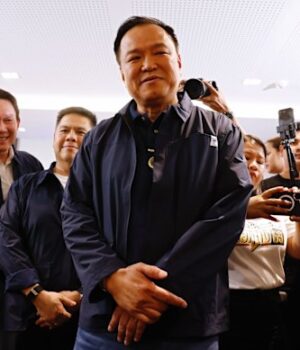
The seat count indicates that Bhumjaithai, led by incumbent Prime Minister Anutin Charnvirakul, a construction tycoon, will need to negotiate with one or more parties to form a governing coalition.
It will not be the People’s Party.
Shortly before 10pm, local time, the party’s grim-faced leaders lined up stiff as boards in front of at least 150 journalists jammed into the seventh floor of headquarters to concede they had flopped and now would focus on resuming their roles in opposition.
“I have already announced that we cannot vote for the Bhumjaithai [prime ministerial] candidate,” leader Natthaphong Ruengpanyawut, a 38-year-old former software engineer, said, referring to Anutin. “Therefore, we cannot join a government where the Bhumjaithai Party is the lead party in forming the government.”
Across town, Anutin was jubilant. The preliminary results had his party on 197 seats, far surpassing expectations and crowning an express surge to power propelled by political chaos that has delivered three prime ministers in not even as many years.
He has been in the job since September last year, appointed by politicians after Pheu Thai’s Paetongtarn Shinwatra was sacked by the Constitutional Court over a leaked, supposedly fawning phone call to Cambodia’s de facto leader, Hun Sen, as tensions between the countries were escalating toward war.
‘A victory for all Thai people’
Overcoming his mishandling of deadly floods in the south by tapping nationalist fervour from the Cambodia conflict, Anutin now claims a popular mandate to “uphold the interests of the nation, religion, the Monarchy and the people”.
“The victory of the Bhumjaithai Party today is a victory for all Thai people,” he said late on Sunday.
What becomes of the Shinawatra political dynasty now is unclear. Patriarch Thaksin is currently serving a year in jail on abuse of power charges. The family’s Pheu Thai party, which finished third, could ultimately join Bhumjaithai as the junior coalition partner, but after dominating Thai politics for a quarter of a century, voters showed on Sunday they were looking elsewhere.
Anutin’s challenges are many. Tourism remains weak, and the economy, soon to be overtaken by booming Vietnam, is the slowest growing in South-East Asia.
Nattarin, a 36-year-old office worker in Bangkok, told this masthead outside a polling booth on Sunday it was “like someone switched the economy off”.
“It’s the cost of living that’s the problem,” she said. “Everything is going up, but our incomes don’t match.”
Showing a clear divide between the capital and the regions, the People’s Party appears to have swept most, if not all, constituencies in Bangkok. This masthead canvassed about 20 people at different polling stations in the city on Sunday and found only one person who voted for someone else. Asked why they voted orange, their responses inevitably began with a version of “we want change”.
At the party’s headquarters on Sunday night, Napatsorn Boonlee, 63, was one of dozens of supporters watching the outside television, her initial excitement when the Bangkok booths were coming in fast fading as counts were returned from elsewhere.
“I started wondering, “Wait, are we going to lose? We’re not coming in first?” At first, the scores were close – Anutin wasn’t that far ahead. Then, suddenly, the gap kept getting wider and wider. And Pheu Thai started climbing up, too. ”
She diagnosed it as a case of surefire vote-buying outside Bangkok. Others might point to decisions of the party, which has softened some of its policies to be more palatable to the establishment and appeal to a broader base.
However, likely turning off some of that potential base was the movement’s criticism of the military, when Thailand was not warring with Cambodia. Overcompensating for this may have turned others off.
When Paetongtarn was sacked by the court, it was the People’s Party that held its nose, set down conditions like an early election, and then helped conservative Anutin’s elevation to the prime ministership, an unforgivable sin for some supporters.
As the leader Natthaphong was sidestepping questions about such matters upstairs, Napatsorn took out a pre-packed texta and cardboard.
Among the makeshift signs for her party: “You have done your best fighting. Don’t stop dreaming.”
Get a note directly from our foreign correspondents on what’s making headlines around the world. Sign up for our weekly What in the World newsletter.